



Question: Application 7.1 Controlling Air Toxics As noted in the chapter, one of the Clean Air Act Amendments passed by the U.S. government in 1990 was
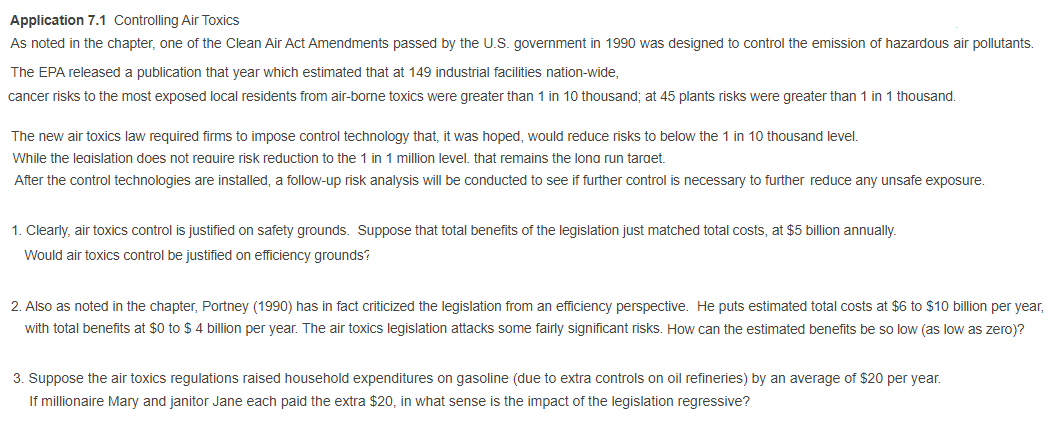
Application 7.1 Controlling Air Toxics As noted in the chapter, one of the Clean Air Act Amendments passed by the U.S. government in 1990 was designed to control the emission of hazardous air pollutants The EPA released a publication that year which estimated that at 149 industrial facilities nation-wide, cancer risks to the most exposed local residents from air-borne toxics were greater than 1 in 10 thousand; at 45 plants risks were greater than 1 in 1 thousand. The new air toxics law required firms to impose control technology that it was hoped, would reduce risks to below the 1 in 10 thousand level. While the leaislation does not require risk reduction to the 1 in 1 million level, that remains the long run taraet. After the control technologies are installed, a follow-up risk analysis will be conducted to see if further control is necessary to further reduce any unsafe exposure 1. Clearly, air toxics control is justified on safety grounds. Suppose that total benefits of the legislation just matched total costs, at $5 billion annually. Would air toxics control be justified on efficiency grounds? 2. Also as noted in the chapter, Portney (1990) has in fact criticized the legislation from an efficiency perspective. He puts estimated total costs at $6 to $10 billion per year, with total benefits at $0 to $ 4 billion per year. The air toxics legislation attacks some fairly significant risks. How can the estimated benefits be so low (as low as zero)? 3. Suppose the air toxics regulations raised household expenditures on gasoline (due to extra controls on oil refineries) by an average of $20 per year. If millionaire Mary and janitor Jane each paid the extra $20, in what sense is the impact of the legislation regressive? Application 7.1 Controlling Air Toxics As noted in the chapter, one of the Clean Air Act Amendments passed by the U.S. government in 1990 was designed to control the emission of hazardous air pollutants The EPA released a publication that year which estimated that at 149 industrial facilities nation-wide, cancer risks to the most exposed local residents from air-borne toxics were greater than 1 in 10 thousand; at 45 plants risks were greater than 1 in 1 thousand. The new air toxics law required firms to impose control technology that it was hoped, would reduce risks to below the 1 in 10 thousand level. While the leaislation does not require risk reduction to the 1 in 1 million level, that remains the long run taraet. After the control technologies are installed, a follow-up risk analysis will be conducted to see if further control is necessary to further reduce any unsafe exposure 1. Clearly, air toxics control is justified on safety grounds. Suppose that total benefits of the legislation just matched total costs, at $5 billion annually. Would air toxics control be justified on efficiency grounds? 2. Also as noted in the chapter, Portney (1990) has in fact criticized the legislation from an efficiency perspective. He puts estimated total costs at $6 to $10 billion per year, with total benefits at $0 to $ 4 billion per year. The air toxics legislation attacks some fairly significant risks. How can the estimated benefits be so low (as low as zero)? 3. Suppose the air toxics regulations raised household expenditures on gasoline (due to extra controls on oil refineries) by an average of $20 per year. If millionaire Mary and janitor Jane each paid the extra $20, in what sense is the impact of the legislation regressive
Step by Step Solution
There are 3 Steps involved in it

Get step-by-step solutions from verified subject matter experts