







Question: ...: Application Exercise: To demonstrate the practical uses of basic learning principles, a psychologist with an interest in behavior modification has collected data on a
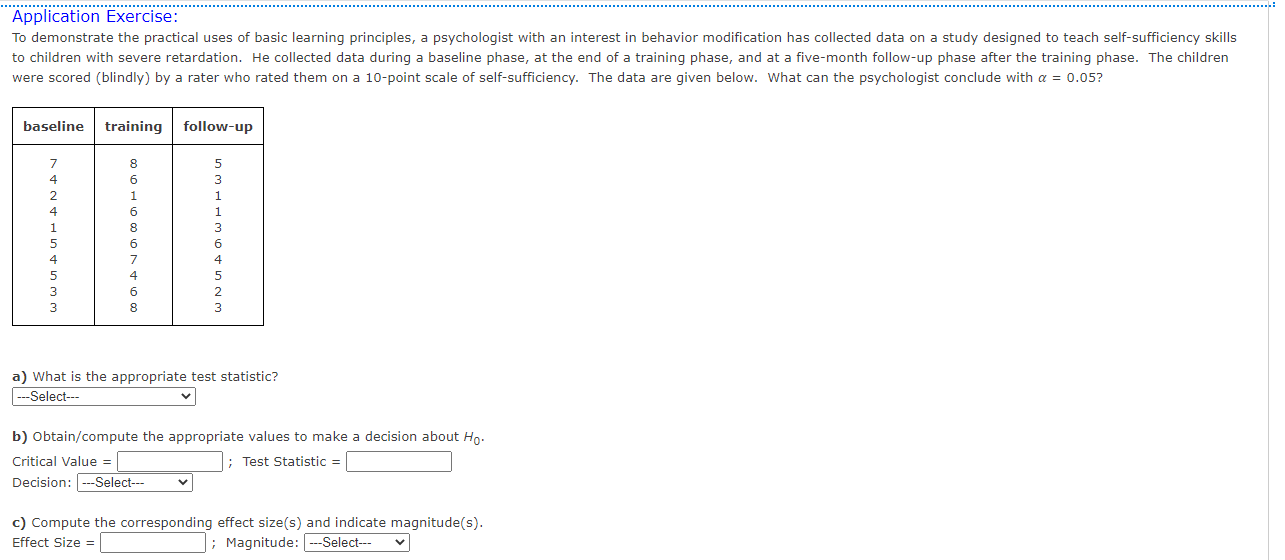
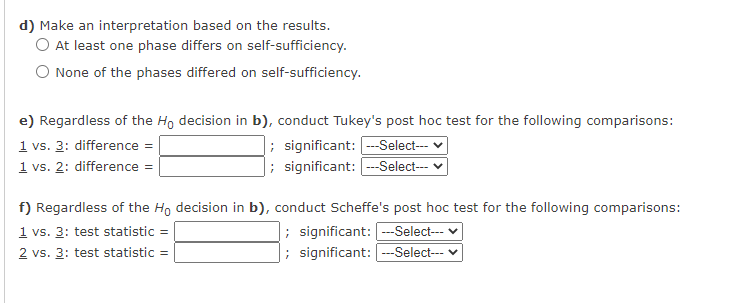
...: Application Exercise: To demonstrate the practical uses of basic learning principles, a psychologist with an interest in behavior modification has collected data on a study designed to teach self-sufficiency skills to children with severe retardation. He collected data during a baseline phase, at the end of a training phase, and at a five-month follow-up phase after the training phase. The children were scored (blindly) by a rater who rated them on a 10-point scale of self-sufficiency. The data are given below. What can the psychologist conclude with a = 0.05? baseline training follow-up WWUDUHANDY W NUA OW HH WU a) What is the appropriate test statistic? --Select--- b) Obtain/compute the appropriate values to make a decision about Ho. Critical Value = ; Test Statistic = Decision: ---Select--- c) Compute the corresponding effect size(s) and indicate magnitude(s). Effect Size = ; Magnitude: ---Select---d) Make an interpretation based on the results. O At least one phase differs on self-sufficiency. O None of the phases differed on self-sufficiency. e) Regardless of the Ho decision in b), conduct Tukey's post hoc test for the following comparisons: 1 vs. 3: difference = significant: -Select--- v 1 vs. 2: difference = significant: ---Select--- v f) Regardless of the Ho decision in b), conduct Scheffe's post hoc test for the following comparisons: 1 vs. 3: test statistic = significant: -Select--- v 2 vs. 3: test statistic = ; significant: ---Select--- v
Step by Step Solution
There are 3 Steps involved in it

Get step-by-step solutions from verified subject matter experts
 Study Help