Question: Apply the seven-step modeling process (below) to a real, potential, or theoretical business problem by giving your initial analysis and application of each step to
Apply the seven-step modeling process (below) to a real, potential, or theoretical business problem by giving your initial analysis and application of each step to the problem.
 problem
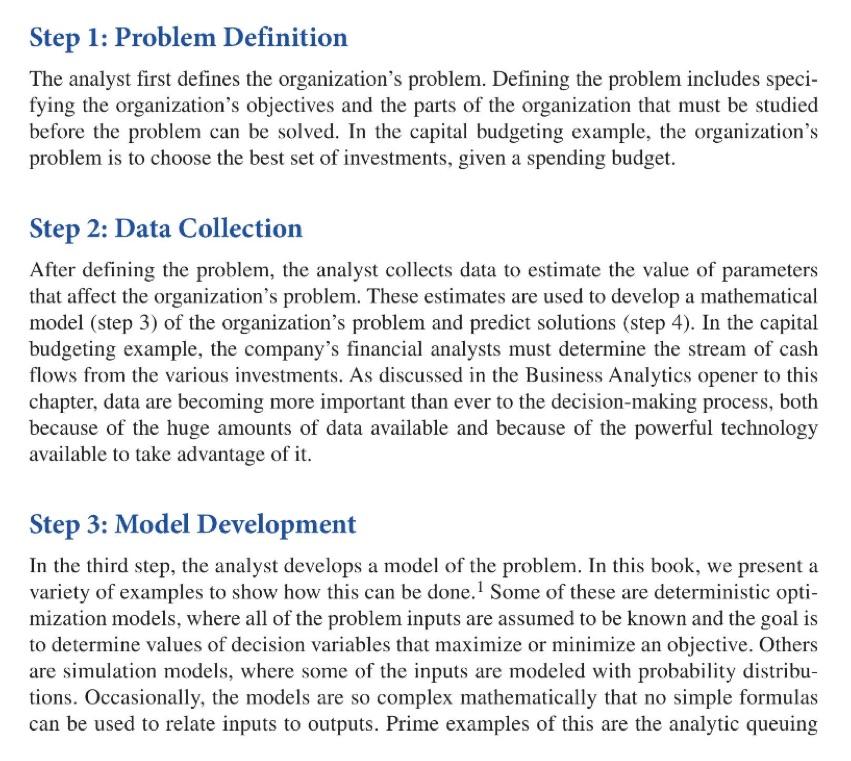
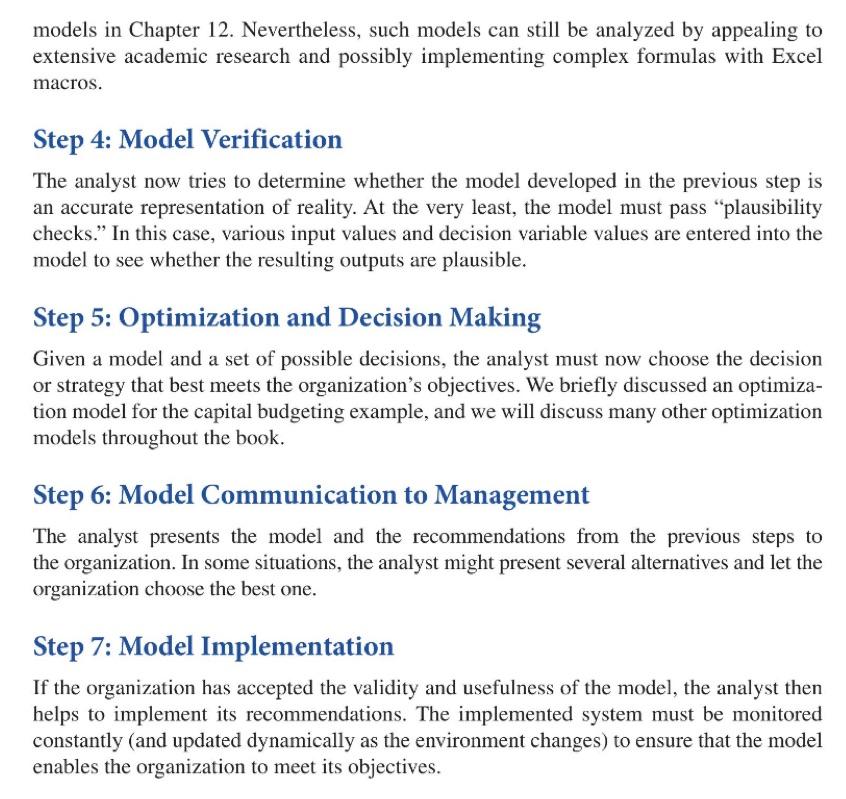
Step 1: Problem Definition The analyst first defines the organization's problem. Defining the problem includes speci- fying the organization's objectives and the parts of the organization that must be studied before the problem can be solved. In the capital budgeting example, the organization's problem is to choose the best set of investments, given a spending budget. Step 2: Data Collection After defining the problem, the analyst collects data to estimate the value of parameters that affect the organization's problem. These estimates are used to develop a mathematical model (step 3) of the organization's problem and predict solutions (step 4). In the capital budgeting example, the company's financial analysts must determine the stream of cash flows from the various investments. As discussed in the Business Analytics opener to this chapter, data are becoming more important than ever to the decision-making process, both because of the huge amounts of data available and because of the powerful technology available to take advantage of it. Step 3: Model Development In the third step, the analyst develops a model of the problem. In this book, we present a variety of examples to show how this can be done. Some of these are deterministic opti- mization models, where all of the problem inputs are assumed to be known and the goal is to determine values of decision variables that maximize or minimize an objective. Others are simulation models, where some of the inputs are modeled with probability distribu- tions. Occasionally, the models are so complex mathematically that no simple formulas can be used to relate inputs to outputs. Prime examples of this are the analytic queuing models in Chapter 12. Nevertheless, such models can still be analyzed by appealing to extensive academic research and possibly implementing complex formulas with Excel macros. Step 4: Model Verification The analyst now tries to determine whether the model developed in the previous step is an accurate representation of reality. At the very least, the model must pass "plausibility checks." In this case, various input values and decision variable values are entered into the model to see whether the resulting outputs are plausible. Step 5: Optimization and Decision Making Given a model and a set of possible decisions, the analyst must now choose the decision or strategy that best meets the organization's objectives. We briefly discussed an optimiza- tion model for the capital budgeting example, and we will discuss many other optimization models throughout the book. Step 6: Model Communication to Management The analyst presents the model and the recommendations from the previous steps to the organization. In some situations, the analyst might present several alternatives and let the organization choose the best one. Step 7: Model Implementation If the organization has accepted the validity and usefulness of the model, the analyst then helps to implement its recommendations. The implemented system must be monitored constantly (and updated dynamically as the environment changes) to ensure that the model enables the organization to meet its objectives









 Study Help