







Question: Apply the tabu search algorithm (Algorithm 15C) on page 895 in Chapter 15 to a TSP with 5 cities. Generate your own distance matrix randomly
Apply the tabu search algorithm (Algorithm 15C) on page 895 in Chapter 15 to a TSP with 5 cities. Generate your own distance matrix randomly use integers in Excel. Let your first solution be the one found by using the nearest neigbor algorithm. Let tmax be 10. Once an interchange occurs, put the smaller indexed position on the tabu list for 2 iterations. Give your results as a table like in the book. Also make sure to provide your distance matrix, and your net changes for all of the possible interchanges during each iteration. You may solve this question in Excel for convenience. Note that the total distance includes the return trip to your starting point in the TSP.
Algorithm 15C: tABu seArChstep 0: initialization.Choose any starting feasible solution x102 and an iteration limit tmax. Then set incumbent solution xndx102 and solution index td0. No moves are tabu.step 1: stopping.If no non-tabu move x in move set M leads to a feasible neighbor of current solution x1t2, or if t=tmax, then stop. Incumbent solu-tion xn is an approximate optimum.step 2: move.Choose some non-tabu feasible move xMasx1t+12.step 3: step.Updatex1t+12dx1t2+x1t+12step 4: incumbent solution.If the objective function value of x1t+12 is superior to that of incumbent solution xn, replace xndx1t+12.step 5: tabu list.Remove from the list of tabu of forbidden moves any that have been on it for a sufficient number of iterations, and add a collection of moves that includes any returning immediately from x1t+12 to x1t2.step 6: increment.Increment tdt+1, and return to Step 1.
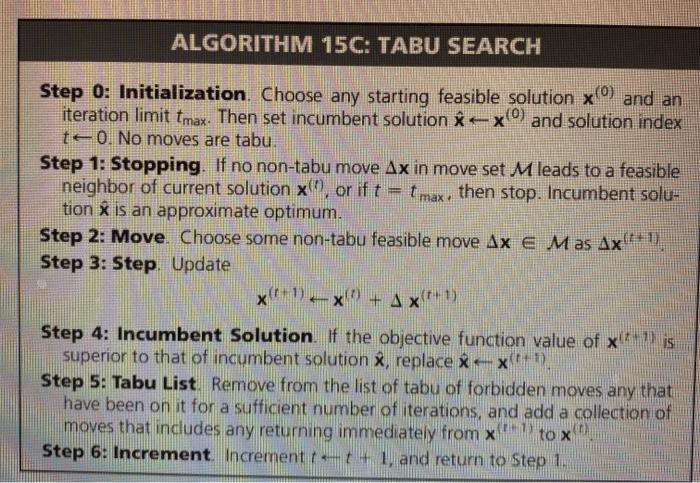
ALGORITHM 15C: TABU SEARCH Step 0: Initialization. Choose any starting feasible solution x(") and an iteration limit tmax. Then set incumbent solution = x() and solution index te 0. No moves are tabu. Step 1: Stopping. If no non-tabu move Ax in move set Mleads to a feasible neighbor of current solution x(!), or if t = t max. then stop. Incumbent solu- tion x is an approximate optimum. Step 2: Move. Choose some non-tabu feasible move Ax e Mas Ax(++, Step 3: Step Update xx! + Axt Step 4: Incumbent Solution. If the objective function value of superior to that of incumbent solution x, replace xx Step 5: Tabu List Remove from the list of tabu of forbidden moves any that have been on it for a sufficient number of iterations, and add a collection of moves that includes any returning immediately from x' Step 6: Increment. Incrementat + 1, and return to Step 1. to X ALGORITHM 15C: TABU SEARCH Step 0: Initialization. Choose any starting feasible solution x(") and an iteration limit tmax. Then set incumbent solution = x() and solution index te 0. No moves are tabu. Step 1: Stopping. If no non-tabu move Ax in move set Mleads to a feasible neighbor of current solution x(!), or if t = t max. then stop. Incumbent solu- tion x is an approximate optimum. Step 2: Move. Choose some non-tabu feasible move Ax e Mas Ax(++, Step 3: Step Update xx! + Axt Step 4: Incumbent Solution. If the objective function value of superior to that of incumbent solution x, replace xx Step 5: Tabu List Remove from the list of tabu of forbidden moves any that have been on it for a sufficient number of iterations, and add a collection of moves that includes any returning immediately from x' Step 6: Increment. Incrementat + 1, and return to Step 1. to X
Step by Step Solution
There are 3 Steps involved in it

Get step-by-step solutions from verified subject matter experts
 Study Help