







Question: Applying our decision-making model to this case, we should first try to determine the facts. We discussed some of this earlier in this chapter. Perhaps
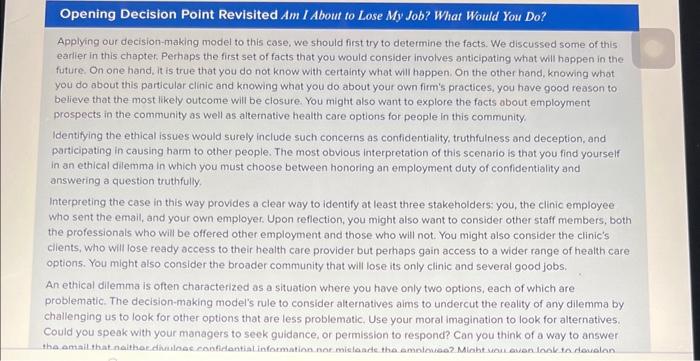
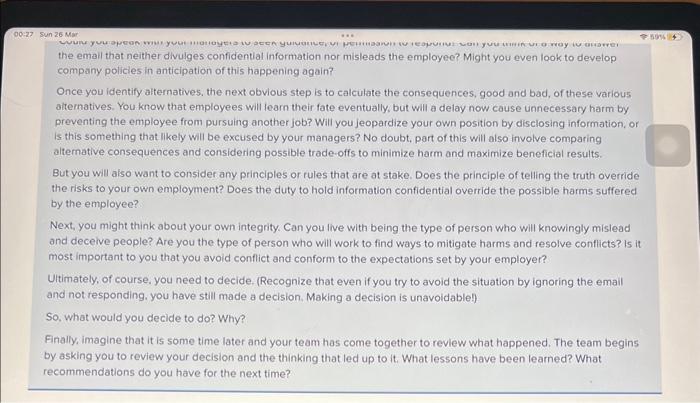
Applying our decision-making model to this case, we should first try to determine the facts. We discussed some of this earlier in this chapter. Perhaps the first set of facts that you would consider involves anticipating what will happen in the future, On one hand, it is true that you do not know with certainty what will happen. On the other hand. knowing what you do about this particular clinic and knowing what you do about your own fitm's practices, you have good reason to believe that the most likely outcome will be closure. You might also want to explore the facts about employment prospects in the community as well as alternative health care options for people in this community. Identifying the ethical issues would surely include such concerns as confidentiality, truthfulness and deception, and participating in causing harm to other people. The most obvious interpretation of this scenario is that you find yourself in an ethical dilemma in which you must choose between honoring an employment duty of confidentiality and answering a question truthfully. Interpreting the case in this way provides a clear way to identify at least three stakeholders: you, the clinic employee who sent the email, and your own employer. Upon reflection, you might also want to consider other staff members, both the professionals who will be offered other employment and those who will not. You might also consider the clinic's clients, who will lose ready access to their health care provider but perhaps gain access to a wider range of health care options. You might also consider the broader community that will lose its only clinic and several good jobs. An ethical dilemma is often characterized as a situation where you have only two options, each of which are problematic. The decision-making model's rule to consider alternatives aims to undercut the reality of any dilemma by challenging us to look for other options that are less problematic. Use your moral imagination to look for alternatives. Could you speak with your managers to seek guidance, or permission to respond? Can you think of a way to answer the email that neither divulges confidential information nor misleads the employee? Might you even look to develop company policies in anticipation of this happening again? Once you identify alternatives, the next obvious step is to calculate the consequences, good and bad, of these various aiternatives. You know that employees will learn their fate eventually, but will a delay now cause unnecessary harm by preventing the employee from pursuing another job? Will you jeopardize your own position by disclosing information, or is this something that likely will be excused by your managers? No doubt, part of this will also involve comparing altemative consequences and considering possible trade-offs to minimize harm and maximize beneficial results. But you will also want to consider any principles or rules that are at stake. Does the principle of telling the truth override the risks to your own employment? Does the duty to hold information confidential override the possible harms suffered by the employee? Next, you might think about your own integrity. Can you live with being the type of person who will knowingly mislead and decelve people? Are you the type of person who will work to find ways to mitigate harms and resolve conflicts? Is it most important to you that you avoid conflict and conform to the expectations set by your employer? Ultimately, of course. you need to decide. (Recognize that even if you try to avoid the situation by ignoring the email and not responding. you have still made a decision, Making a decision is unavoidablel) So, what would you decide to do? Why? Finally, imagine that it is some time later and your team has come together to review what happened. The team begins by asking you to review your decision and the thinking that led up to it. What lessons have been learned? What recommendations do you have for the next time
Step by Step Solution
There are 3 Steps involved in it

Get step-by-step solutions from verified subject matter experts
 Study Help