







Question: are these true or false? 9. True or False? Aa Aa Use your knowledge of truth functions and the five propositional logic operators to determine
are these true or false?
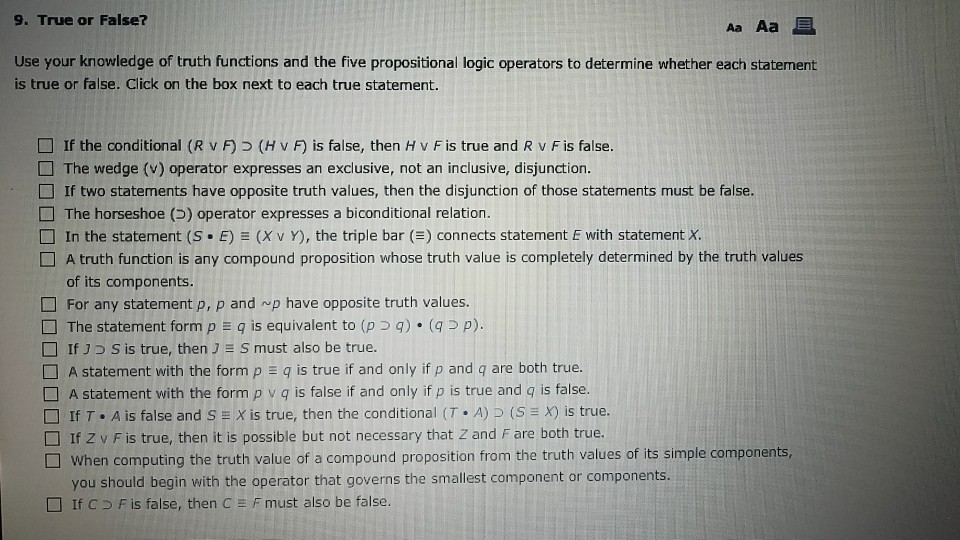
9. True or False? Aa Aa Use your knowledge of truth functions and the five propositional logic operators to determine whether each statement is true or false. Click on the box next to each true statement. If the conditional (R v F) (H v F) is false, then H v F is true and R v Fis false. ? The wedge (v) operator expresses an exclusive, not an inclusive, disjunction. ? If two statements have opposite truth values, then the disjunction of those statements must be false. ? The horseshoe (-) operator expresses a biconditional relation. In the statement (s-E)-(Xv Y), the triple bar(5) connects statement E with statement x. A truth function is any compound proposition whose truth value is completely determined by the truth values of its components. For any statement p, p and Mp have opposite truth values. The statement form p E q is equivalent to (p ). (g p ? If J s is true, ten must also be true. A statement with the form p q is true if and only if p and q are both true. D A statement with the form p v q is false if and only if p is true and q is false. If T . A is false and S X is true, then the conditional (T+ A) D (S ? X) is true. If Z v F is true, then it is possible but not necessary that Z and F are both true. ? when computing the truth value of a compound proposition from the truth values of its simple components you should begin with the operator that governs the smallest component or components. If C F is false, then C F must also be false
Step by Step Solution
There are 3 Steps involved in it

Get step-by-step solutions from verified subject matter experts
 Study Help