







Question: are workplace wellness programs using proper motivational tools 1. Use correct spelling punctuation, and grammar (5 points) 2. Your post must contain three paragraphs. Each
are workplace wellness programs using proper motivational tools 
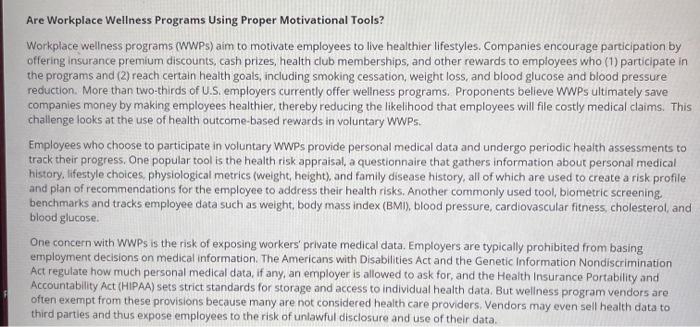
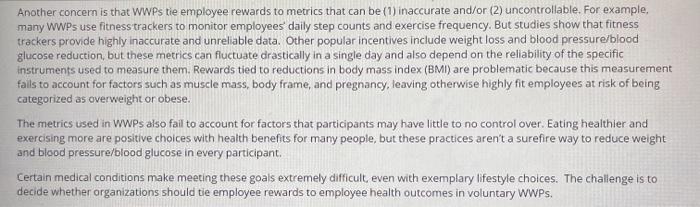
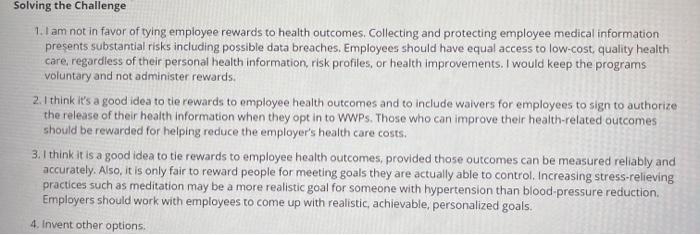
1. Use correct spelling punctuation, and grammar (5 points) 2. Your post must contain three paragraphs. Each paragraph must contain a minimum of three sentences a. Introduction paragraph - State your position (5 points) b. Main paragraph - Fully explain your position (5 points) c. Closing paragraph - Restate your position (5 points) 3. You must respond to a classmate's post. Use at least one paragraph (5 points) Are Workplace Wellness Programs Using Proper Motivational Tools? Workplace wellness programs (WWPs) aim to motivate employees to live healthier lifestyles. Companies encourage participation by offering Insurance premium discounts, cash prizes, health club memberships, and other rewards to employees who (1) participate in the programs and (2) reach certain health goals, including smoking cessation, weight loss, and blood glucose and blood pressure reduction. More than two-thirds of U.S. employers currently offer wellness programs. Proponents believe WWPs ultimately save companies money by making employees healthier , thereby reducing the likelihood that employees will file costly medical claims. This challenge looks at the use of health outcome-based rewards in voluntary WWPs. Employees who choose to participate in voluntary WWPs provide personal medical data and undergo periodic health assessments to track their progress, One popular tool is the health risk appraisal, a questionnaire that gathers information about personal medical history, lifestyle choices, physiological metrics (weight, height), and family disease history, all of which are used to create a risk profile and plan of recommendations for the employee to address their health risks. Another commonly used tool, biometric screening benchmarks and tracks employee data such as weight, body mass index (BMI), blood pressure, cardiovascular fitness, cholesterol and blood glucose. One concern with WWPs is the risk of exposing workers' private medical data. Employers are typically prohibited from basing employment decisions on medical information. The Americans with Disabilities Act and the Genetic Information Nondiscrimination Act regulate how much personal medical data, if any, an employer is allowed to ask for, and the Health Insurance Portability and Accountability Act (HIPAA) sets strict standards for storage and access to individual health data. But wellness program vendors are often exempt from these provisions because many are not considered health care providers. Vendors may even sell health data to third parties and thus expose employees to the risk of unlawful disclosure and use of their data. Another concern is that WWPs tie employee rewards to metrics that can be (1) inaccurate and/or (2) uncontrollable. For example, many WWPs use fitness trackers to monitor employees daily step counts and exercise frequency. But studies show that fitness trackers provide highly inaccurate and unreliable data. Other popular incentives include weight loss and blood pressure/blood glucose reduction, but these metrics can fluctuate drastically in a single day and also depend on the reliability of the specific instruments used to measure them. Rewards tied to reductions in body mass index (BMI) are problematic because this measurement fails to account for factors such as muscle mass, body frame, and pregnancy, leaving otherwise highly fit employees at risk of being categorized as overweight or obese. The metrics used in WWPs also fail to account for factors that participants may have little to no control over Eating healthier and exercising more are positive choices with health benefits for many people, but these practices aren't a surefire way to reduce weight and blood pressure/blood glucose in every participant. Certain medical conditions make meeting these goals extremely difficult even with exemplary lifestyle choices. The challenge is to decide whether organizations should tie employee rewards to employee health outcomes in voluntary WWPs. Solving the Challenge 1. I am not in favor of tying employee rewards to health outcomes. Collecting and protecting employee medical information presents substantial risks including possible data breaches. Employees should have equal access to low-cost quality health care, regardless of their personal health information, risk profiles, or health improvements. I would keep the programs voluntary and not administer rewards. 2. I think it's a good idea to tie rewards to employee health outcomes and to include waivers for employees to sign to authorize the release of their health information when they opt in to WWPs. Those who can improve their health-related outcomes should be rewarded for helping reduce the employer's health care costs. 3. I think it is a good idea to tie rewards to employee health outcomes, provided those outcomes can be measured reliably and accurately. Also, it is only fair to reward people for meeting goals they are actually able to control. Increasing stress-relieving practices such as meditation may be a more realistic goal for someone with hypertension than blood pressure reduction Employers should work with employees to come up with realistic achievable, personalized goals. 4. Invent other options
Step by Step Solution
There are 3 Steps involved in it
1 Expert Approved Answer
Step: 1 Unlock

Question Has Been Solved by an Expert!
Get step-by-step solutions from verified subject matter experts
Step: 2 Unlock
Step: 3 Unlock
 Study Help