







Question: Arithmetic Seq / Series Determine if the sequence is arithmetic. If it is, find the common difference, the term named in the problem, the explicit
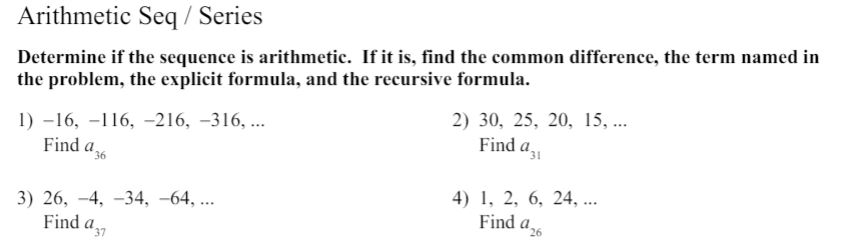
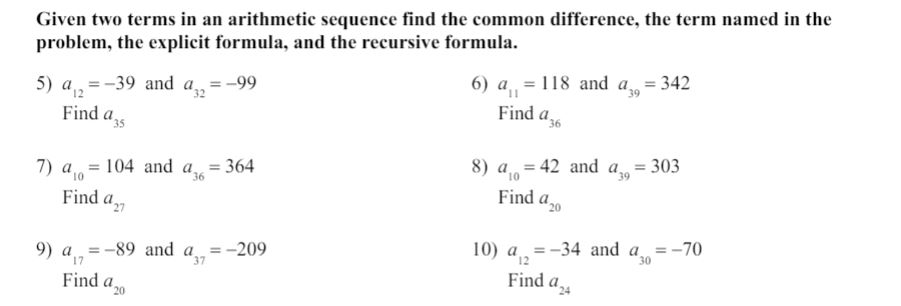
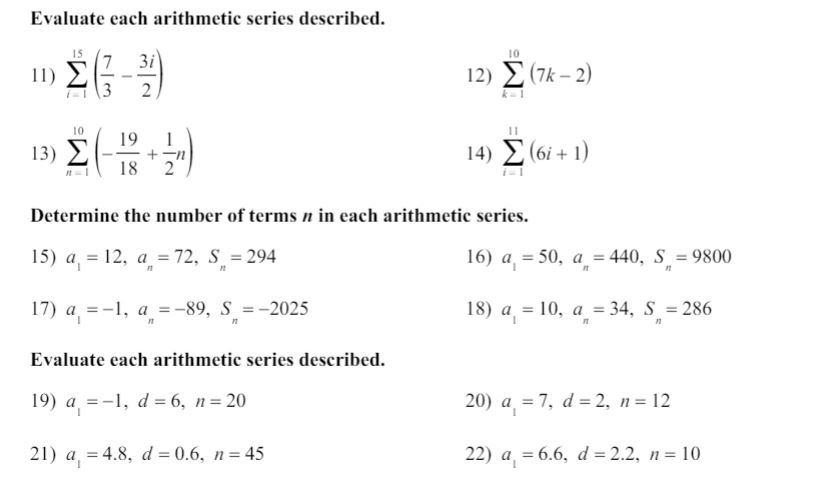
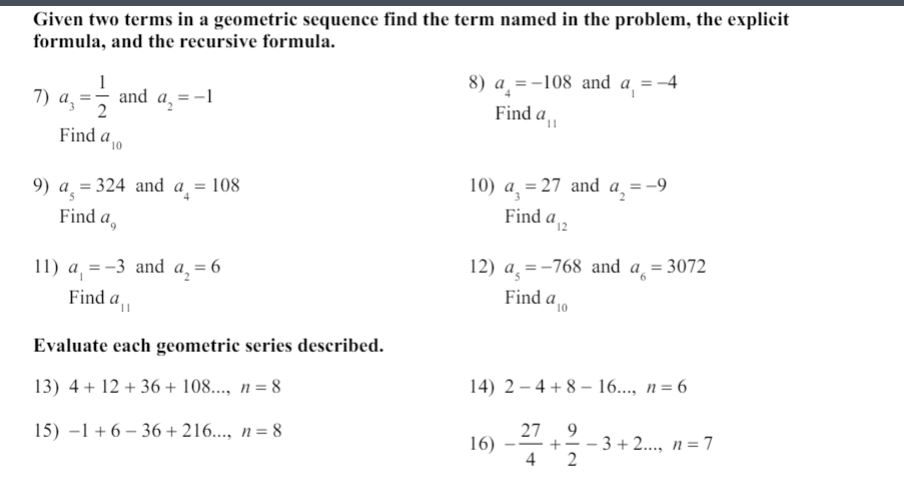
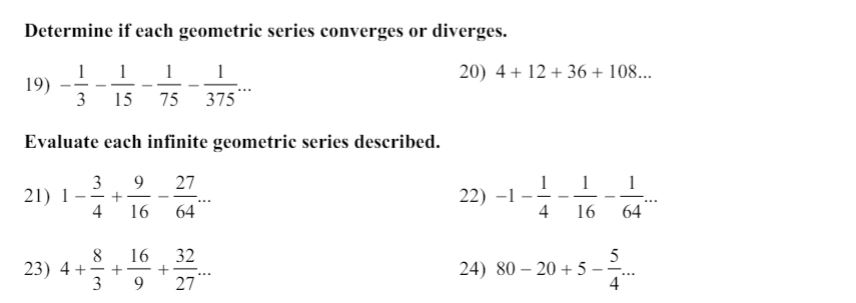
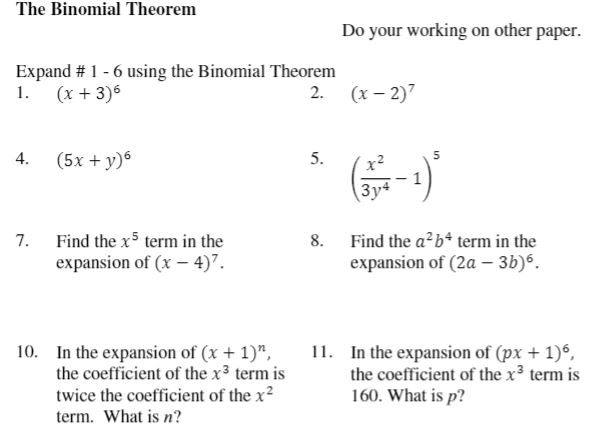
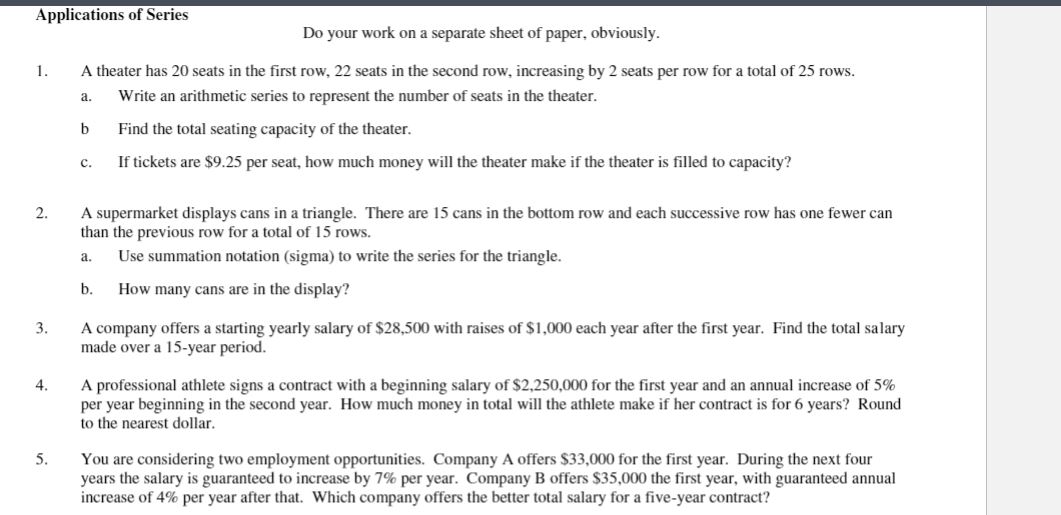
Arithmetic Seq / Series Determine if the sequence is arithmetic. If it is, find the common difference, the term named in the problem, the explicit formula, and the recursive formula. 1} =16, -116. =216, -316, ... 2) 30, 25, 20, 15, ... Find a, Find a, 3) 26, -4, =34, 64, ... 41, 2, 6, 24, .. Find a__ Finda, Given two terms in an arithmetic sequence find the common difference, the term named in the problem, the explicit formula, and the recursive formula. 5) a,= -39 and a,= -99 Find a., 7) a.= 104 and a, = 364 Find a,, 9) a_ =-89 and a_=-209 Find a,, 6) a =118 and a =342 Finda_ 8) a =42 and a =303 Finda, 10) @ ,=-34 and a_=-70 Find a,, \f\f\fDetermine if each geometric series converges or diverges. 1 l I 1 20) 4+ 12+ 36+ 108... 19) ~ = 3 15 75 3757 Evaluate each infinite geometric series described. 39 27 1 4 a3 2) == b0 . 2) -l m , 4 16 64 4 16 64 16 32 Do) R 5 24) 80-20+5.. 3 9 27 4 The Binomial Theorem Do your working on other paper. Expand # 1 - 6 using the Binomial Theorem . (x+3) 2. (x-2) 4. (5x+y) 3. x* ' (5+-1) 7. Find the x* term in the 8. Find the a*b* term in the expansion of (x 4)7. expansion of (2a 3b). 10. In the expansion of (x + 1), 11. In the expansion of (px + 1)5, the coefficient of the x* term is the coefficient of the x* term is twice the coefficient of the x> 160. What is p? term. What is n? Applications of Series Do your work on a separate sheet of paper, obviously. 1. A theater has 20 seats in the first row, 22 seats in the second row, increasing by 2 seats per row for a total of 25 rows. a. Write an arithmetic series to represent the number of seats in the theater. b Find the total seating capacity of the theater. c. If tickets are $9.25 per seat, how much money will the theater make if the theater is filled to capacity? 2. A supermarket displays cans in a triangle. There are 15 cans in the bottom row and each successive row has one fewer can than the previous row for a total of 15 rows. a. Use summation notation (sigma) to write the series for the triangle. b. How many cans are in the display? 3: A company offers a starting yearly salary of $28,500 with raises of $1,000 each year after the first year. Find the total salary made over a |5-year period. 4. A professional athlete signs a contract with a beginning salary of $2,250,000 for the first year and an annual increase of 5% per year beginning in the second year. How much money in total will the athlete make if her contract is for 6 years? Round to the nearest dollar. 5 You are considering two employment opportunities. Company A offers $33,000 for the first year. During the next four years the salary is guaranteed to increase by 7% per year. Company B offers $35,000 the first year, with guaranteed annual increase of 4% per year after that. Which company offers the better total salary for a five-year contract
Step by Step Solution
There are 3 Steps involved in it

Get step-by-step solutions from verified subject matter experts
 Study Help