







Question: Artificial Intelligence Nave Bayes is frequently applied to categorizing text (e.g. documents, web pages) based on the presence or absence of different words. Assume we
Artificial Intelligence
Nave Bayes is frequently applied to categorizing text (e.g. documents, web pages) based on the presence or absence of different words. Assume we want to categorize science texts into the following categories: Physics, Biology, and Chemistry. The following probabilities have been estimated from analyzing a corpus of pre-classified web pages gathered from Yahoo:
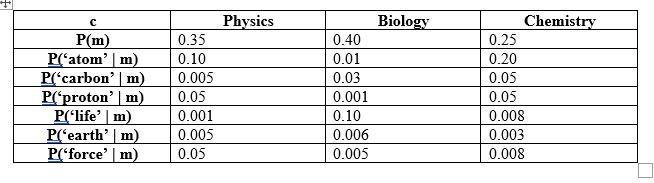
Assuming the probability of each evidence word is independent given the category of the text, compute the posterior probability for each of the possible categories for each of the following short texts. Assume the categories are disjoint and complete for this application. Assume that the words are first stemmed to reduce them to their base form (atoms -> atom, forces -> force, protons -> proton). a.) The carbon atom is the foundation of life on earth. b.) The carbon atom contains twelve protons. c.) String theory attempts to unify all the forces on earth.
P(m) P('atomm) P('carbon' m) POproton' m) P(life' m) P(-earth' m) P(-force' m) Physics 0.35 0.10 0.005 0.05 0.001 0.005 0.05 Biology 0.40 0.01 0.03 0.001 0.10 0.006 0.005 Chemistry 0.25 0.20 0.05 0.05 0.008 0.003 0.008
Step by Step Solution
There are 3 Steps involved in it

Get step-by-step solutions from verified subject matter experts
 Study Help