







Question: Artificial Intelligence please summarize this with your own words The four outcomes listed above lead to a number of dilemmas, the first one is (challenging
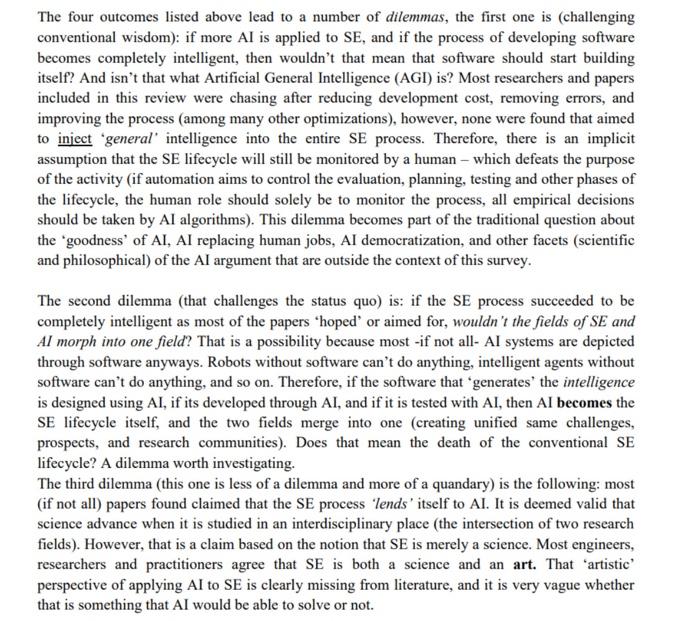
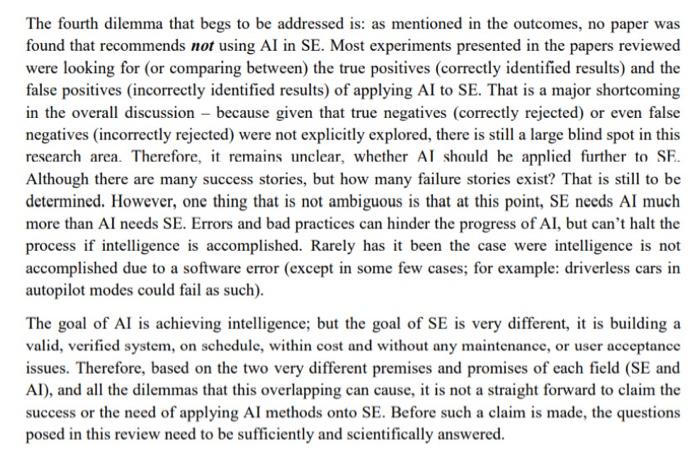
The four outcomes listed above lead to a number of dilemmas, the first one is (challenging conventional wisdom): if more AI is applied to SE, and if the process of developing software becomes completely intelligent, then wouldn't that mean that software should start building itself? And isn't that what Artificial General Intelligence (AGI) is? Most researchers and papers included in this review were chasing after reducing development cost, removing errors, and improving the process (among many other optimizations), however, none were found that aimed to inject 'general' intelligence into the entire SE process. Therefore, there is an implicit assumption that the SE lifecycle will still be monitored by a human - which defeats the purpose of the activity (if automation aims to control the evaluation, planning, testing and other phases of the lifecycle, the human role should solely be to monitor the process, all empirical decisions should be taken by AI algorithms). This dilemma becomes part of the traditional question about the 'goodness' of AI,AI replacing human jobs, AI democratization, and other facets (scientific and philosophical) of the AI argument that are outside the context of this survey. The second dilemma (that challenges the status quo) is: if the SE process succeeded to be completely intelligent as most of the papers 'hoped' or aimed for, wouldn't the fields of SE and AI morph into one field? That is a possibility because most -if not all- AI systems are depicted through software anyways. Robots without software can't do anything, intelligent agents without software can't do anything, and so on. Therefore, if the software that 'generates' the intelligence is designed using AI, if its developed through AI, and if it is tested with AI, then AI becomes the SE lifecycle itself, and the two fields merge into one (creating unified same challenges, prospects, and research communities). Does that mean the death of the conventional SE lifecycle? A dilemma worth investigating. The third dilemma (this one is less of a dilemma and more of a quandary) is the following: most (if not all) papers found claimed that the SE process 'lends' itself to AI. It is deemed valid that science advance when it is studied in an interdisciplinary place (the intersection of two research fields). However, that is a claim based on the notion that SE is merely a science. Most engineers, researchers and practitioners agree that SE is both a science and an art. That 'artistic' perspective of applying AI to SE is clearly missing from literature, and it is very vague whether that is something that AI would be able to solve or not. The fourth dilemma that begs to be addressed is: as mentioned in the outcomes, no paper was found that recommends not using AI in SE. Most experiments presented in the papers reviewed were looking for (or comparing between) the true positives (correctly identified results) and the false positives (incorrectly identified results) of applying AI to SE. That is a major shortcoming in the overall discussion - because given that true negatives (correctly rejected) or even false negatives (incorrectly rejected) were not explicitly explored, there is still a large blind spot in this research area. Therefore, it remains unclear, whether AI should be applied further to SF. Although there are many success stories, but how many failure stories exist? That is still to be determined. However, one thing that is not ambiguous is that at this point, SE needs AI much more than AI needs SE. Errors and bad practices can hinder the progress of AI, but can't halt the process if intelligence is accomplished. Rarely has it been the case were intelligence is not accomplished due to a software error (except in some few cases; for example: driverless cars in autopilot modes could fail as such). The goal of AI is achieving intelligence; but the goal of SE is very different, it is building a valid, verified system, on schedule, within cost and without any maintenance, or user aceeptance issues. Therefore, based on the two very different premises and promises of each field (SE and AI), and all the dilemmas that this overlapping can cause, it is not a straight forward to claim the success or the need of applying AI methods onto SE. Before such a claim is made, the questions posed in this review need to be sufficiently and scientifically answered
Step by Step Solution
There are 3 Steps involved in it

Get step-by-step solutions from verified subject matter experts
 Study Help