







Question: Artificial Intelligence Question ## knight_search_tester.py ## Modified by John Stell 2018 from original by Brandon Bennett --- 27/10/2009 ## This is the top level file
Artificial Intelligence Question
## knight_search_tester.py ## Modified by John Stell 2018 from original by Brandon Bennett --- 27/10/2009
## This is the top level file for running search on the knight's tour
import sys from tree import * from queue_search import *
from knights_tour import *
# Use this if you want to make Python wait between search tests. # For Python 3 replace raw_input by input # defwait(): # raw_input('
search(get_knights_tour_problem(4,4), 'depth_first', 100000, [] ) search(get_knights_tour_problem(5,5), 'depth_first', 500000, ['loop_check'] )
-----------------------------
## Definition of Knight's Tour search problem ## For use with queue_search.py
from __future__ import print_function
from copy import deepcopy
# Representation of a state: # (move_number, (current_x_pos, current_y_pos), full_board_state) # So on a small 3x3 board after 3 moves we might have a state such as: # # ( 3, (2,0), [[1,0,0], # [0,0,2], # [3,0,0]] )
def knight_get_initial_state(x,y): return ( 0, 0, matrix_of_zeros(y,x) )
def matrix_of_zeros(X,Y): return [ [0 for x in range(X)] for y in range(Y)] # Pythonic or what?
def knight_possible_actions( state ): if state[0] == 0: return knight_initial_moves() return knight_following_moves(state)
def knight_initial_moves(): moves = [] for i in range(BOARD_X): for j in range(BOARD_Y): moves = moves + [[i,j]] return moves
def square_is_empty(i,j, state): if state[2][i][j] == 0: return True return False
knights_moves = ( (1,2), (2,1), (-1,2), (2,-1), (1,-2), (2,-1), (-1,-2), (-2,-1) )
def knight_following_moves( state ): kx = state[1][0] ky = state[1][1] moves = [] for move in knights_moves: newx = kx + move[0] ## target x coord newy = ky + move[1] ## target y coord
## If target square is on board and empty ## add it to the list of moves if newx in range(BOARD_X) and newy in range(BOARD_Y): if state[2][newx][newy] == 0: moves = moves + [move] return moves
def knight_successor_state( action, state ): if state[0] == 0: newstate = knight_initial_successor( action ) return newstate board = deepcopy(state[2]) xpos = state[1][0] + action[0] ypos = state[1][1] + action[1] movenum = state[0] + 1 board[xpos][ypos] = movenum return (movenum, (xpos,ypos), board)
def knight_initial_successor( action ): board = deepcopy(knight_initial_state[2]) board[action[0]][action[1]] = 1 return( 1, action, board )
def knight_goal_state( state ): if state[0] == BOARD_X * BOARD_Y: print( " GOAL STATE:" ) print_board_state( state ) return True return False
def print_board_state( state ): board = state[2] for row in board: for square in row: print( " %2i" % square, end = '' ) print()
def knight_print_problem_info(): print( "The Knight's Tour (", BOARD_X, "x", BOARD_Y, "board)" )
## Return a problem spec tuple for a given board size def get_knights_tour_problem(x, y): global BOARD_X, BOARD_Y, knight_initial_state BOARD_X = x BOARD_Y = y knight_initial_state = knight_get_initial_state(x,y) return ( None, knight_print_problem_info, knight_initial_state, knight_possible_actions, knight_successor_state, knight_goal_state )
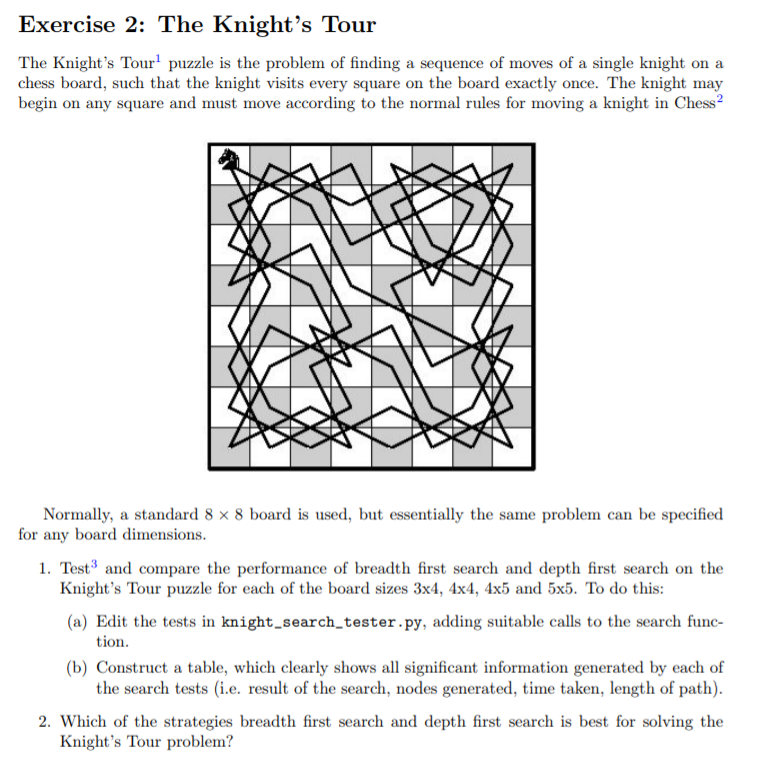
Exercise 2: The Knight's Tour The Knight's Tour puzzle is the problem of finding a sequence of moves of a single knight on a chess board, such that the knight visits every square on the board exactly once. The knight may begin on any square and must move according to the normal rules for moving a knight in Chess2 Normially, a standard 8 8 board is used, but essentially the same problem can be specified 1. Test3 and compare the performance of breadth first search and depth first search on the (a) Edit the tests in knight_search_tester.py, adding suitable calls to the search func (b) Construct a table, which clearly shows all significant information generated by each of for any board dimensions. Knight's Tour puzzle for each of the board sizes 3x4, 4x4, 4x5 and 5x5. To do this: tion the search tests (i.e. result of the search, nodes generated, time taken, length of path) 2. Which of the strategies breadth first search and depth first search is best for solving the Knight's Tour problem? Exercise 2: The Knight's Tour The Knight's Tour puzzle is the problem of finding a sequence of moves of a single knight on a chess board, such that the knight visits every square on the board exactly once. The knight may begin on any square and must move according to the normal rules for moving a knight in Chess2 Normially, a standard 8 8 board is used, but essentially the same problem can be specified 1. Test3 and compare the performance of breadth first search and depth first search on the (a) Edit the tests in knight_search_tester.py, adding suitable calls to the search func (b) Construct a table, which clearly shows all significant information generated by each of for any board dimensions. Knight's Tour puzzle for each of the board sizes 3x4, 4x4, 4x5 and 5x5. To do this: tion the search tests (i.e. result of the search, nodes generated, time taken, length of path) 2. Which of the strategies breadth first search and depth first search is best for solving the Knight's Tour
Step by Step Solution
There are 3 Steps involved in it

Get step-by-step solutions from verified subject matter experts
 Study Help