



Question: As a developing country, India is much more reliant on physical cash (the rupee, given by the symbol ) than the United States. Not
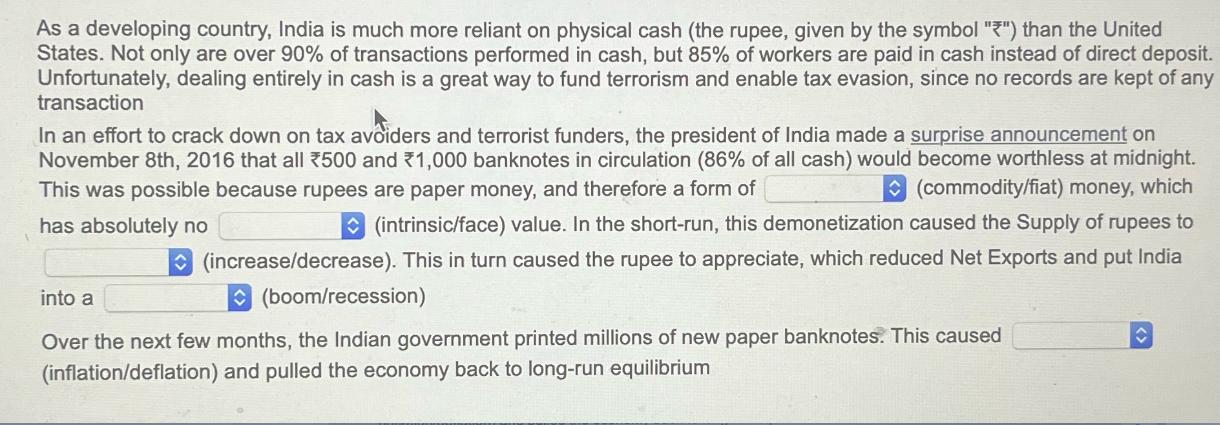
As a developing country, India is much more reliant on physical cash (the rupee, given by the symbol "") than the United States. Not only are over 90% of transactions performed in cash, but 85% of workers are paid in cash instead of direct deposit. Unfortunately, dealing entirely in cash is a great way to fund terrorism and enable tax evasion, since no records are kept of any transaction In an effort to crack down on tax avoiders and terrorist funders, the president of India made a surprise announcement on November 8th, 2016 that all 500 and 1,000 banknotes in circulation (86% of all cash) would become worthless at midnight. This was possible because rupees are paper money, and therefore a form of (commodity/fiat) money, which has absolutely no (intrinsic/face) value. In the short-run, this demonetization caused the Supply of rupees to (increase/decrease). This in turn caused the rupee to appreciate, which reduced Net Exports and put India into a (boom/recession) Over the next few months, the Indian government printed millions of new paper banknotes. This caused (inflation/deflation) and pulled the economy back to long-run equilibrium
Step by Step Solution
There are 3 Steps involved in it
In an effort to crack down on tax avoiders and terrorist funders the ... View full answer

Get step-by-step solutions from verified subject matter experts