



Question: As described in Example 6.2, metals are actually crystalline materials. Metal crystals are called grains. When the average grain size is small, the metal is
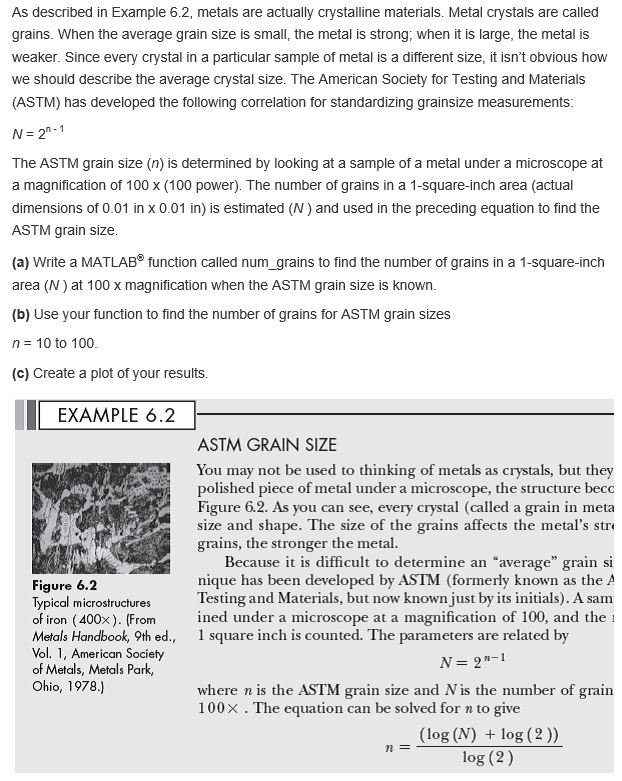
As described in Example 6.2, metals are actually crystalline materials. Metal crystals are called grains. When the average grain size is small, the metal is strong, when it is large, the metal is weaker. Since every crystal in a particular sample of metal is a different size, it isn't obvious how we should describe the average crystal size. The American Society for Testing and Materials (ASTM) has developed the following correlation for standardizing grainsize measurements The ASTM grain size (n) is determined by looking at a sample of a metal under a microscope at a magnification of 100 x (100 power). The number of grains in a 1-square-inch area (actual dimensions of 0.01 in x 0.01 in) is estimated (N) and used in the preceding equation to find the ASTM grain size (a) Write a MATLAB function called num_grains to find the number of grains in a 1-square-inch area (N) at 100 x magnification when the ASTM grain size is known (b) Use your function to find the number of grains for ASTM grain sizes n=1010 100 (c) Create a plot of your results EXAMPLE 6.2 ASTM GRAIN SIZE You may not be used to thinking of metals as crystals, but they polished piece of metal under a microscope, the structure becc you can see, every crystal (called a grain in meta size and shape. The size of the grains affects the metal's stre grains, the stronger the metal Because it is difficult to determine an average" grain si nique has been developed by ASTM (formerly known as theA Figure 6.2 Typical microstructures Testing and Materials, but now known just by its initials). A sam of iron (400x). (From ined under a microscope at a magnification of 100, and the Metals Handbook, 9th ed., 1square inch is counted. The parameters are related by Vol. 1, American Society of Metals, Metals Park, Ohio, 1978.) where n is the ASTM grain size and Nis the number of grain 100x . The equation can be solved for n to give (log (N) +log (2)) log (2)
Step by Step Solution
There are 3 Steps involved in it

Get step-by-step solutions from verified subject matter experts