







Question: As explained in chapter 5, risk measures such as standard variation and beta equate risk to volatility. In other words, the more volatile the
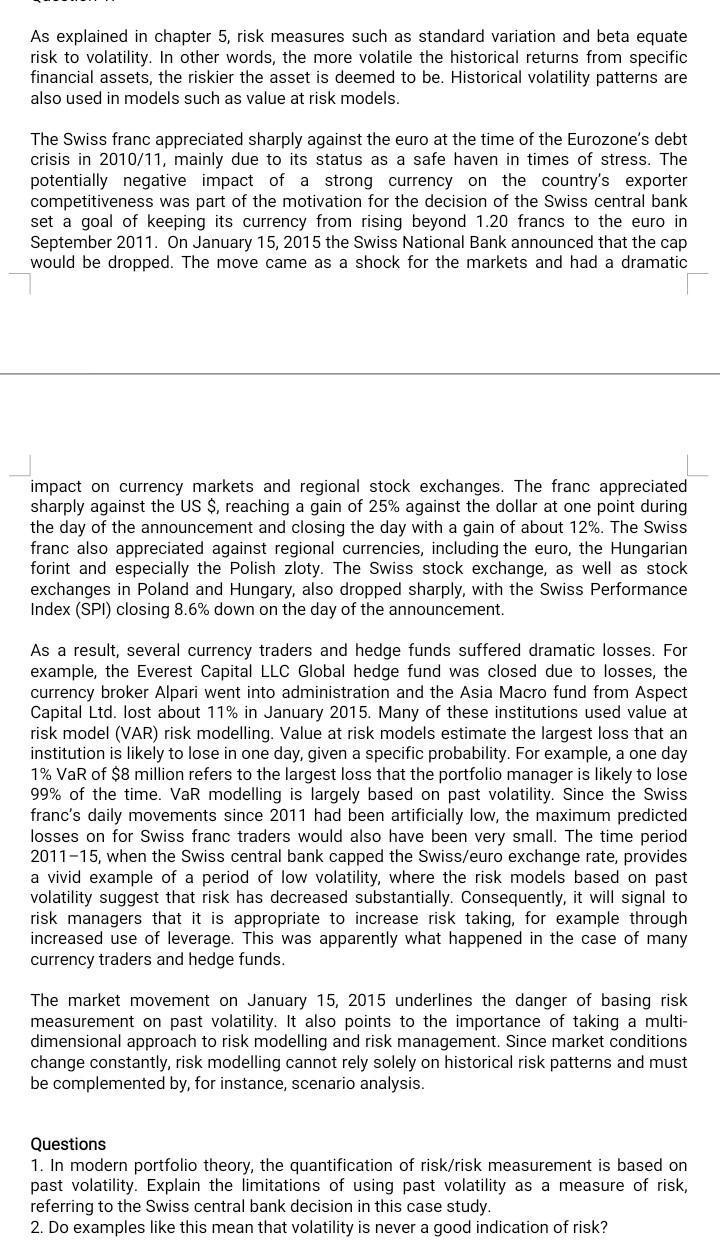
As explained in chapter 5, risk measures such as standard variation and beta equate risk to volatility. In other words, the more volatile the historical returns from specific financial assets, the riskier the asset is deemed to be. Historical volatility patterns are also used in models such as value at risk models. The Swiss franc appreciated sharply against the euro at the time of the Eurozone's debt crisis in 2010/11, mainly due to its status as a safe haven in times of stress. The potentially negative impact of a strong currency on the country's exporter competitiveness was part of the motivation for the decision of the Swiss central bank set a goal of keeping its currency from rising beyond 1.20 francs to the euro in September 2011. On January 15, 2015 the Swiss National Bank announced that the cap would be dropped. The move came as a shock for the markets and had a dramatic impact on currency markets and regional stock exchanges. The franc appreciated sharply against the US $, reaching a gain of 25% against the dollar at one point during the day of the announcement and closing the day with a gain of about 12%. The Swiss franc also appreciated against regional currencies, including the euro, the Hungarian forint and especially the Polish zloty. The Swiss stock exchange, as well as stock exchanges in Poland and Hungary, also dropped sharply, with the Swiss Performance Index (SPI) closing 8.6% down on the day of the announcement. As a result, several currency traders and hedge funds suffered dramatic losses. For example, the Everest Capital LLC Global hedge fund was closed due to losses, the currency broker Alpari went into administration and the Asia Macro fund from Aspect Capital Ltd. lost about 11% in January 2015. Many of these institutions used value at risk model (VAR) risk modelling. Value at risk models estimate the largest loss that an institution is likely to lose in one day, given a specific probability. For example, a one day 1% VaR of $8 million refers to the largest loss that the portfolio manager is likely to lose 99% of the time. VaR modelling is largely based on past volatility. Since the Swiss franc's daily movements since 2011 had been artificially low, the maximum predicted losses on for Swiss franc traders would also have been very small. The time period 2011-15, when the Swiss central bank capped the Swiss/euro exchange rate, provides a vivid example of a period of low volatility, where the risk models based on past volatility suggest that risk has decreased substantially. Consequently, it will signal to risk managers that it is appropriate to increase risk taking, for example through increased use of leverage. This was apparently what happened in the case of many currency traders and hedge funds. The market movement on January 15, 2015 underlines the danger of basing risk measurement on past volatility. It also points to the importance of taking a multi- dimensional approach to risk modelling and risk management. Since market conditions change constantly, risk modelling cannot rely solely on historical risk patterns and must be complemented by, for instance, scenario analysis. Questions 1. In modern portfolio theory, the quantification of risk/risk measurement is based on past volatility. Explain the limitations of using past volatility as a measure of risk, referring to the Swiss central bank decision in this case study. 2. Do examples like this mean that volatility is never a good indication of risk?
Step by Step Solution
3.45 Rating (158 Votes )
There are 3 Steps involved in it
Answer 1 The main limitation of using past volatility as a measure of risk is that it is based on historical data which may not be representative of future risk For example the Swiss franc appreciated ... View full answer

Get step-by-step solutions from verified subject matter experts
 Study Help