







Question: As summarized in Table 1-4, discuss which values best reflect your personal orientation on each of the six dimensions and why? Offer an example of
As summarized in Table 1-4, discuss which values best reflect your personal orientation on each of the six dimensions and why? Offer an example of your own behavior that fits each values orientation.
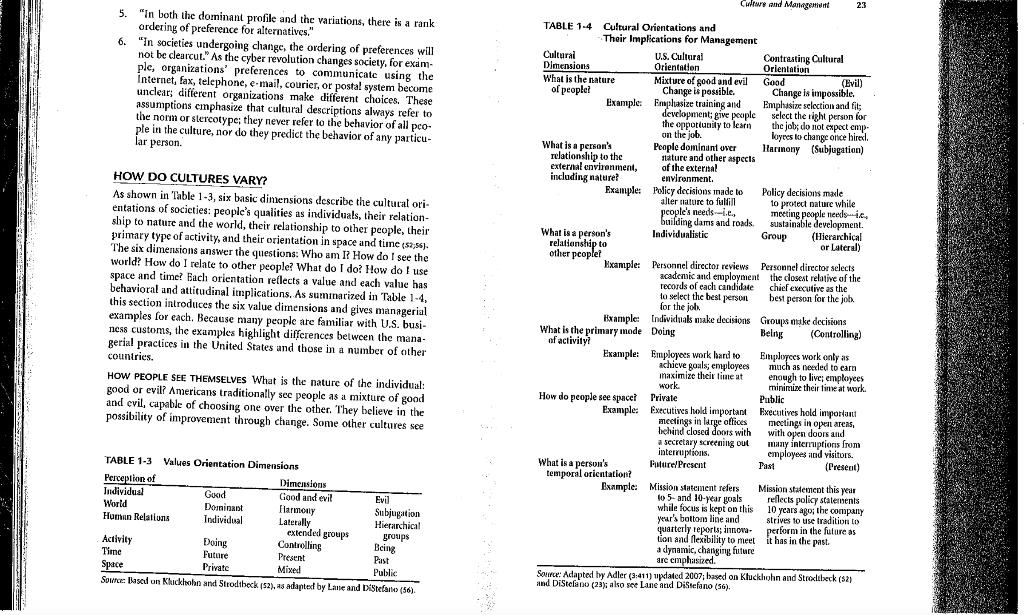
Cultwe and Maimagement 23 "In both the dominant profile and the variations, there is a rank ordering of preference for alternatives." 6. "In societies undergoing change, the ordering of preferences will not be clearcut." As the cyber revolution changes society, for exam- ple, organizations' preferences to communicate using the Internet, fax, telephone, e-mail, courier, or posta! system become unclear; different organizations make different choices. These assumptions emphasize that cultural descriptions always refer to the norm or stercotype; they never refer to the behavior of all peo- ple in the culture, nor do they predict the behavior of any particu- lar person. 5. TABLE 1-4 Cultural Orientations and Their Implications for Management U.S. Cultural Orientatien Mixture of good and evil Good Change is possible. Example: Emplasize training and development; give people the oppottunity to learn on the job. People dominunt over tature and other aspects of the external environment Example: Policy decisions made to alter nature to fullill people's needs-i.e., building dams and roads. Individualistic Contrasting Cultural Orientation Cultural Dimensions What is the nature of people? (Evil) Change is impossible. Emphasize selection and fit; select the right person for the job; do not expect emp- loyres ko change once hired. Harmony (Subjugation) What is a person's relationship to the external envirenment, including nature? HOW DO CULTURES VARY? Policy decisions made to protect nature while meeting people needs-ie, Sustainable development. (Hierarchical or Lateral) As shown in Table 1-3, six basic dimensions describe the cultural ori- entations of societies: people's qualities as individuals, their relation- ship to nature and the world, their relationship to other people, their primary type of activity, and their orientation in space and time (s2,55). The six dimensions answer the questions: Who am I? How do I see the world? How do I relate to other people? What do I do? How do I use space and time? Bach orientation reflects a value and each value has behavioral and attitudinal implications. As suminarized in Table 1-4, this section introduces the six value dimensions and gives managerial examples for each. Because many people are familiar with U.S. busi- ness customs, the examples highlight differences belwen the mana- gerial practices in the United States and those in a number of ather countries. What is a person's relationship to other peoplet Group Example: Personnel director reviews Personnel director selects academic and employment the closest relative of the records of each candidate to select the best person for the job. chief executive as the best person for the job. Example: Individuals make decisions Groups make decisions (Controlling) Belng What is the primary mode Doing of activity? Eitployees work only as much as needed to carn enough to live; emptoyees minimixe their time at work. Public Example: Employees work hard to achieve goals; employees inaximize their time at work. HOW PEOPLE SEE THEMSELVES What is the nature of the individual: good or evil? Americans traditionally sec people as a mixture of good and evil, capable of choosing one over the other. They believe in the possibility of improvement through change. Some other cultures see How do people see space? Private Example: Executives hold important Executives hold imporlant meetings in open areas, with open doors and many interruptions from employees and visitors. (Present) meetings in large offices hehind closed doots with a secretary screening out interruptions. What is a person's temporal orientation? Future/Present Past TABLE 1-3 Values Orientation Dimensions Example: Mission statement refers Mission statement this yeur rellects policy statements Perception of Dimensions Good and evit [larmony Laterally extended groups Controlling Present Mixed to 5- and 10-year goals while focus is kept on this 10 years ago; the company year's bottom line and quarterly reports; innova- perform in the future as tion and flexibility to meet it has in the past. a dynamic, changing future are emphasized. Individual World Guod Evil Doininant Subjugation Hierarchical strives to use tradition to Human Relatiuns Individual Activity Time oing Future groups Being Past Space Source: Based un Khuckhohn and Strodtbeck (52), as adapted by Lane and DIStefano (56). Soure: Adapted by Adler (3:411) updated 2007; based on Kluckhohn and Strodtbeck (s2) and DiStefano (23); also see Lane and Distefano (56). Private Public
Step by Step Solution
3.56 Rating (163 Votes )
There are 3 Steps involved in it
The six of the basic dimensions which reflects the orientation of culture towards societies are 1 Va... View full answer

Get step-by-step solutions from verified subject matter experts
 Study Help