







Question: As we learned in module 2, the Pressure gradient in the vertical direction (2) is: P _ E pg (eq. 1) This differential equation can
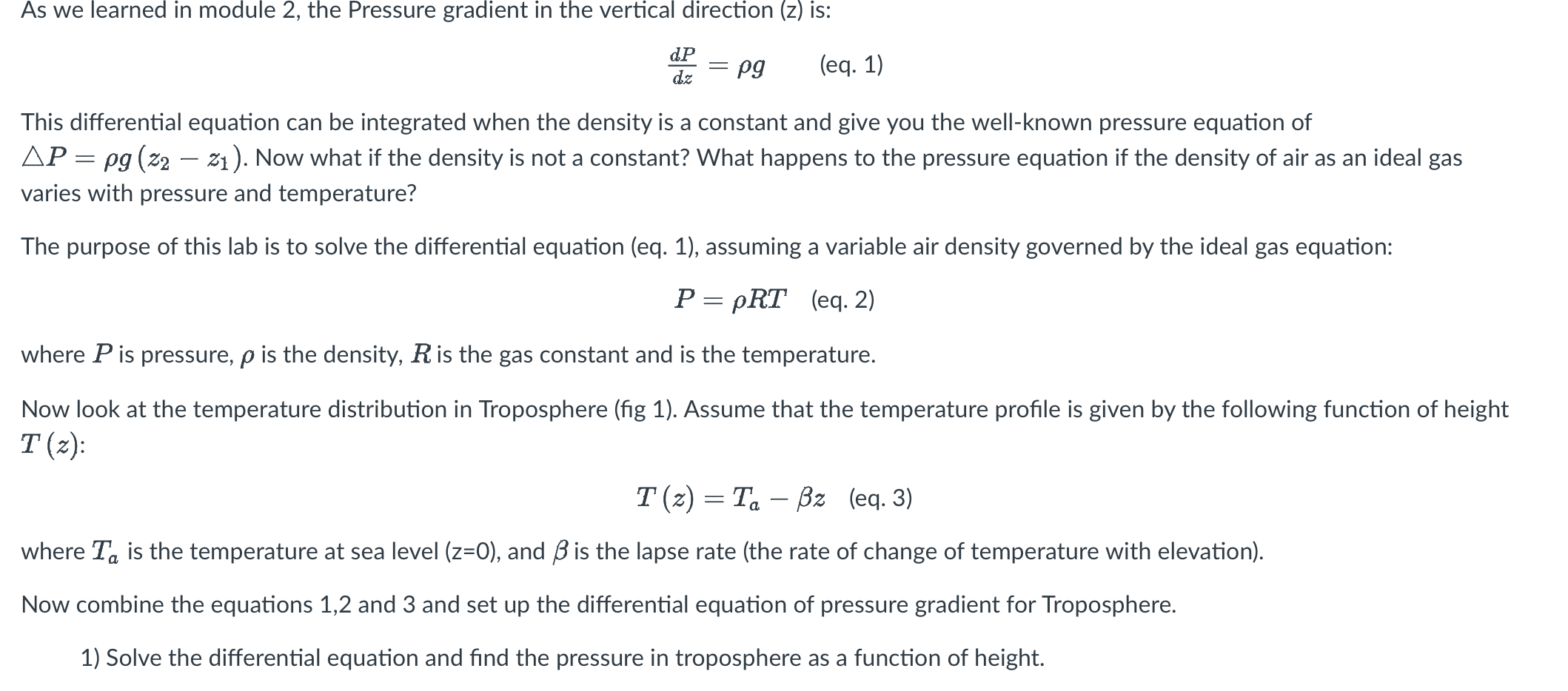
As we learned in module 2, the Pressure gradient in the vertical direction (2) is: P _ E pg (eq. 1) This differential equation can be integrated when the density is a constant and give you the well-known pressure equation of AP = pg (22 21). Now what if the density is not a constant? What happens to the pressure equation if the density of air as an ideal gas varies with pressure and temperature? The purpose of this lab is to solve the differential equation (eq. 1), assuming a variable air density governed by the ideal gas equation: P = pRT (eq. 2) where P is pressure, p is the density, R is the gas constant and is the temperature. Now look at the temperature distribution in Troposphere (g 1). Assume that the temperature prole is given by the following function of height T (z): T(z) = T\" z (eq. 3) where Ta is the temperature at sea level (z=O), and is the lapse rate (the rate of change of temperature with elevation). Now combine the equations 1,2 and 3 and set up the differential equation of pressure gradient for Troposphere. 1) Solve the differential equation and nd the pressure in troposphere as a function of height
Step by Step Solution
There are 3 Steps involved in it

Get step-by-step solutions from verified subject matter experts
 Study Help