







Question: Using matlab in part b please. 2. Couette flow Consider the flow between two flat plates. The top plate is moving at speed V, and
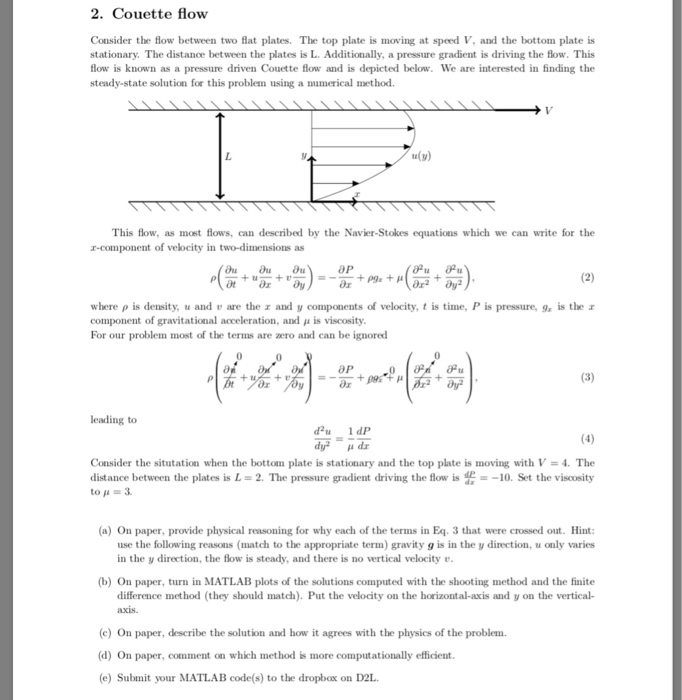
2. Couette flow Consider the flow between two flat plates. The top plate is moving at speed V, and the bottom plate is stationary. The distance between the plates is L. Additionally, a pressure gradient is driving the flow. This flow is known as a pressure driven Couette flow and is depicted below. We are interested in finding the steady-state solution for this problem using a numerical method uy) This flow, as most flows, can described by the Navier-Stokes equations which we can write for the r-component of velocity in two-dimensions as 2 ay where is density, u and u are the z and y components of velocity, t is tine, P is pressure 9, is the z component of gravitational acceleration, and is viscosity For our problem most of the terms are aero and can be ignored leading to du 1 dP Consider the situtation when the bottom plate is stationary and the top plate is moving with V-. The distance between the plates is L = 2. The pressure gradient driving the flow is =-10. Set the viscosity (a) On paper, provide physical reasoning for why each of the terms in Eq. 3 that were crossed out. Hint use the following reasons (match to the appropriate term) gravity g is in the y direction, u only varies in the y direction, the flow is steady, and there is no vertical velocitye (b) On paper, turn in MATLAB plots of the solutions computed with the shooting method and the finite difference method (they should match). Put the velocity on the horizontal-axis and y on the vertical axis. (c) On paper, describe the solution and how it agrees with the physics of the problem (d) On paper, comment on which method is more computationally efficient (e) Submit your MATLAB code(s) to the dropbox on D2L 2. Couette flow Consider the flow between two flat plates. The top plate is moving at speed V, and the bottom plate is stationary. The distance between the plates is L. Additionally, a pressure gradient is driving the flow. This flow is known as a pressure driven Couette flow and is depicted below. We are interested in finding the steady-state solution for this problem using a numerical method uy) This flow, as most flows, can described by the Navier-Stokes equations which we can write for the r-component of velocity in two-dimensions as 2 ay where is density, u and u are the z and y components of velocity, t is tine, P is pressure 9, is the z component of gravitational acceleration, and is viscosity For our problem most of the terms are aero and can be ignored leading to du 1 dP Consider the situtation when the bottom plate is stationary and the top plate is moving with V-. The distance between the plates is L = 2. The pressure gradient driving the flow is =-10. Set the viscosity (a) On paper, provide physical reasoning for why each of the terms in Eq. 3 that were crossed out. Hint use the following reasons (match to the appropriate term) gravity g is in the y direction, u only varies in the y direction, the flow is steady, and there is no vertical velocitye (b) On paper, turn in MATLAB plots of the solutions computed with the shooting method and the finite difference method (they should match). Put the velocity on the horizontal-axis and y on the vertical axis. (c) On paper, describe the solution and how it agrees with the physics of the problem (d) On paper, comment on which method is more computationally efficient (e) Submit your MATLAB code(s) to the dropbox on D2L
Step by Step Solution
There are 3 Steps involved in it

Get step-by-step solutions from verified subject matter experts
 Study Help