







Question: As you have learned from Chapter 3 in the book, filters are used to either block or pass certain radio frequencies. In transmitters, filters are
- As you have learned from Chapter 3 in the book, filters are used to either block or pass certain radio frequencies. In transmitters, filters are used to eliminate unwanted signals that are generated by the process of modulation. In a receiver, filters block unwanted signals and leave only the signals that will be used to decode and extract the data from.
- Mixers are primarily used in transmitters to combine the data signals with the carrier frequency that will be used to transmit the signal.
- Complete the diagrams below with the resulting output of the different radio system components.
- Remember to convert all numbers shown to the same representation (1,000 Hz = 1 KHz) to simplify calculations, help you to visualize the results, and prevent mistakes.
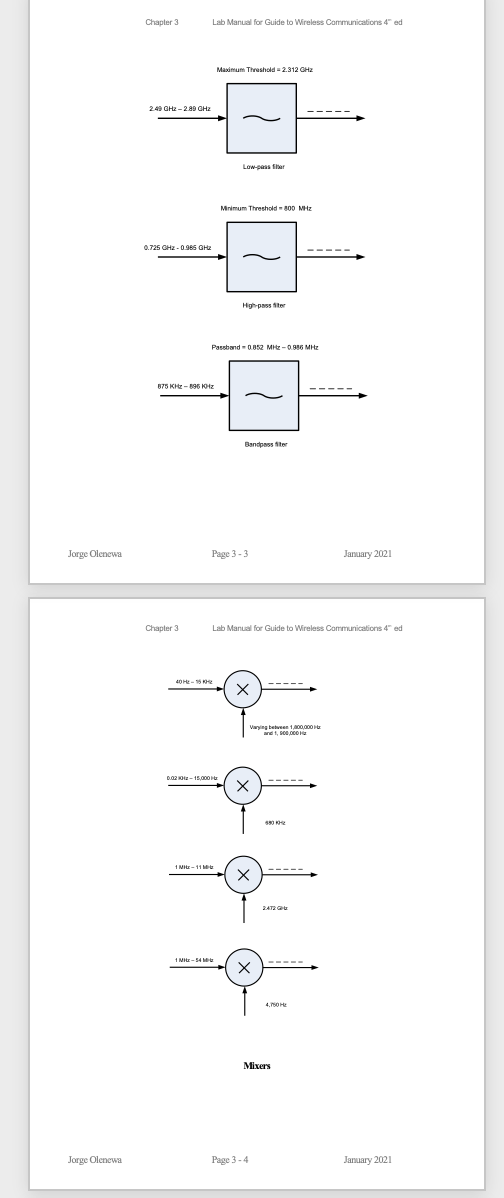
Chapter 3 Lab Manual for Guide to Wireless Communications 4" ed Maximum Threshold 2.312 GHz 249 GH2-2.89 GHz Lowcase Minimum Threshold 800 MHz 0.725 GHz - 0.965 GHz High-pass filter Passband - 0052 M2 -0.986 MHz 875 KH-1960 Bansonster Jorge Olenewa Page 3 - 3 January 2021 Chapter 3 Lab Manual for Guide to Wireless Communications 4" ed 40 HE Vwrying beves 100.000 and, 0.020-15.00 X 590 Mi-11 X 2.4T2G ME t - 54 4. POH Mixers Jorge Olenewa Page 3-4 January 2021 Chapter 3 Lab Manual for Guide to Wireless Communications 4" ed Maximum Threshold 2.312 GHz 249 GH2-2.89 GHz Lowcase Minimum Threshold 800 MHz 0.725 GHz - 0.965 GHz High-pass filter Passband - 0052 M2 -0.986 MHz 875 KH-1960 Bansonster Jorge Olenewa Page 3 - 3 January 2021 Chapter 3 Lab Manual for Guide to Wireless Communications 4" ed 40 HE Vwrying beves 100.000 and, 0.020-15.00 X 590 Mi-11 X 2.4T2G ME t - 54 4. POH Mixers Jorge Olenewa Page 3-4 January 2021
Step by Step Solution
There are 3 Steps involved in it

Get step-by-step solutions from verified subject matter experts
 Study Help