



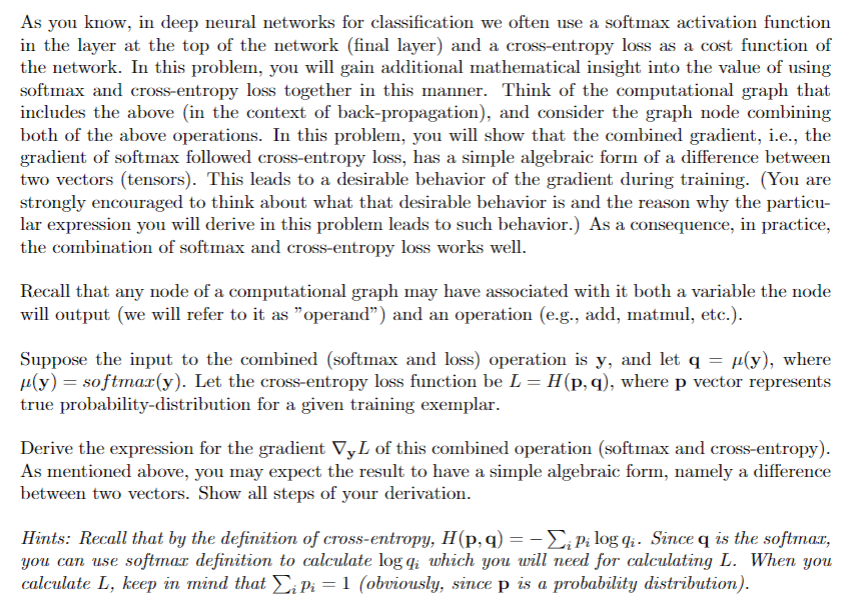
Question: As you know, in deep neural networks for classification we often use a softmax activation function in the layer at the top of the network
As you know, in deep neural networks for classification we often use a softmax activation function
in the layer at the top of the network final layer and a crossentropy loss as a cost function of
the network. In this problem, you will gain additional mathematical insight into the value of using
softmax and crossentropy loss together in this manner. Think of the computational graph that
includes the above in the context of backpropagation and consider the graph node combining
both of the above operations. In this problem, you will show that the combined gradient, ie the
gradient of softmax followed crossentropy loss, has a simple algebraic form of a difference between
two vectors tensors This leads to a desirable behavior of the gradient during training. You are
strongly encouraged to think about what that desirable behavior is and the reason why the particu
lar expression you will derive in this problem leads to such behavior. As a consequence, in practice,
the combination of softmax and crossentropy loss works well.
Recall that any node of a computational graph may have associated with it both a variable the node
will output we will refer to it as "operand" and an operation eg add, matmul, etc.
Suppose the input to the combined softmax and loss operation is and let where
softmax Let the crossentropy loss function be where vector represents
true probabilitydistribution for a given training exemplar.
Derive the expression for the gradient of this combined operation softmax and crossentropy
As mentioned above, you may expect the result to have a simple algebraic form, namely a difference
between two vectors. Show all steps of your derivation.
Hints: Recall that by the definition of crossentropy, Since is the softmax,
you can use softmax definition to calculate which you will need for calculating When you
calculate L keep in mind that obviously since is a probability distribution
Step by Step Solution
There are 3 Steps involved in it
1 Expert Approved Answer
Step: 1 Unlock

Question Has Been Solved by an Expert!
Get step-by-step solutions from verified subject matter experts
Step: 2 Unlock
Step: 3 Unlock