





Question: Question 3. Spring 2019 question 18: We will consider an artificial neural network (ANN) trained on the Urban Traffic dataset described in table 4 to
Question 3. Spring 2019 question 18: We willQuestion 3. Spring 2019 question 18: We willQuestion 3. Spring 2019 question 18: We will

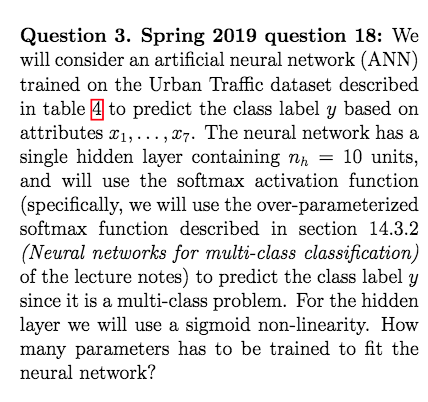
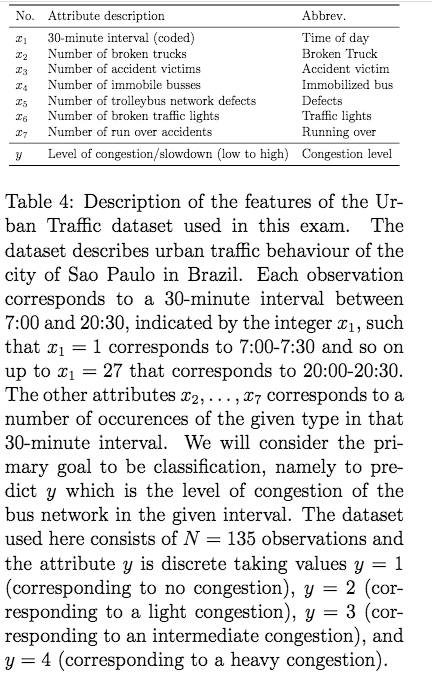
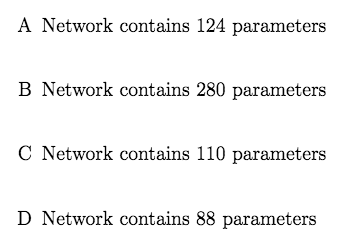
Question 3. Spring 2019 question 18: We will consider an artificial neural network (ANN) trained on the Urban Traffic dataset described in table 4 to predict the class label y based on attributes 21,..., 27. The neural network has a single hidden layer containing non = 10 units, and will use the softmax activation function (specifically, we will use the over-parameterized softmax function described in section 14.3.2 (Neural networks for multi-class classification) of the lecture notes) to predict the class label y since it is a multi-class problem. For the hidden layer we will use a sigmoid non-linearity. How many parameters has to be trained to fit the neural network? No. Attribute description Abbrev. 30-minute interval (coded) Time of day 22 Number of broken trucks Broken Truck Number of accident victims Accident victim Number of immobile busses Immobilized bus Number of trolleybus network defects Defects 26 Number of broken traffic lights Traffic lights Number of run over accidents Running over y Level of congestion/slowdown (low to high) Congestion level Table 4: Description of the features of the Ur- ban Traffic dataset used in this exam. The dataset describes urban traffic behaviour of the city of Sao Paulo in Brazil. Each observation corresponds to a 30-minute interval between 7:00 and 20:30, indicated by the integer 21, such that x1 = 1 corresponds to 7:00-7:30 and so on up to x1 = 27 that corresponds to 20:00-20:30. The other attributes 22, ...,27 corresponds to a number of occurences of the given type in that 30-minute interval. We will consider the pri- mary goal to be classification, namely to pre- dict y which is the level of congestion of the bus network in the given interval. The dataset used here consists of N = 135 observations and the attribute y is discrete taking values y = 1 (corresponding to no congestion), y = 2 (cor- responding to a light congestion), y = 3 (cor- responding to an intermediate congestion), and y=4 (corresponding to a heavy congestion). A Network contains 124 parameters B Network contains 280 parameters C Network contains 110 parameters D Network contains 88 parameters
Step by Step Solution

There are 3 Steps involved in it

1 Expert Approved Answer
Step: 1 Unlock blur-text-image

Question Has Been Solved by an Expert!

Get step-by-step solutions from verified subject matter experts

Step: 2 Unlock
Step: 3 Unlock

Students Have Also Explored These Related General Management Questions!