







Question: ASK YOUR TEACHER PRACTICE ANOTHER As shown in the figure below, cars # 1 and # 2 are sliding across a horiznntsl f - ictionless
ASK YOUR TEACHER
PRACTICE ANOTHER
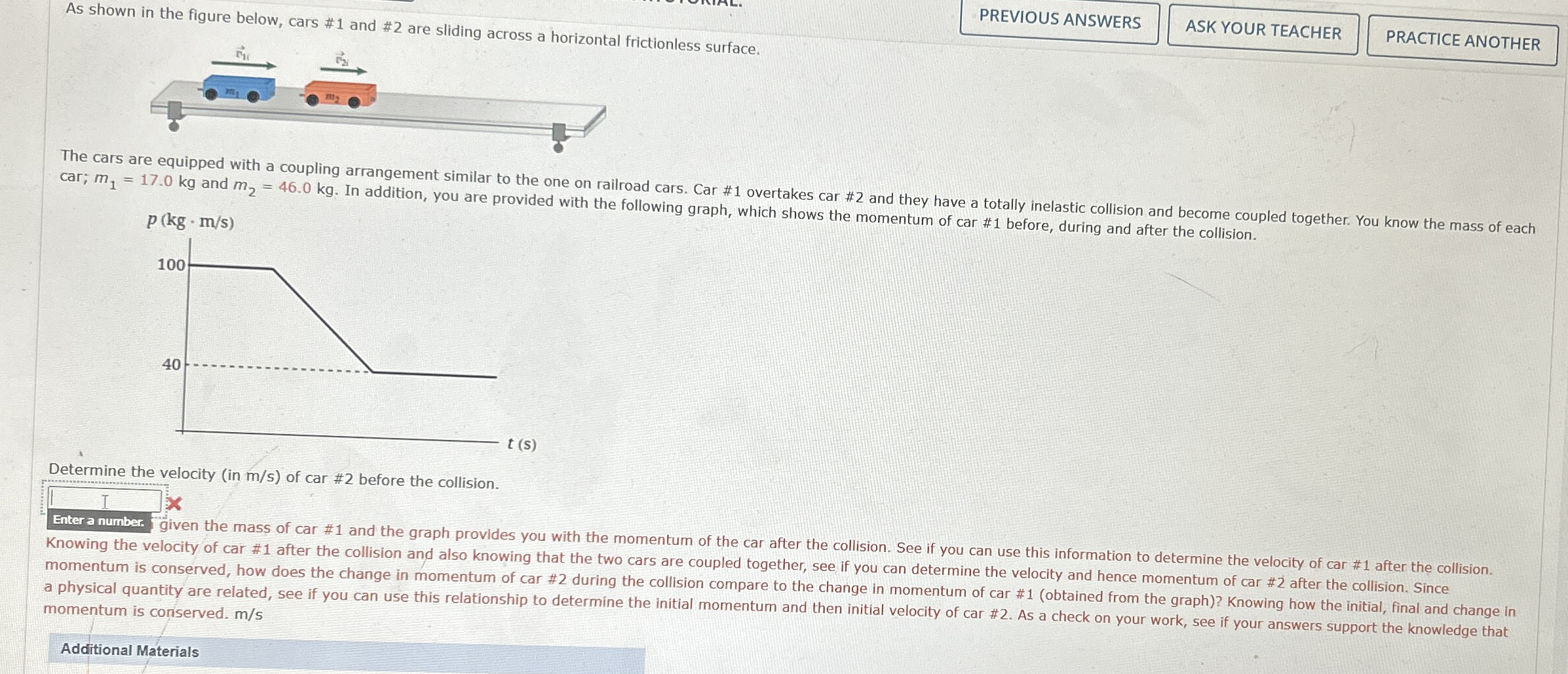
As shown in the figure below, cars # and # are sliding across a horiznntsl fictionless surface.
The cars are equipped with a coupling arrangement similar to the one on railroad cars. Car # overtakes car # and they have a totally inelastic collision and become coupled together. You know the mass of each car; and In addition, you are provided with the following graph, which shows the momentum of car # before, during and after the collision.
Determine the velocity in of car # before the collision.
Enter a number
given the mass of car # and the graph provides you with the momentum of the car after the collision. See if you can use this information to determine the velocity of car # after the collision. Knowing the velocity of car # after the collision and also knowing that the two cars are coupled together, see if you can determine the velocity and hence momentum of car # after the collision. Since momentum is conserved, how does the change in momentum of car # during the collision compare to the change in momentum of car #obtained from the graph Knowing how the initial, final and change in a physical quantity are related, see if you can use this relationship to determine the initial momentum and then initial velocity of car # As a check on your work, see if your answers support the knowledge that momentum is conserved.
Additional Materials
Step by Step Solution
There are 3 Steps involved in it
1 Expert Approved Answer
Step: 1 Unlock

Question Has Been Solved by an Expert!
Get step-by-step solutions from verified subject matter experts
Step: 2 Unlock
Step: 3 Unlock
 Study Help