







Question: Asking about how to figure out it. 2. Consider the following welfare program, designed to ensure that needy people get adequate income to buy food.
Asking about how to figure out it.
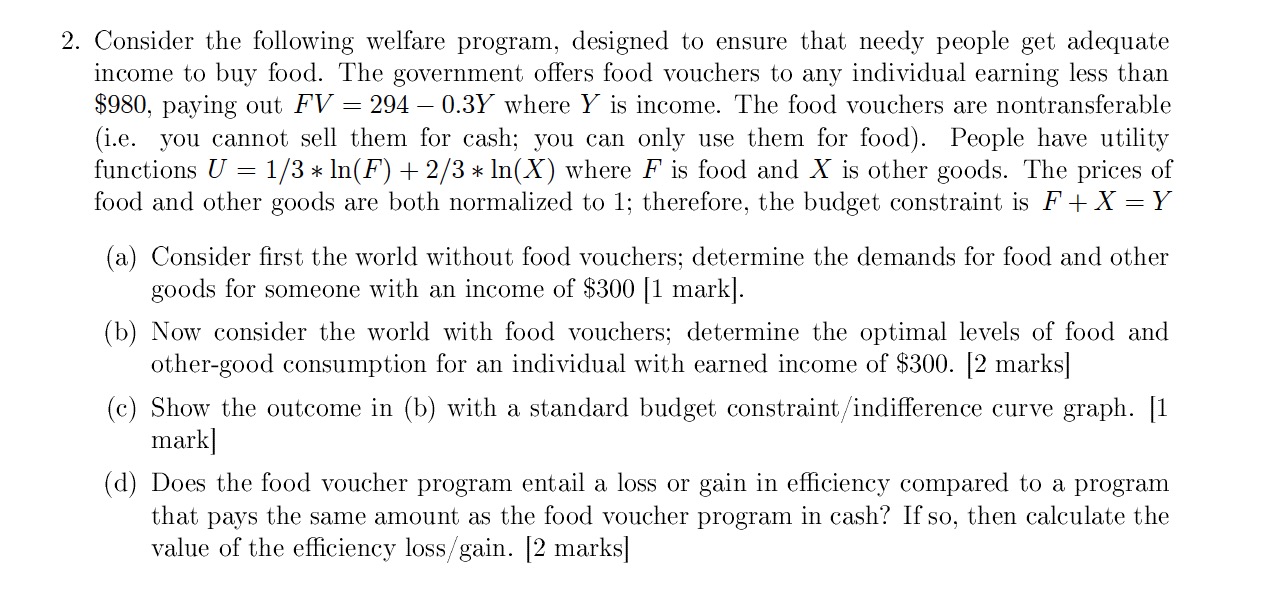
2. Consider the following welfare program, designed to ensure that needy people get adequate income to buy food. The government offers food vouchers to any individual earning less than $980, paying out F V : 294 0.3Y where Y is income. The food vouchers are nontransferable (i.e. you cannot sell them for cash; you can only use them for food]. People have utility functions U = 1/3 * ln(F) + 2/3 * 111(X) where F is food and X is other goods. The prices of food and other goods are both normalized to 1; therefore, the budget constraint is F + X : Y (a) Consider rst the world without food vouchers; determine the demands for food and other goods for someone with an income of $300 [1 mark]. (b) Now consider the world with food vouchers; determine the optimal levels of food and other-good consumption for an individual with earned income of $300. [2 marks] (c) Show the outcome in (b) with a standard budget constraint/ indifference curve graph. [1 mark] (d) Does the food voucher program entail a loss or gain in efciency compared to a program that pays the same amount as the food voucher program in cash? If so, then calculate the value of the efciency loss/ gain. [2 marks]
Step by Step Solution
There are 3 Steps involved in it

Get step-by-step solutions from verified subject matter experts
 Study Help