zoom in to read it better :)
QUESTION 1 WHAT PROBLEMS AND CHOICES WILL THE DIRECTORS BE FACED WITH IN DETERMINING THE NEW STRATEGIC DIRECTION OF THE YWCA?
QUESTION 2- IF IT IS DECIDED THAT THE YWCAS HEADQUARTERS WILL BE SOLD, WHAT EFFECT MIGHT THIS HAVE ON YWCAS REPUTATION AS A STRONG ESTABLISHED PROVIDER OF WOMENS SERVICES? WHAT THE ISSUES RELATED TO SELLING THE BUILDING? MAKING MINIMAL RENOVATIONS AND CONTINUING TO OPERATE AS USUAL?
QUESTION 3-PUT TOGETHER A SWOT ANALYSIS OF THE YWCA?
QUESTION 4- SHOULD THE YWCA REMAIN IN THE HEATH AND FITNESS BUSINESS?
QUESTION 5- WHAT FACTORS SHOULD BE CONSIDERED IN DECIDING IF THE YWCA SHOULD CONTINUE IN THE CHILD CARE BUSINESS?
QUESTION 6- DOES THE MANAGEMENT STRUCTURE OF THE YWCA APPEAR TO BE EFFECTIVE? WHAT CHANGES CAN BE MADE TO MAKE IT MORE EFFECTIVE?
please answer all question, or e mail me:
Lisbeth.herrera 135 @ gmail. com
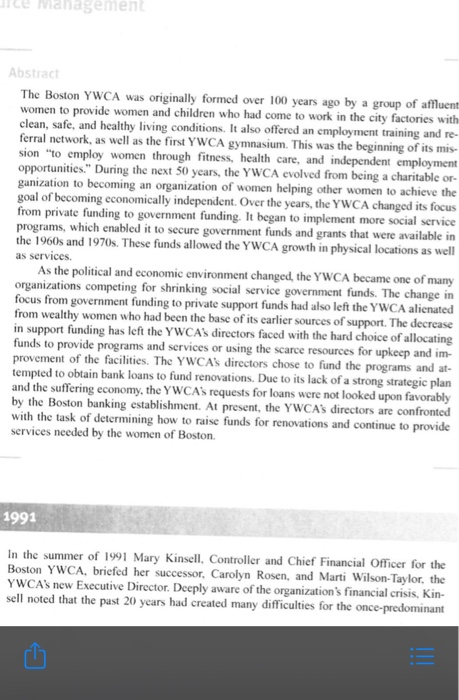
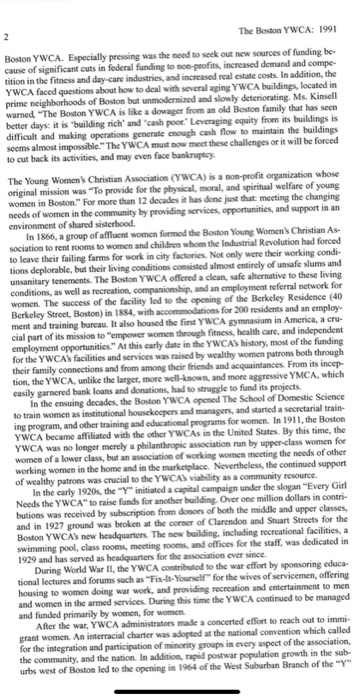
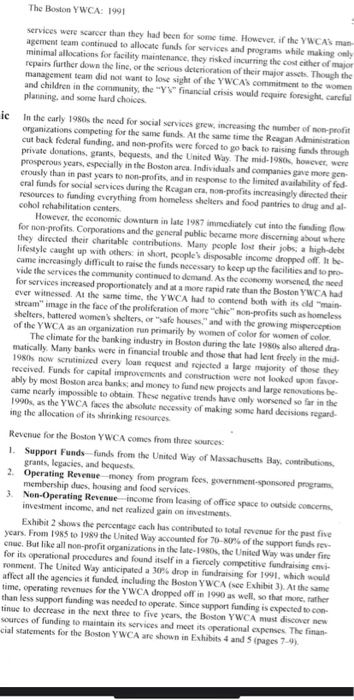
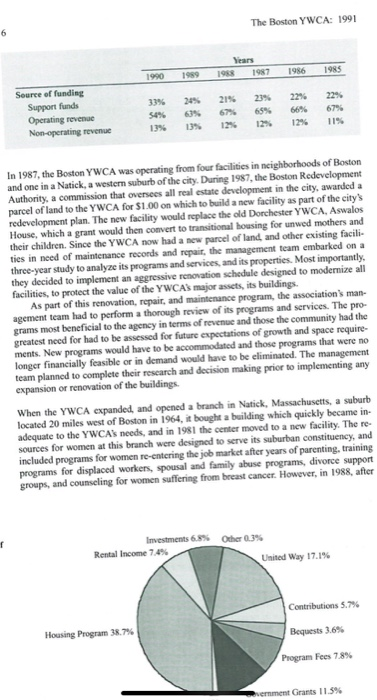
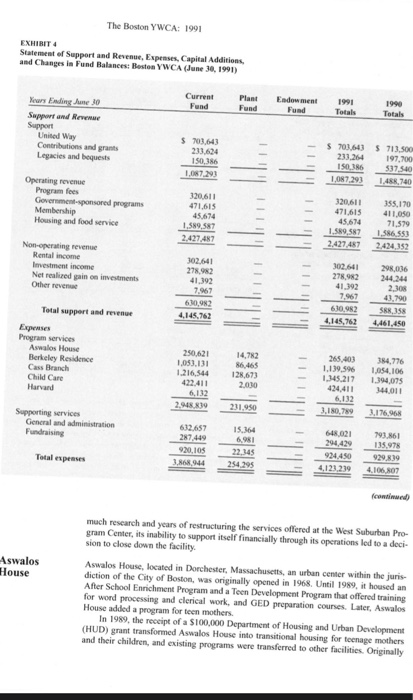
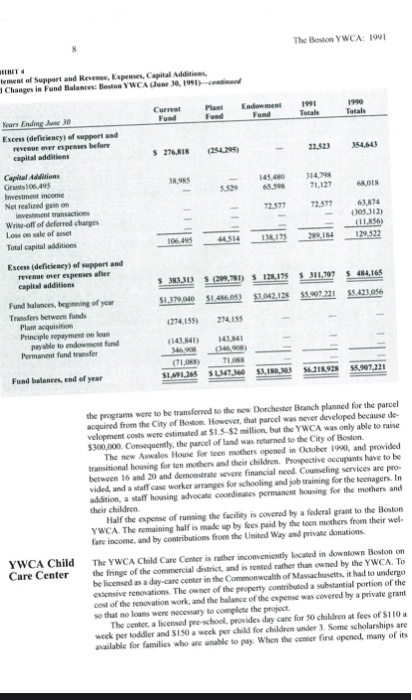
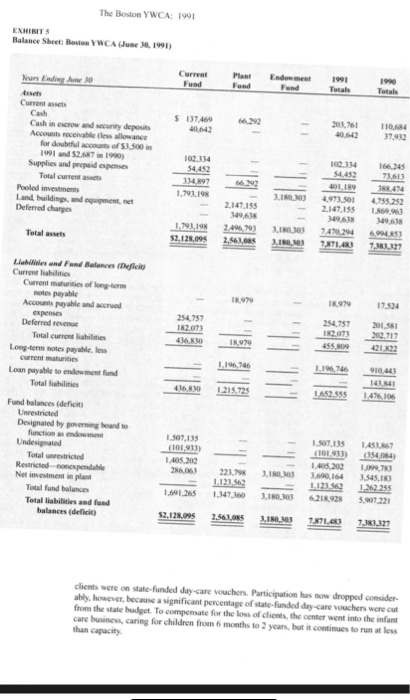
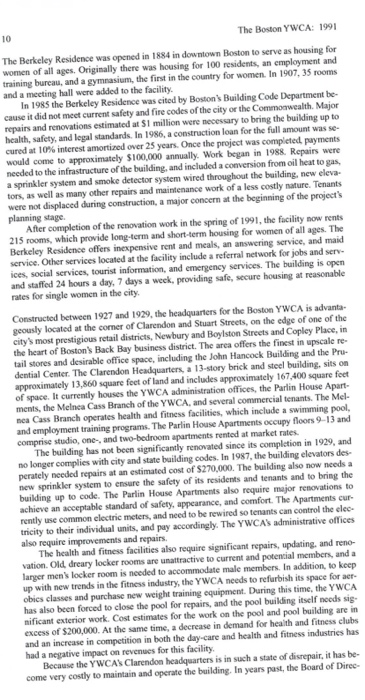
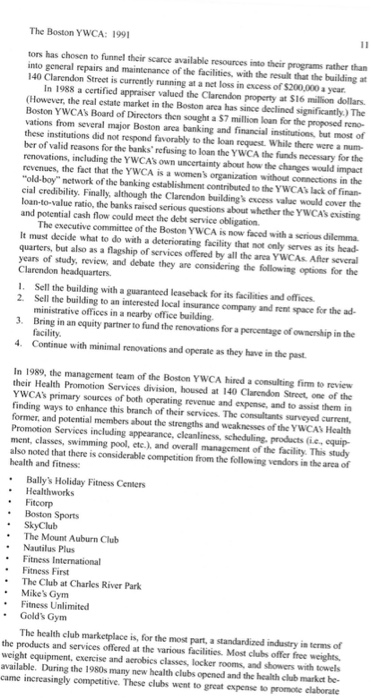
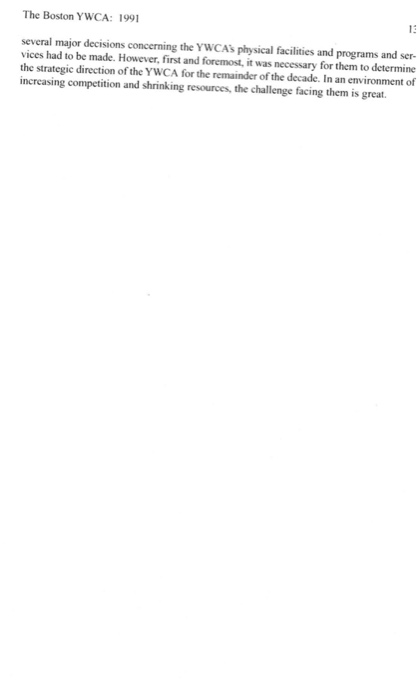
Management Abstract The Boston YWCA was originally formed over 100 years ago by a group of affluent women to provide women and children who had come to work in the city factories with clean, safe, and healthy living conditions. It also offered an employment training and re- ferral network, as well as the first YWCA gymnasium. This was the beginning of its mis- sion to employ women through fitness, health care, and independent employment opportunities." During the next 50 years, the YWCA evolved from being a charitable or ganization to becoming an organization of women helping other women to achieve the goal of becoming economically independent. Over the years, the YWCA changed its focus from private funding to government funding. It began to implement more social service programs, which enabled it to secure government funds and grants that were available in the 1960s and 1970s. These funds allowed the YWCA growth in physical locations as well as services. As the political and economic environment changed the YWCA became one of many organizations competing for shrinking social service government funds. The change in focus from government funding to private support funds had also left the YWCA alienated from wealthy women who had been the base of its earlier sources of support. The decrease in support funding has left the YWCAS directors faced with the hard choice of allocating funds to provide programs and services or using the scarce resources for upkeep and im- provement of the facilities. The YWCA's directors chose to fund the programs and at- tempted to obtain bank loans to fund renovations. Due to its lack of a strong strategic plan and the suffering economy, the YWCA's requests for loans were not looked upon favorably by the Boston banking establishment. At present, the YWCA's directors are confronted with the task of determining how to raise funds for renovations and continue to provide services needed by the women of Boston 1991 In the summer of 1991 Mary Kinsell, Controller and Chief Financial Officer for the Boston YWCA, briefed her successor, Carolyn Rosen, and Marti Wilson-Taylor, the YWCA's new Executive Director. Deeply aware of the organization's financial crisis, Kin- sell noted that the past 20 years had created many difficulties for the once-predominant 2 The Boston YWCA: 1991 Boston YWCA. Especially pressing was the need to seek out new sources of funding be- cause of significant cuts in federal funding to non-profits, increased demand and compe tition in the fitness and day-care industries, and increased real estate costs. In addition, the YWCA faced questions about how to deal with several aging YWCA buildings, located in prime neighborhoods of Boston but unmodernized and slowly deteriorating. Ms. Kinsell warned. "The Boston YWCA is like a dowager from an old Boston family that has seen better days: it is 'building rich and cash poor' Leveraging equity from its buildings is difficult and making operations generate enough cash flow to maintain the buildings seems almost impossible." The YWCA must now meet these challenges or it will be forced to cut back its activities, and may even face bankruptcy. The Young Women's Christian Association (YWCA) is a non-profit organization whose original mission was "To provide for the physical, moral, and spiritual welfare of young women in Boston." For more than 12 decades it has done just that meeting the changing needs of women in the community by providing services, opportunities, and support in an environment of shared sisterhood. In 1866, a group of affluent women formed the Boston Young Women's Christian As- sociation to rent rooms to women and children whom the Industrial Revolution had forced to leave their failing farms for work in city factories. Not only were their working condi tions deplorable, but their living conditions consisted almost entirely of unsafe slums and unsanitary tenements. The Boston YWCA offered a clean, safe alternative to these living conditions, as well as recreation, companionship, and an employment referral network for women. The success of the facility led to the opening of the Berkeley Residence (40 Berkeley Street, Boston) in 1884, with accommodations for 200 residents and an employ. ment and training bureau. It also housed the first YWCA gymnasium in America, a cru cial part of its mission to empower women through fitness, health care, and independent employment opportunities. At this early date in the YWCAS history, most of the funding for the YWCAS facilities and services was raised by wealthy women patrons both through their family connections and from among their friends and acquaintances. From its incep tion, the YWCA, unlike the larger, more well-known, and more aggressive YMCA, which casily garnered bank loans and donations, had to struggle to fund its projects. In the ensuing decades, the Boston YWCA opened The School of Domestie Science to train women as institutional housekeepers and managers, and started a secretarial train ing program, and other training and educational programs for women. In 1911, the Boston YWCA became affiliated with the other YWCAs in the United States. By this time, the YWCA was no longer merely a philanthropic association run by upper-class women for women of a lower class, but an association of working women meeting the needs of other working women in the home and in the marketplace. Nevertheless, the continued support of wealthy patrons was crucial to the YWCAS viability as a community resource. In the early 1920s, the "Y" initiated a capital campaign under the slogan "Every Girl Needs the YWCA"to raise funds for another building. Over one million dollars in contri- butions was received by subscription from donors of both the middle and upper classes, and in 1927 ground was broken at the corner of Clarendon and Stuart Streets for the Boston YWCAS new headquarters. The new building, including recreational facilities, a swimming pool, classrooms, meeting rooms, and offices for the staff, was dedicated in 1929 and has served as headquarters for the association ever since. During World War II, the YWCA contributed to the war effort by sponsoring educa- tional lectures and forums such as "Fix-It-Yourself for the wives of servicemen, offering housing to women doing war work, and providing recreation and entertainment to men and women in the armed services. During this time the YWCA continued to be managed and funded primarily by women, for women After the war, YWCA administrators made a concerted effort to reach out to immi- grant women. An interracial charter was adopted at the national convention which called for the integration and participation of minority groups in every aspect of the association, the community, and the nation. In addition, rapid postwar population growth in the sub- urbs west of Boston led to the opening in 1964 of the West Suburban Branch of the "Y" The Boston YWCA: 1991 services were scarcer than they had been for some time. However, if the YWCAS m agement team continued to allocate funds for services and programs while making only minimal allocations for facility maintenance, they risked incurring the cost either of major repairs further down the line of the serious deterioration of their major assets. Though the management team did not want to lose sight of the YWCAS commitment to the women and children in the community, the financial crisis would require foresight, careful planning, and some hard choices ic In the early 1980s the need for social services grew, increasing the number of non-profit organizations competing for the same funds. At the same time the Reagan Administration cut back federal funding, and non-profits were forced to go back to raising funds through private donations, grants, bequests, and the United Way. The mid-1980, however, were prosperous years, especially in the Boston area. Individuals and companies gave more gen- erously than in past years to non-profits, and in response to the limited availability of fed cral funds for social services during the Reagan era, non-profits increasingly directed their resources to funding everything from homeless shelters and food pantries to drug and al- cohol rehabilitation centers However, the economic downturn in late 1987 immediately cut into the funding flow for non-profits Corporations and the general public became more discerning about where they directed their charitable contributions. Many people lost their jobs a high-debe lifestyle caught up with others in short, people disposable income dropped off. It be came increasingly difficult to raise the funds necessary to keep up the facilities and to pro vide the services the community continued to demand. As the economy worsened the need for services increased proportionately and at a more rapid rate than the Boston YWCA had ever witnessed. At the same time, the YWCA had to contend both with its old man stream" image in the face of the proliferation of more "chic nonprofits such as homeless shelters, buttered women's shelters, or "afe houses and with the growing miperception of the YWCA as an organization run primarily by women of color for women of color The climate for the banking industry in Boston during the late 1980s also hered dir matically. Many banks were in financial trouble and those that had lent freely in the mid- 1980s now scrutinized every loan request and rejected a large majority of these they received. Funds for capital improvements and construction were not looked upon fare ably by most Boston arca banks, and money to fund new projects and large renovations be came nearly impossible to obtain. These negative trends have only worsened so far in the 1990s, as the YWCA faces the absolute necessity of making some hand decisions regard ing the allocation of its shrinking resources Revenue for the Boston YWCA comes from three sources 1. Support Fundsfunds from the United Way of Massachusetts Bay, contribution grants, legacies, and bequests 2. Operating Revenue money from program fees, government-sponsored programs membership dues, housing and food services 3. Non-Operating Revenue-income from Icasing of office space to outside concerns, investment income, and net realized gain on investments Exhibit 2 shows the percentage each has contributed to total revenue for the past five years. From 1985 to 1989 the United Way accounted for 70-80% of the support funds enue. But like all non-profit organizations in the late 1980s, the United Way was under fire for its operational procedures and found itself in a fiercely competitive fundraising cm. ronment. The United Way anticipated a 30% drop in fundraising for 1991, which would affect all the agencies it funded including the Boston YWCA (see Exhibit 3). At the same time, operating revenues for the YWCA dropped off in 1990 as well, so that more rather than less support funding was needed to operate. Since support funding is expected to con tinue to decrease in the next three to five years, the Boston YWCA must discover now sources of funding to maintain its services and meet its operational expenses. The finan cial statements for the Boston YWCA are shown in Exhibits 4 and 5 pages 7-9) The Boston YWCA: 1991 6 Sears 1988 1987 1990 1985 1989 1986 23% 22% 22% 67% Source of funding Support funds Operating revenue Non-operating revenue S4 13% 1296 In 1987, the Boston YWCA was operating from four facilities in neighborhoods of Boston and one in a Natick, a western suburb of the city. During 1987, the Boston Redevelopment Authority, a commission that oversees all real estate development in the city, awarded a parcel of land to the YWCA for $1.00 on which to build a new facility as part of the city's redevelopment plan. The new facility would replace the old Dorchester YWCA, Aswalos House, which a grant would then convert to transitional housing for unwed mothers and their children. Since the YWCA now had a new parcel of land, and other existing facili ties in need of maintenance records and repair, the management team embarked on a three-year study to analyze its programs and services, and its properties. Most importantly, they decided to implement an aggressive renovation schedule designed to modernize all facilities, to protect the value of the YWCAs major assets, its buildings. As part of this renovation, repair and maintenance program, the association's man- agement team had to perform a thorough review of its programs and services. The pro grams most beneficial to the agency in terms of revenue and those the community had the greatest need for had to be assessed for future expectations of growth and space require- ments. New programs would have to be accommodated and those programs that were no longer financially feasible or in demand would have to be eliminated. The management team planned to complete their research and decision making prior to implementing any expansion or renovation of the buildings. When the YWCA expanded, and opened a branch in Natick, Massachusetts, a suburb located 20 miles west of Boston in 1964, it bought a building which quickly became in- adequate to the YWCA's needs, and in 1981 the center moved to a new facility. The re- sources for women at this branch were designed to serve its suburban constituency, and included programs for women re-entering the job market after years of parenting, training programs for displaced workers, spousal and family abuse programs, divorce support groups, and counseling for women suffering from breast cancer. However, in 1988, after Other 0.3% f Investments 68% Rental Income 74% United Way 17.1% Contributions 5.7% Housing Program 38.7% Bequests 3.6% Program Fees 78% vernment Grants 11.5% The Boston YWCA: 1991 EXHIBIT 4 Statement of Support and Revenue Expenses. Capital Additions and Changes in Fund Balances: Boston YWCA (June 30, 1991) Current Fund Plant Fuad Endowment Fund 1991 Totals 1990 Totals Yours Ending June 30 Support and Revenue Support United Way Contributions and grants Legacies and baquests $ 703.643 233.624 150,386 1.087.29 $ 703,643 $ 713.500 233.254 197,700 190186 537.540 1,087.293 1.488,740 Operating revenue Program fees Government sponsored programs Membership Housing and food service 320611 471,615 45,674 1.589,587 2.427,487 320,611 471,615 45,674 1.589,587 2.427,487 355,170 411.050 71.579 1,586,553 2.424,352 Non-operating revenue Rental income Investment income Net realized gain on investments Other revenue 111 302.641 278.982 41.392 7.967 630,982 4,145,762 302.541 278,982 41.392 7,967 630,982 4,145,762 298,036 244.244 2.308 43.790 S88158 4,461.450 Total support and revenue Enses Program services Awalos House Berkeley Residence Cass Branch Child Care Harvard 250,621 1.053.131 1.216,544 422.411 6,132 2,948.8.10 14,782 86,465 128,673 2,030 265,403 1.1.39.596 1.345.217 424,411 384,776 1,054,106 1.394,075 344,011 231.950 3,180,789 3.176.968 Supporting services General and administration Fundraising 15,364 612.657 7.449 920,105 3.868 944 Total expenses 22.345 254 295 648 021 294,429 924.450 4.123.239 793,261 135,978 929.839 4.105.07 (conti Aswalos House much research and years of restructuring the services offered at the West Suburban Pro- gram Center, its inability to support itself financially through its operations led to a deci sion to close down the facility Aswalos House, located in Dorchester, Massachusetts, an urban center within the juris diction of the City of Boston, was originally opened in 1968. Until 1989, it housed an After School Enrichment Program and a Teen Development Program that offered training for word processing and clerical work, and GED preparation courses. Later, Aswalos House added a program for teen mothers In 1989, the receipt of a $100,000 Department of Housing and Urban Development (HUD) grant transformed Aswalos House into transitional housing for teenage mothers and their children, and existing programs were transferred to other facilities. Originally The Best YWCA: 1991 tement of Support and Revenue Expenses, Capital Additions, Changes in Fund Balances Boston YWCA (June 30, 1991) 1991 Current Fuad Endomment Fund Totals Fund Mars Ending 30 Excess deficiency of support and revenue mer expenses before capital additions 354.643 $ 276.18 38,95 3147 71.127 65 ES 72.577 72377 Capital Additions Gr106.495 Investment income Net realized pain on Wri-off of deferred charges Low on sale of asset Total capital additions 63,874 0305312) (11.856) 129522 106.495 14 20.154 1175 Excess (deficiency of support and remuner expenses after capital additions S 311.999 S484,165 $363.31) 5 (209.781) 5 128,175 $1,370.000 $1.06.03 $1,042.125 $5.007221 55.421056 (274.1353 214.155 Pund balances, beginning of your Transfers between funds Plant acquisition Principle repayment on loan payable to endowment fund Permanent fund transfer 14 Fund balances, end of year 51.41.365 SUM47.360 S3,180303 $6.318.938 $5.907221 the programs were to be transferred to the new Dorchester Branch planned for the parcel acquired from the City of Boston. However, that parcel was never developed because de velopment costs were estimated at $1$-$2 million, but the YWCA was only able to raise $300,000. Consequently, the parcel of land was returned to the City of Boston The new Aswales House for teen mothers opened in October 1990, and provided transitional housing for ten mothers and their children. Prospective occupants have to be between 16 and 20 and demonstrate severe financial need. Counseling services are pro vided, and a staff case worker arranges for schooling and job training for the teenagers. In addition, a staff housing advocate coordinates permanent housing for the mothers and their children Half the expense of running the facility is covered by a federal grant to the Boston YWCA. The remaining half is made up by fees paid by the teen mothers from their wel fure income, and by contributions from the United Way and private donations The YWCA Child Care Center is rather inconveniently located in downtown Boston on the fringe of the commercial district, and is rented rather than owned by the YWCA. To be licensed as a day care center in the Commonwealth of Massachusetts, it had to undergo extensive renovations. The owner of the property contributed a substantial portion of the cost of the renovation work, and the balance of the expense was covered by a private grant so that no loans were necessary to complete the project The center, a licensed pre-school provides day care for 50 children at fees of S110 a week per toddler and $150 a week per child for children under 3 Some scholarships are available for families who are unable to pay. When the center first opened many of its YWCA Child Care Center The Boston YWCA: 1991 EXHIBITS Balance Sheet: Best YWCA June 30, 1991) Kurs Edinme Current Fund Plant Fund 1991 Totals 1990 Totals $137.460 40,642 66.2 10.42 110,684 37932 Current as Cash Cash in escrow and security deposits Accounts receivable less allowance for doubtful of $3.300 Supplies and prepaid some Total Pooled investments Land buildings, and most met Deferred changes 102,334 54,452 334.97 1.793.198 166.245 73.613 3.10.103 10.334 54,452 401.189 4.973 501 2.147.155 349,633 7470294 7.871.483 2.147.155 349.638 2.496,793 2.561.08 1.793,198 $2,128.095 4.755.252 1.963 349,618 6994853 7.10.0.327 Total 3.1 103 3.10.13 12.90 18.979 17.524 254,757 182,073 436,830 254,757 182,073 4559 201.581 202.717 421 22 18,979 1.1946 1.195746 Liabilities and Fund Balance Current liabilities Current maurities of long-tom notes payable Accounts payable and accrued expenses Deferred revenue Total current liabilities Long-term notes payable, le current maurities Loan payable to endowment fund Total liabilities Fund balance deficit Unrestricted Designated by governing and to functions and Undesignated Total restricted Restricted opendable Net investment in plan Total fund balances Total liabilities and fund balances (deficit 910.44 141, 141 1.476106 41610 1215.725 1.452.555 1.507,135 (101913) 1.405.202 286,063 IND 223.796 1.121.562 1.347.360 1.507.135 101.933) 1.05.202 3.0.164 1.121562 621892 1.4567 (354.084 1,009,783 3.545.18 1.262.255 5.907.221 1.691.265 3.180,303 52.128.095 2.56,085 3.180.103 7.371.233 7.12327 clients were on state-funded day care vouchers. Participation has now dropped consider ably, however, because a significant percentage of state-funded day care vouchers were cut from the state budget. To compensate for the loss of clients, the center went into the infant care business caring for children from 6 months to 2 years, but it continues to run at less than capacity The Boston YWCA: 1991 10 The Berkeley Residence was opened in 1884 in downtown Boston to serve as housing for women of all ages. Originally there was housing for 100 residents, an employment and training burcau, and a gymnasium, the first in the country for women. In 1907, 35 rooms and a meeting hall were added to the facility In 1985 the Berkeley Residence was cited by Boston Building Code Department be- cause it did not meet current safety and fire codes of the city or the Commonwealth. Major repairs and renovations estimated at 1 million were necessary to bring the building up to health, safety, and legal standards. In 1986, a construction loan for the full amount was se- cured at 10% interest amortized over 25 years. Once the project was completed, payments would come to approximately $100,000 annually. Work began in 1988. Repairs were needed to the infrastructure of the building, and included a conversion from oil heat to gas, a sprinkler system and smoke detector system wired throughout the building, new eleva- tors, as well as many other repairs and maintenance work of a less costly nature. Tenants were not displaced during construction, a major concern at the beginning of the project's planning stage After completion of the renovation work in the spring of 1991, the facility now rents 215 rooms, which provide long-term and short-term housing for women of all ages. The Berkeley Residence offers inexpensive rent and meals, an answering service, and maid service. Other services located at the facility include a referral network for jobs and sery ices, social services, tourist information, and emergency services. The building is open and staffed 24 hours a day, 7 days a week, providing safe, secure housing at reasonable rates for single women in the city Constructed between 1927 and 1929, the headquarters for the Boston YWCA is advanta geously located at the comer of Clarendon and Stuart Streets, on the edge of one of the city's most prestigious retail districts, Newbury and Boylston Streets and Copley Place, in the heart of Boston's Back Bay business district. The area offers the finest in upscale re- tail stores and desirable office space, including the John Hancock Building and the Pru- dential Center. The Clarendon Headquarters, a 13-story brick and steel building, sits on approximately 13,860 square feet of land and includes approximately 167,400 square feet of space. It currently houses the YWCA administration offices, the Parlin House Apart ments, the Melnca Cass Branch of the YWCA, and several commercial tenants. The Mel- nea Cass Branch operates health and fitness facilities, which include a swimming pool, and employment training programs. The Parlin House Apartments occupy floors 9-13 and comprise studio, one, and two-bedroom apartments rented at market rates The building has not been significantly renovated since its completion in 1929, and no longer complies with city and state building codes. In 1987, the building elevators des perately needed repairs at an estimated cost of $270,000. The building also now needs a new sprinkler system to ensure the safety of its residents and tenants and to bring the building up to code. The Parlin House Apartments also require major renovations to achieve an acceptable standard of safety, appearance, and comfort. The Apartments cur rently use common electric meters, and need to be rewired so tenants can control the elec tricity to their individual units, and pay accordingly. The YWCAS administrative offices also require improvements and repairs. The health and fitness facilities also require significant repairs, updating, and reno- vation. Old, dreary locker rooms are unattractive to current and potential members, and a larger men's locker room is needed to accommodate male members. In addition, to keep up with new trends in the fitness industry, the YWCA needs to refurbish its space for aer obics classes and purchase now weight training equipment. During this time, the YWCA has also been forced to close the pool for repairs, and the pool building itself needs sig. nificant exterior work. Cost estimates for the work on the pool and pool building are in excess of $200,000. At the same time, a decrease in demand for health and fitness clubs and an increase in competition in both the day care and health and fitness industries has had a negative impact on revenues for this facility Because the YWCAS Clarendon headquarters is in such a state of disrepair, it has be- come very costly to maintain and operate the building. In years past, the Board of Diree The Boston YWCA: 1991 11 tors has chosen to funnel their scarce available resources into their programs rather than into general repairs and maintenance of the facilities, with the result that the building a 140 Clarendon Street is currently running at a met loss in crucess of $200,000 a year In 1988 a certified appraiser valued the Clarendon property at $16 million dollars. (However, the real estate market in the Boston area has since declined significantly.) The Boston YWCAS Board of Directors then sought a 57 million loan for the proposed reno vations from several major Boston area banking and financial institutions, but most of these institutions did not respond favorably to the loan request. While there were a num ber of valid reasons for the banks' refusing to loan the YWCA the funds necessary for the renovations, including the YWCA's own uncertainty about how the changes would impact revenues, the fact that the YWCA is a women's organization without connections in the "old-boy network of the banking establishment contributed to the YWCAS lack of finan cial credibility. Finally, although the Clarendon buildings excess value would cover the loan-to-value ratio, the banks raised serious questions about whether the YWCAS existing and potential cash flow could meet the debt service obligation The executive committee of the Boston YWCA is now faced with a scrious dilemma It must decide what to do with a deteriorating facility that not only serves as its head quarters, but also as a flagship of services offered by all the area YWCAS. After several years of study, review, and debate they are considering the following options for the Clarendon headquarters 1. Sell the building with a guaranteed leasehack for its facilities and offices 2 Sell the building to an interested local insurance company and rent space for the ad ministrative offices in a nearby office building 3. Bring in an equity partner to fund the renovations for a percentage of ownership in the 4. Continue with minimal renovations and operate as they have in the past. . In 1989, the management team of the Boston YWCA hired a consulting firm to review their Health Promotion Services division, housed at 140 Clarendon Street, one of the YWCAS primary sources of both operating revenue and expense, and to assist them in finding ways to enhance this branch of their services. The consultants surveyed current former, and potential members about the strengths and weaknesses of the YWCAS Health Promotion Services including appearance, cleanliness, scheduling, products (ie, equip ment, classes, swimming pool, etc.) and overall management of the facility. This study also noted that there is considerable competition from the following vendors in the area of health and fitness Bally's Holiday Fitness Centers Healthworks Fitcorp Boston Sports SkyClub The Mount Auburn Club Nautilus Plus Fitness International Fitness First The Club at Charles River Park Mike Gym Fitness Unlimited Gold's Gym The health club marketplace is for the most part, a standardized industry in terms of the products and services offered at the various facilities. Most clubs offer free weights weight equipment, exercise and aerobics classes, locker rooms and showers with towels available. During the 1980s many new health clubs opened and the health club market be- came increasingly competitive. These clubs went to great expense to promote elaborate The Boston YWCA: 1991 several major decisions concerning the YWCA's physical facilities and programs and ser- vices had to be made. However, first and foremost, it was necessary for them to determine the strategic direction of the YWCA for the remainder of the decade. In an environment of increasing competition and shrinking resources, the challenge facing them is great Management Abstract The Boston YWCA was originally formed over 100 years ago by a group of affluent women to provide women and children who had come to work in the city factories with clean, safe, and healthy living conditions. It also offered an employment training and re- ferral network, as well as the first YWCA gymnasium. This was the beginning of its mis- sion to employ women through fitness, health care, and independent employment opportunities." During the next 50 years, the YWCA evolved from being a charitable or ganization to becoming an organization of women helping other women to achieve the goal of becoming economically independent. Over the years, the YWCA changed its focus from private funding to government funding. It began to implement more social service programs, which enabled it to secure government funds and grants that were available in the 1960s and 1970s. These funds allowed the YWCA growth in physical locations as well as services. As the political and economic environment changed the YWCA became one of many organizations competing for shrinking social service government funds. The change in focus from government funding to private support funds had also left the YWCA alienated from wealthy women who had been the base of its earlier sources of support. The decrease in support funding has left the YWCAS directors faced with the hard choice of allocating funds to provide programs and services or using the scarce resources for upkeep and im- provement of the facilities. The YWCA's directors chose to fund the programs and at- tempted to obtain bank loans to fund renovations. Due to its lack of a strong strategic plan and the suffering economy, the YWCA's requests for loans were not looked upon favorably by the Boston banking establishment. At present, the YWCA's directors are confronted with the task of determining how to raise funds for renovations and continue to provide services needed by the women of Boston 1991 In the summer of 1991 Mary Kinsell, Controller and Chief Financial Officer for the Boston YWCA, briefed her successor, Carolyn Rosen, and Marti Wilson-Taylor, the YWCA's new Executive Director. Deeply aware of the organization's financial crisis, Kin- sell noted that the past 20 years had created many difficulties for the once-predominant 2 The Boston YWCA: 1991 Boston YWCA. Especially pressing was the need to seek out new sources of funding be- cause of significant cuts in federal funding to non-profits, increased demand and compe tition in the fitness and day-care industries, and increased real estate costs. In addition, the YWCA faced questions about how to deal with several aging YWCA buildings, located in prime neighborhoods of Boston but unmodernized and slowly deteriorating. Ms. Kinsell warned. "The Boston YWCA is like a dowager from an old Boston family that has seen better days: it is 'building rich and cash poor' Leveraging equity from its buildings is difficult and making operations generate enough cash flow to maintain the buildings seems almost impossible." The YWCA must now meet these challenges or it will be forced to cut back its activities, and may even face bankruptcy. The Young Women's Christian Association (YWCA) is a non-profit organization whose original mission was "To provide for the physical, moral, and spiritual welfare of young women in Boston." For more than 12 decades it has done just that meeting the changing needs of women in the community by providing services, opportunities, and support in an environment of shared sisterhood. In 1866, a group of affluent women formed the Boston Young Women's Christian As- sociation to rent rooms to women and children whom the Industrial Revolution had forced to leave their failing farms for work in city factories. Not only were their working condi tions deplorable, but their living conditions consisted almost entirely of unsafe slums and unsanitary tenements. The Boston YWCA offered a clean, safe alternative to these living conditions, as well as recreation, companionship, and an employment referral network for women. The success of the facility led to the opening of the Berkeley Residence (40 Berkeley Street, Boston) in 1884, with accommodations for 200 residents and an employ. ment and training bureau. It also housed the first YWCA gymnasium in America, a cru cial part of its mission to empower women through fitness, health care, and independent employment opportunities. At this early date in the YWCAS history, most of the funding for the YWCAS facilities and services was raised by wealthy women patrons both through their family connections and from among their friends and acquaintances. From its incep tion, the YWCA, unlike the larger, more well-known, and more aggressive YMCA, which casily garnered bank loans and donations, had to struggle to fund its projects. In the ensuing decades, the Boston YWCA opened The School of Domestie Science to train women as institutional housekeepers and managers, and started a secretarial train ing program, and other training and educational programs for women. In 1911, the Boston YWCA became affiliated with the other YWCAs in the United States. By this time, the YWCA was no longer merely a philanthropic association run by upper-class women for women of a lower class, but an association of working women meeting the needs of other working women in the home and in the marketplace. Nevertheless, the continued support of wealthy patrons was crucial to the YWCAS viability as a community resource. In the early 1920s, the "Y" initiated a capital campaign under the slogan "Every Girl Needs the YWCA"to raise funds for another building. Over one million dollars in contri- butions was received by subscription from donors of both the middle and upper classes, and in 1927 ground was broken at the corner of Clarendon and Stuart Streets for the Boston YWCAS new headquarters. The new building, including recreational facilities, a swimming pool, classrooms, meeting rooms, and offices for the staff, was dedicated in 1929 and has served as headquarters for the association ever since. During World War II, the YWCA contributed to the war effort by sponsoring educa- tional lectures and forums such as "Fix-It-Yourself for the wives of servicemen, offering housing to women doing war work, and providing recreation and entertainment to men and women in the armed services. During this time the YWCA continued to be managed and funded primarily by women, for women After the war, YWCA administrators made a concerted effort to reach out to immi- grant women. An interracial charter was adopted at the national convention which called for the integration and participation of minority groups in every aspect of the association, the community, and the nation. In addition, rapid postwar population growth in the sub- urbs west of Boston led to the opening in 1964 of the West Suburban Branch of the "Y" The Boston YWCA: 1991 services were scarcer than they had been for some time. However, if the YWCAS m agement team continued to allocate funds for services and programs while making only minimal allocations for facility maintenance, they risked incurring the cost either of major repairs further down the line of the serious deterioration of their major assets. Though the management team did not want to lose sight of the YWCAS commitment to the women and children in the community, the financial crisis would require foresight, careful planning, and some hard choices ic In the early 1980s the need for social services grew, increasing the number of non-profit organizations competing for the same funds. At the same time the Reagan Administration cut back federal funding, and non-profits were forced to go back to raising funds through private donations, grants, bequests, and the United Way. The mid-1980, however, were prosperous years, especially in the Boston area. Individuals and companies gave more gen- erously than in past years to non-profits, and in response to the limited availability of fed cral funds for social services during the Reagan era, non-profits increasingly directed their resources to funding everything from homeless shelters and food pantries to drug and al- cohol rehabilitation centers However, the economic downturn in late 1987 immediately cut into the funding flow for non-profits Corporations and the general public became more discerning about where they directed their charitable contributions. Many people lost their jobs a high-debe lifestyle caught up with others in short, people disposable income dropped off. It be came increasingly difficult to raise the funds necessary to keep up the facilities and to pro vide the services the community continued to demand. As the economy worsened the need for services increased proportionately and at a more rapid rate than the Boston YWCA had ever witnessed. At the same time, the YWCA had to contend both with its old man stream" image in the face of the proliferation of more "chic nonprofits such as homeless shelters, buttered women's shelters, or "afe houses and with the growing miperception of the YWCA as an organization run primarily by women of color for women of color The climate for the banking industry in Boston during the late 1980s also hered dir matically. Many banks were in financial trouble and those that had lent freely in the mid- 1980s now scrutinized every loan request and rejected a large majority of these they received. Funds for capital improvements and construction were not looked upon fare ably by most Boston arca banks, and money to fund new projects and large renovations be came nearly impossible to obtain. These negative trends have only worsened so far in the 1990s, as the YWCA faces the absolute necessity of making some hand decisions regard ing the allocation of its shrinking resources Revenue for the Boston YWCA comes from three sources 1. Support Fundsfunds from the United Way of Massachusetts Bay, contribution grants, legacies, and bequests 2. Operating Revenue money from program fees, government-sponsored programs membership dues, housing and food services 3. Non-Operating Revenue-income from Icasing of office space to outside concerns, investment income, and net realized gain on investments Exhibit 2 shows the percentage each has contributed to total revenue for the past five years. From 1985 to 1989 the United Way accounted for 70-80% of the support funds enue. But like all non-profit organizations in the late 1980s, the United Way was under fire for its operational procedures and found itself in a fiercely competitive fundraising cm. ronment. The United Way anticipated a 30% drop in fundraising for 1991, which would affect all the agencies it funded including the Boston YWCA (see Exhibit 3). At the same time, operating revenues for the YWCA dropped off in 1990 as well, so that more rather than less support funding was needed to operate. Since support funding is expected to con tinue to decrease in the next three to five years, the Boston YWCA must discover now sources of funding to maintain its services and meet its operational expenses. The finan cial statements for the Boston YWCA are shown in Exhibits 4 and 5 pages 7-9) The Boston YWCA: 1991 6 Sears 1988 1987 1990 1985 1989 1986 23% 22% 22% 67% Source of funding Support funds Operating revenue Non-operating revenue S4 13% 1296 In 1987, the Boston YWCA was operating from four facilities in neighborhoods of Boston and one in a Natick, a western suburb of the city. During 1987, the Boston Redevelopment Authority, a commission that oversees all real estate development in the city, awarded a parcel of land to the YWCA for $1.00 on which to build a new facility as part of the city's redevelopment plan. The new facility would replace the old Dorchester YWCA, Aswalos House, which a grant would then convert to transitional housing for unwed mothers and their children. Since the YWCA now had a new parcel of land, and other existing facili ties in need of maintenance records and repair, the management team embarked on a three-year study to analyze its programs and services, and its properties. Most importantly, they decided to implement an aggressive renovation schedule designed to modernize all facilities, to protect the value of the YWCAs major assets, its buildings. As part of this renovation, repair and maintenance program, the association's man- agement team had to perform a thorough review of its programs and services. The pro grams most beneficial to the agency in terms of revenue and those the community had the greatest need for had to be assessed for future expectations of growth and space require- ments. New programs would have to be accommodated and those programs that were no longer financially feasible or in demand would have to be eliminated. The management team planned to complete their research and decision making prior to implementing any expansion or renovation of the buildings. When the YWCA expanded, and opened a branch in Natick, Massachusetts, a suburb located 20 miles west of Boston in 1964, it bought a building which quickly became in- adequate to the YWCA's needs, and in 1981 the center moved to a new facility. The re- sources for women at this branch were designed to serve its suburban constituency, and included programs for women re-entering the job market after years of parenting, training programs for displaced workers, spousal and family abuse programs, divorce support groups, and counseling for women suffering from breast cancer. However, in 1988, after Other 0.3% f Investments 68% Rental Income 74% United Way 17.1% Contributions 5.7% Housing Program 38.7% Bequests 3.6% Program Fees 78% vernment Grants 11.5% The Boston YWCA: 1991 EXHIBIT 4 Statement of Support and Revenue Expenses. Capital Additions and Changes in Fund Balances: Boston YWCA (June 30, 1991) Current Fund Plant Fuad Endowment Fund 1991 Totals 1990 Totals Yours Ending June 30 Support and Revenue Support United Way Contributions and grants Legacies and baquests $ 703.643 233.624 150,386 1.087.29 $ 703,643 $ 713.500 233.254 197,700 190186 537.540 1,087.293 1.488,740 Operating revenue Program fees Government sponsored programs Membership Housing and food service 320611 471,615 45,674 1.589,587 2.427,487 320,611 471,615 45,674 1.589,587 2.427,487 355,170 411.050 71.579 1,586,553 2.424,352 Non-operating revenue Rental income Investment income Net realized gain on investments Other revenue 111 302.641 278.982 41.392 7.967 630,982 4,145,762 302.541 278,982 41.392 7,967 630,982 4,145,762 298,036 244.244 2.308 43.790 S88158 4,461.450 Total support and revenue Enses Program services Awalos House Berkeley Residence Cass Branch Child Care Harvard 250,621 1.053.131 1.216,544 422.411 6,132 2,948.8.10 14,782 86,465 128,673 2,030 265,403 1.1.39.596 1.345.217 424,411 384,776 1,054,106 1.394,075 344,011 231.950 3,180,789 3.176.968 Supporting services General and administration Fundraising 15,364 612.657 7.449 920,105 3.868 944 Total expenses 22.345 254 295 648 021 294,429 924.450 4.123.239 793,261 135,978 929.839 4.105.07 (conti Aswalos House much research and years of restructuring the services offered at the West Suburban Pro- gram Center, its inability to support itself financially through its operations led to a deci sion to close down the facility Aswalos House, located in Dorchester, Massachusetts, an urban center within the juris diction of the City of Boston, was originally opened in 1968. Until 1989, it housed an After School Enrichment Program and a Teen Development Program that offered training for word processing and clerical work, and GED preparation courses. Later, Aswalos House added a program for teen mothers In 1989, the receipt of a $100,000 Department of Housing and Urban Development (HUD) grant transformed Aswalos House into transitional housing for teenage mothers and their children, and existing programs were transferred to other facilities. Originally The Best YWCA: 1991 tement of Support and Revenue Expenses, Capital Additions, Changes in Fund Balances Boston YWCA (June 30, 1991) 1991 Current Fuad Endomment Fund Totals Fund Mars Ending 30 Excess deficiency of support and revenue mer expenses before capital additions 354.643 $ 276.18 38,95 3147 71.127 65 ES 72.577 72377 Capital Additions Gr106.495 Investment income Net realized pain on Wri-off of deferred charges Low on sale of asset Total capital additions 63,874 0305312) (11.856) 129522 106.495 14 20.154 1175 Excess (deficiency of support and remuner expenses after capital additions S 311.999 S484,165 $363.31) 5 (209.781) 5 128,175 $1,370.000 $1.06.03 $1,042.125 $5.007221 55.421056 (274.1353 214.155 Pund balances, beginning of your Transfers between funds Plant acquisition Principle repayment on loan payable to endowment fund Permanent fund transfer 14 Fund balances, end of year 51.41.365 SUM47.360 S3,180303 $6.318.938 $5.907221 the programs were to be transferred to the new Dorchester Branch planned for the parcel acquired from the City of Boston. However, that parcel was never developed because de velopment costs were estimated at $1$-$2 million, but the YWCA was only able to raise $300,000. Consequently, the parcel of land was returned to the City of Boston The new Aswales House for teen mothers opened in October 1990, and provided transitional housing for ten mothers and their children. Prospective occupants have to be between 16 and 20 and demonstrate severe financial need. Counseling services are pro vided, and a staff case worker arranges for schooling and job training for the teenagers. In addition, a staff housing advocate coordinates permanent housing for the mothers and their children Half the expense of running the facility is covered by a federal grant to the Boston YWCA. The remaining half is made up by fees paid by the teen mothers from their wel fure income, and by contributions from the United Way and private donations The YWCA Child Care Center is rather inconveniently located in downtown Boston on the fringe of the commercial district, and is rented rather than owned by the YWCA. To be licensed as a day care center in the Commonwealth of Massachusetts, it had to undergo extensive renovations. The owner of the property contributed a substantial portion of the cost of the renovation work, and the balance of the expense was covered by a private grant so that no loans were necessary to complete the project The center, a licensed pre-school provides day care for 50 children at fees of S110 a week per toddler and $150 a week per child for children under 3 Some scholarships are available for families who are unable to pay. When the center first opened many of its YWCA Child Care Center The Boston YWCA: 1991 EXHIBITS Balance Sheet: Best YWCA June 30, 1991) Kurs Edinme Current Fund Plant Fund 1991 Totals 1990 Totals $137.460 40,642 66.2 10.42 110,684 37932 Current as Cash Cash in escrow and security deposits Accounts receivable less allowance for doubtful of $3.300 Supplies and prepaid some Total Pooled investments Land buildings, and most met Deferred changes 102,334 54,452 334.97 1.793.198 166.245 73.613 3.10.103 10.334 54,452 401.189 4.973 501 2.147.155 349,633 7470294 7.871.483 2.147.155 349.638 2.496,793 2.561.08 1.793,198 $2,128.095 4.755.252 1.963 349,618 6994853 7.10.0.327 Total 3.1 103 3.10.13 12.90 18.979 17.524 254,757 182,073 436,830 254,757 182,073 4559 201.581 202.717 421 22 18,979 1.1946 1.195746 Liabilities and Fund Balance Current liabilities Current maurities of long-tom notes payable Accounts payable and accrued expenses Deferred revenue Total current liabilities Long-term notes payable, le current maurities Loan payable to endowment fund Total liabilities Fund balance deficit Unrestricted Designated by governing and to functions and Undesignated Total restricted Restricted opendable Net investment in plan Total fund balances Total liabilities and fund balances (deficit 910.44 141, 141 1.476106 41610 1215.725 1.452.555 1.507,135 (101913) 1.405.202 286,063 IND 223.796 1.121.562 1.347.360 1.507.135 101.933) 1.05.202 3.0.164 1.121562 621892 1.4567 (354.084 1,009,783 3.545.18 1.262.255 5.907.221 1.691.265 3.180,303 52.128.095 2.56,085 3.180.103 7.371.233 7.12327 clients were on state-funded day care vouchers. Participation has now dropped consider ably, however, because a significant percentage of state-funded day care vouchers were cut from the state budget. To compensate for the loss of clients, the center went into the infant care business caring for children from 6 months to 2 years, but it continues to run at less than capacity The Boston YWCA: 1991 10 The Berkeley Residence was opened in 1884 in downtown Boston to serve as housing for women of all ages. Originally there was housing for 100 residents, an employment and training burcau, and a gymnasium, the first in the country for women. In 1907, 35 rooms and a meeting hall were added to the facility In 1985 the Berkeley Residence was cited by Boston Building Code Department be- cause it did not meet current safety and fire codes of the city or the Commonwealth. Major repairs and renovations estimated at 1 million were necessary to bring the building up to health, safety, and legal standards. In 1986, a construction loan for the full amount was se- cured at 10% interest amortized over 25 years. Once the project was completed, payments would come to approximately $100,000 annually. Work began in 1988. Repairs were needed to the infrastructure of the building, and included a conversion from oil heat to gas, a sprinkler system and smoke detector system wired throughout the building, new eleva- tors, as well as many other repairs and maintenance work of a less costly nature. Tenants were not displaced during construction, a major concern at the beginning of the project's planning stage After completion of the renovation work in the spring of 1991, the facility now rents 215 rooms, which provide long-term and short-term housing for women of all ages. The Berkeley Residence offers inexpensive rent and meals, an answering service, and maid service. Other services located at the facility include a referral network for jobs and sery ices, social services, tourist information, and emergency services. The building is open and staffed 24 hours a day, 7 days a week, providing safe, secure housing at reasonable rates for single women in the city Constructed between 1927 and 1929, the headquarters for the Boston YWCA is advanta geously located at the comer of Clarendon and Stuart Streets, on the edge of one of the city's most prestigious retail districts, Newbury and Boylston Streets and Copley Place, in the heart of Boston's Back Bay business district. The area offers the finest in upscale re- tail stores and desirable office space, including the John Hancock Building and the Pru- dential Center. The Clarendon Headquarters, a 13-story brick and steel building, sits on approximately 13,860 square feet of land and includes approximately 167,400 square feet of space. It currently houses the YWCA administration offices, the Parlin House Apart ments, the Melnca Cass Branch of the YWCA, and several commercial tenants. The Mel- nea Cass Branch operates health and fitness facilities, which include a swimming pool, and employment training programs. The Parlin House Apartments occupy floors 9-13 and comprise studio, one, and two-bedroom apartments rented at market rates The building has not been significantly renovated since its completion in 1929, and no longer complies with city and state building codes. In 1987, the building elevators des perately needed repairs at an estimated cost of $270,000. The building also now needs a new sprinkler system to ensure the safety of its residents and tenants and to bring the building up to code. The Parlin House Apartments also require major renovations to achieve an acceptable standard of safety, appearance, and comfort. The Apartments cur rently use common electric meters, and need to be rewired so tenants can control the elec tricity to their individual units, and pay accordingly. The YWCAS administrative offices also require improvements and repairs. The health and fitness facilities also require significant repairs, updating, and reno- vation. Old, dreary locker rooms are unattractive to current and potential members, and a larger men's locker room is needed to accommodate male members. In addition, to keep up with new trends in the fitness industry, the YWCA needs to refurbish its space for aer obics classes and purchase now weight training equipment. During this time, the YWCA has also been forced to close the pool for repairs, and the pool building itself needs sig. nificant exterior work. Cost estimates for the work on the pool and pool building are in excess of $200,000. At the same time, a decrease in demand for health and fitness clubs and an increase in competition in both the day care and health and fitness industries has had a negative impact on revenues for this facility Because the YWCAS Clarendon headquarters is in such a state of disrepair, it has be- come very costly to maintain and operate the building. In years past, the Board of Diree The Boston YWCA: 1991 11 tors has chosen to funnel their scarce available resources into their programs rather than into general repairs and maintenance of the facilities, with the result that the building a 140 Clarendon Street is currently running at a met loss in crucess of $200,000 a year In 1988 a certified appraiser valued the Clarendon property at $16 million dollars. (However, the real estate market in the Boston area has since declined significantly.) The Boston YWCAS Board of Directors then sought a 57 million loan for the proposed reno vations from several major Boston area banking and financial institutions, but most of these institutions did not respond favorably to the loan request. While there were a num ber of valid reasons for the banks' refusing to loan the YWCA the funds necessary for the renovations, including the YWCA's own uncertainty about how the changes would impact revenues, the fact that the YWCA is a women's organization without connections in the "old-boy network of the banking establishment contributed to the YWCAS lack of finan cial credibility. Finally, although the Clarendon buildings excess value would cover the loan-to-value ratio, the banks raised serious questions about whether the YWCAS existing and potential cash flow could meet the debt service obligation The executive committee of the Boston YWCA is now faced with a scrious dilemma It must decide what to do with a deteriorating facility that not only serves as its head quarters, but also as a flagship of services offered by all the area YWCAS. After several years of study, review, and debate they are considering the following options for the Clarendon headquarters 1. Sell the building with a guaranteed leasehack for its facilities and offices 2 Sell the building to an interested local insurance company and rent space for the ad ministrative offices in a nearby office building 3. Bring in an equity partner to fund the renovations for a percentage of ownership in the 4. Continue with minimal renovations and operate as they have in the past. . In 1989, the management team of the Boston YWCA hired a consulting firm to review their Health Promotion Services division, housed at 140 Clarendon Street, one of the YWCAS primary sources of both operating revenue and expense, and to assist them in finding ways to enhance this branch of their services. The consultants surveyed current former, and potential members about the strengths and weaknesses of the YWCAS Health Promotion Services including appearance, cleanliness, scheduling, products (ie, equip ment, classes, swimming pool, etc.) and overall management of the facility. This study also noted that there is considerable competition from the following vendors in the area of health and fitness Bally's Holiday Fitness Centers Healthworks Fitcorp Boston Sports SkyClub The Mount Auburn Club Nautilus Plus Fitness International Fitness First The Club at Charles River Park Mike Gym Fitness Unlimited Gold's Gym The health club marketplace is for the most part, a standardized industry in terms of the products and services offered at the various facilities. Most clubs offer free weights weight equipment, exercise and aerobics classes, locker rooms and showers with towels available. During the 1980s many new health clubs opened and the health club market be- came increasingly competitive. These clubs went to great expense to promote elaborate The Boston YWCA: 1991 several major decisions concerning the YWCA's physical facilities and programs and ser- vices had to be made. However, first and foremost, it was necessary for them to determine the strategic direction of the YWCA for the remainder of the decade. In an environment of increasing competition and shrinking resources, the challenge facing them is great