







Question: Assembly Language Programming Next, write a program like the one described in Exercise 7 on page 138. Make the source string the phrase I am
Assembly Language Programming
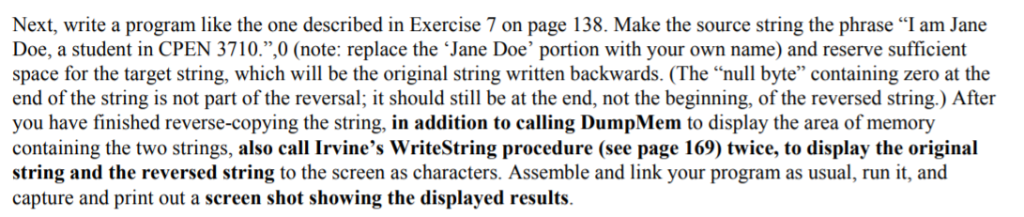
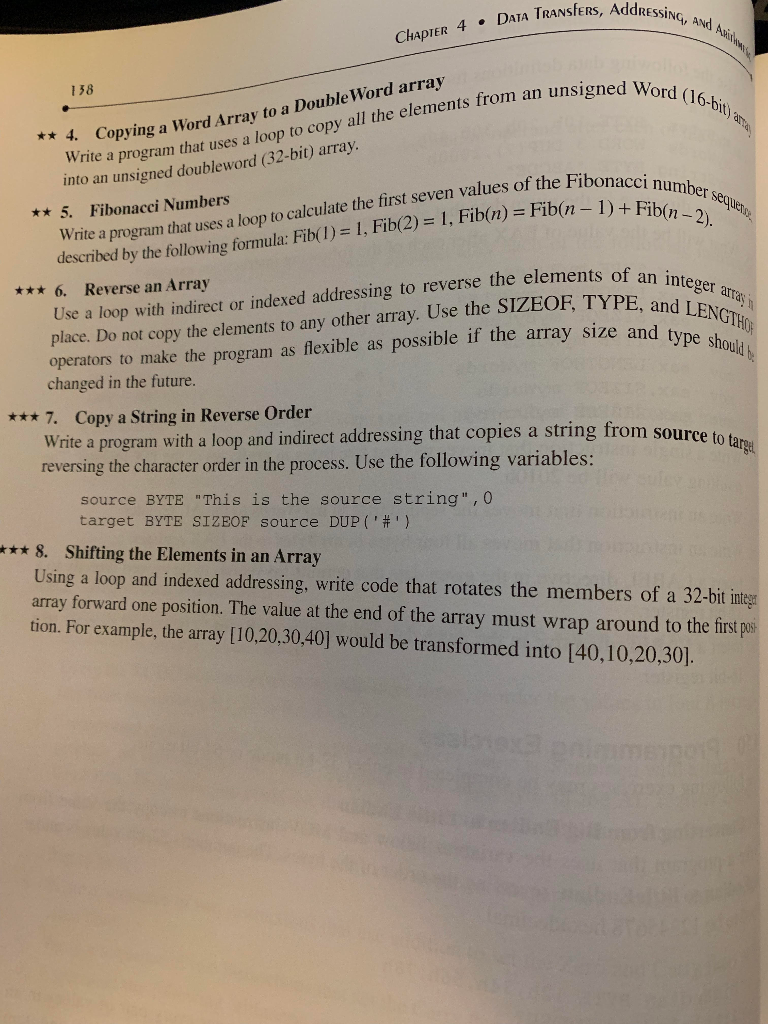
Next, write a program like the one described in Exercise 7 on page 138. Make the source string the phrase "I am Jane Doe, a student in CPEN 3710.",0 (note: replace the 'Jane Doe' portion with your own name) and reserve sufficient space for the target string, which will be the original string written backwards. (The "null byte" containing zero at the end of the string is not part of the reversal; it should still be at the end, not the beginning, of the reversed string.) After you have finished reverse-copying the string, in addition to calling DumpMem to display the area of memory containing the two strings, also call Irvine's WriteString procedure (see page 169) twice, to display the original string and the reversed string to the screen as characters. Assemble and link your program as usual, run it, and capture and print out a screen shot showing the displayed results AddRESSiNG, ANd TER 4 DAIA TRANSfERS, AddREss 1 38 Copying a Word Array to a Double Word array into an unsigned doubleword (32-bit) array **5. Fibonacci Numbers Write a pro te a program that uses a loop to copy all the elements from an unsi number th Write a program that uses a lop to calculate the first seven values of the Fibonaci Fib(n 1)+ Fibnoer se Write a program that uses a loop to calculate described by the following formula: Fib(l)I, Fib) I, Fib(n) Use a loop with indirect or indexed addressing to reverse the elements of place. Do not copy the elements to any other array. Use the SIZEOF, TYPE operators to make the program as flexible as possible if the array size and type s an integer atay and LENGTHO x6. Reverse an Array changed in the future. 7. Copy a String in Reverse Order Write a program with a loop and indirect addressing that copies a string from so reversing the character order in the process. Use the following variables: e to source BYTE "This is the source string",0 target BYTE SIZEOF source DUP('#') **8. Shifting the Elements in an Array Using a loop and indexed addressing, write code that rotates the members of a 32-bit inter array forward one position. The value at the end of the array must wrap around to the first pos tion. For example, the array [10,20,30,40] would be transformed into [40,10,20,30]. Next, write a program like the one described in Exercise 7 on page 138. Make the source string the phrase "I am Jane Doe, a student in CPEN 3710.",0 (note: replace the 'Jane Doe' portion with your own name) and reserve sufficient space for the target string, which will be the original string written backwards. (The "null byte" containing zero at the end of the string is not part of the reversal; it should still be at the end, not the beginning, of the reversed string.) After you have finished reverse-copying the string, in addition to calling DumpMem to display the area of memory containing the two strings, also call Irvine's WriteString procedure (see page 169) twice, to display the original string and the reversed string to the screen as characters. Assemble and link your program as usual, run it, and capture and print out a screen shot showing the displayed results AddRESSiNG, ANd TER 4 DAIA TRANSfERS, AddREss 1 38 Copying a Word Array to a Double Word array into an unsigned doubleword (32-bit) array **5. Fibonacci Numbers Write a pro te a program that uses a loop to copy all the elements from an unsi number th Write a program that uses a lop to calculate the first seven values of the Fibonaci Fib(n 1)+ Fibnoer se Write a program that uses a loop to calculate described by the following formula: Fib(l)I, Fib) I, Fib(n) Use a loop with indirect or indexed addressing to reverse the elements of place. Do not copy the elements to any other array. Use the SIZEOF, TYPE operators to make the program as flexible as possible if the array size and type s an integer atay and LENGTHO x6. Reverse an Array changed in the future. 7. Copy a String in Reverse Order Write a program with a loop and indirect addressing that copies a string from so reversing the character order in the process. Use the following variables: e to source BYTE "This is the source string",0 target BYTE SIZEOF source DUP('#') **8. Shifting the Elements in an Array Using a loop and indexed addressing, write code that rotates the members of a 32-bit inter array forward one position. The value at the end of the array must wrap around to the first pos tion. For example, the array [10,20,30,40] would be transformed into [40,10,20,30]
Step by Step Solution
There are 3 Steps involved in it

Get step-by-step solutions from verified subject matter experts
 Study Help