







Question: Assignment 01 (page 36-37, Blumberg, B., Cooper, D. C., & Schindler, P. S. (2008). Business research methods (4th edition.). London, UK: McGraw-Hill Read the running
 Assignment 01 (page 36-37, Blumberg, B., Cooper, D. C., & Schindler, P. S. (2008). Business research methods (4th edition.). London, UK: McGraw-Hill Read the running case study 1: Mehmet Celik, a future migrant entrepreneur, and the answer the following questions: Question 1 (10) Search from ABS listed entrepreneurship journals for articles on successful determinants of entrepreneurship. Now, having read the case study and journal articles, propose a research title for Mehmets research dissertation. Motivate you answer using either a theory or model or framework from journal articles. What dimensions should Mehmets research cover? Question 2 (10) Do you think that Dr Flowermountain was right in telling Mehmet that his research title is too broad and needs to be narrowed down? Motivate your answer.
Question 3 (10) Write down three possible research objectives for Mehmets research. Motivate for your answer.
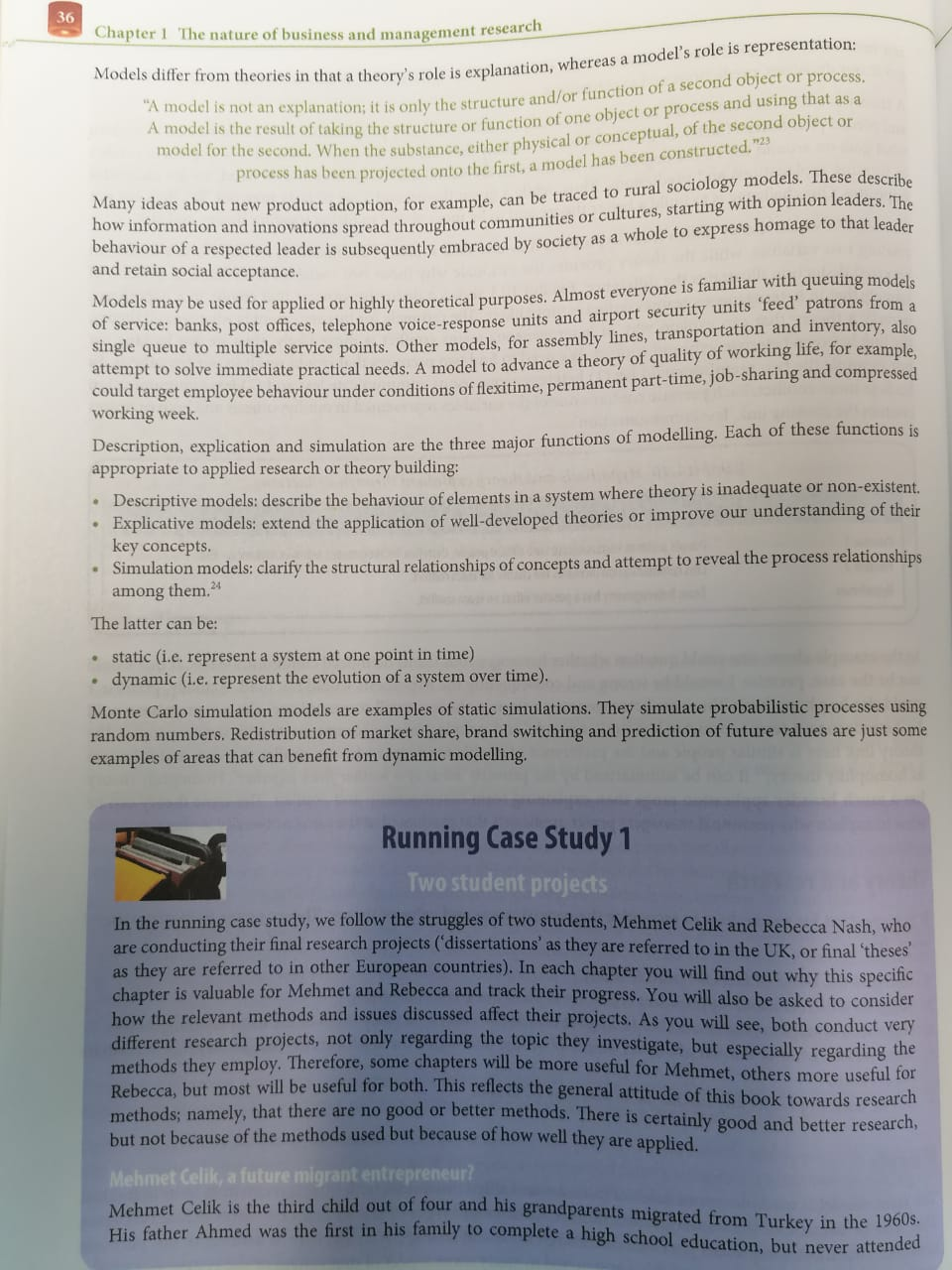
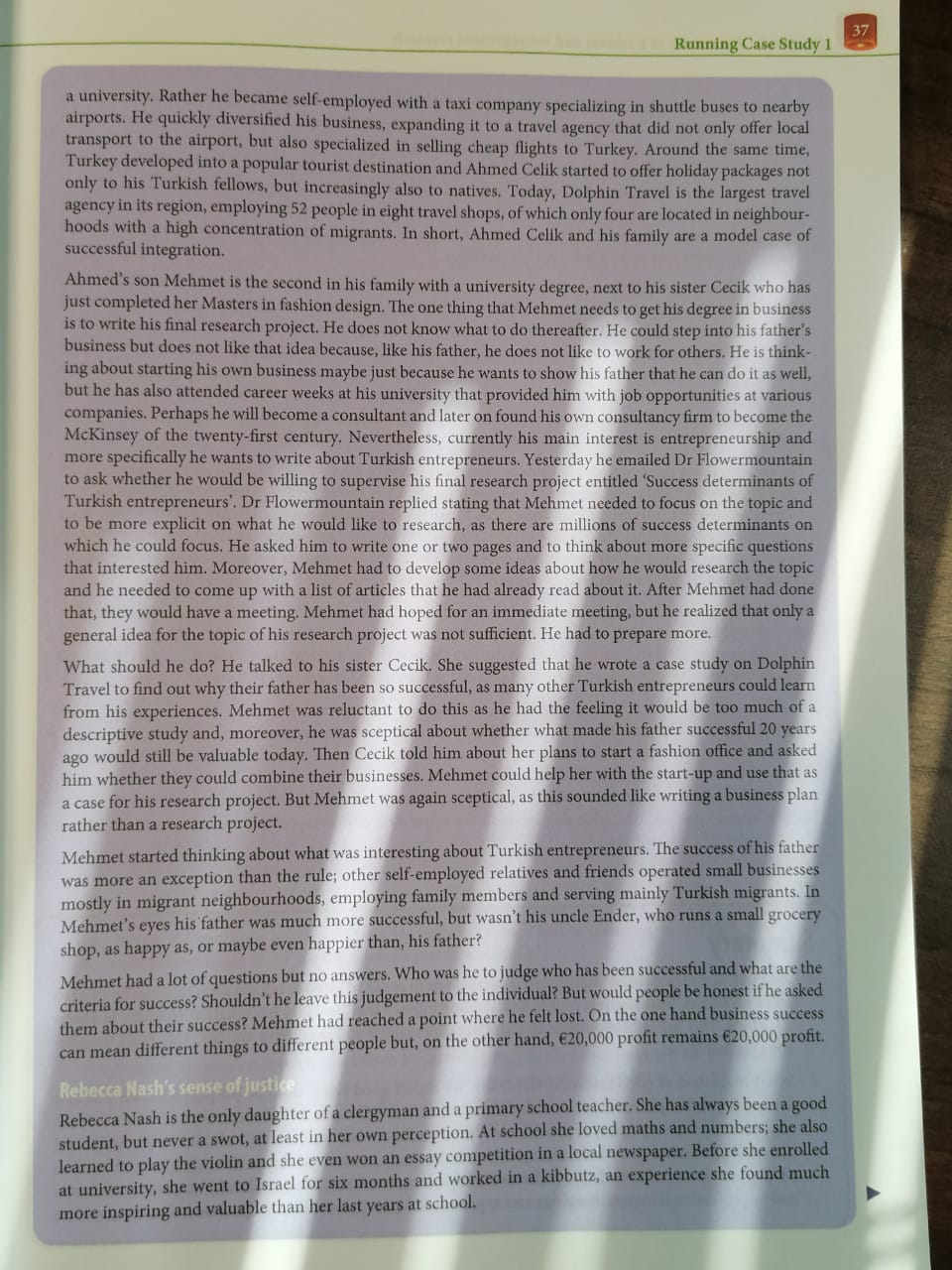
Models differ from theories in that a theory's role is explanation, whereas a model's role is representation: 36 Chapter 1 The nature of business and management research and retain social acceptance. "A model is not an explanation; it is only the structure and/or function of a second object or process, A model is the result of taking the structure or function of one object or process and using that as a model for the second. When the substance, either physical or conceptual, of the second object or process has been projected onto the first, a model has been constructed."23 Many ideas about new product adoption, for example, can be traced to rural sociology models. These describe how information and innovations spread throughoul communities or cultures, starting with opinion leaders. The behaviour of a respected leader is subsequently embraced by society as a whole to express homage to that leader Models may be used for applied or highly theoretical purposes. Almost everyone is familiar with queuing models of service: banks, post offices, telephone voice-response units and airport security units "feed' patrons from a single queue to multiple service points. Other models, for assembly lines, transportation and inventory, also attempt to solve immediate practical needs. A model to advance a theory of quality of working life, for example, could target employee behaviour under conditions of flexitime, permanent part-time, job-sharing and compressed working week. Description, explication and simulation are the three major functions of modelling. Each of these functions is appropriate to applied research or theory building: Descriptive models: describe the behaviour of elements in a system where theory is inadequate or non-existent. . Explicative models: extend the application of well-developed theories or improve our understanding of their key concepts. Simulation models: clarify the structural relationships of concepts and attempt to reveal the process relationships among them.24 The latter can be: . . . static (i.e. represent a system at one point in time) dynamic (i.e. represent the evolution of a system over time). Monte Carlo simulation models are examples of static simulations. They simulate probabilistic processes using random numbers. Redistribution of market share, brand switching and prediction of future values are just some examples of areas that can benefit from dynamic modelling. Running Case Study 1 Two student projects In the running case study, we follow the struggles of two students, Mehmet Celik and Rebecca Nash, who are conducting their final research projects ('dissertations' as they are referred to in the UK, or final theses' as they are referred to in other European countries). In each chapter you will find out why this specific chapter is valuable for Mehmet and Rebecca and track their progress. You will also be asked to consider how the relevant methods and issues discussed affect their projects. As you will see, both conduct very different research projects, not only regarding the topic they investigate, but especially regarding the methods they employ. Therefore, some chapters will be more useful for Mehmet, others more useful for Rebecca, but most will be useful for both. This reflects the general attitude of this book towards research methods; namely, that there are no good or better methods. There is certainly good and better research, but not because of the methods used but because of how well they are applied. Mehmet Celik, a future migrant entrepreneur? Mehmet Celik is the third child out of four and his grandparents migrated from Turkey in the 1960s. His father Ahmed was the first in his family to complete a high school education, but never attended 37 Running Case Study I a university. Rather he became self-employed with a taxi company specializing in shuttle buses to nearby airports. He quickly diversified his business, expanding it to a travel agency that did not only offer local transport to the airport, but also specialized in selling cheap flights to Turkey. Around the same time, Turkey developed into a popular tourist destination and Ahmed Celik started to offer holiday packages not only to his Turkish fellows, but increasingly also to natives. Today, Dolphin Travel is the largest travel agency in its region, employing 52 people in eight travel shops, of which only four are located in neighbour- hoods with a high concentration of migrants. In short, Ahmed Celik and his family are a model case of successful integration. Ahmed's son Mehmet is the second in his family with a university degree, next to his sister Cecik who has just completed her Masters in fashion design. The one thing that Mehmet needs to get his degree in business is to write his final research project. He does not know what to do thereafter. He could step into his father's business but does not like that idea because, like his father, he does not like to work for others. He is think- ing about starting his own business maybe just because he wants to show his father that he can do it as well, but he has also attended career weeks at his university that provided him with job opportunities at various companies. Perhaps he will become a consultant and later on found his own consultancy firm to become the McKinsey of the twenty-first century. Nevertheless, currently his main interest is entrepreneurship and more specifically he wants to write about Turkish entrepreneurs. Yesterday he emailed Dr Flowermountain to ask whether he would be willing to supervise his final research project entitled "Success determinants of Turkish entrepreneurs'. Dr Flowermountain replied stating that Mehmet needed to focus on the topic and to be more explicit on what he would like to research, as there are millions of success determinants on which he could focus. He asked him to write one or two pages and to think about more specific questions that interested him. Moreover, Mehmet had to develop some ideas about how he would research the topic and he needed to come up with a list of articles that he had already read about it. After Mehmet had done that, they would have a meeting. Mehmet had hoped for an immediate meeting, but he realized that only a general idea for the topic of his research project was not sufficient. He had to prepare more. What should he do? He talked to his sister Cecik. She suggested that he wrote a case study on Dolphin Travel to find out why their father has been so successful, as many other Turkish entrepreneurs could learn from his experiences. Mehmet was reluctant to do this as he had the feeling it would be too much of a descriptive study and, moreover, he was sceptical about whether what made his father successful 20 years ago would still be valuable today. Then Cecik told him about her plans to start a fashion office and asked him whether they could combine their businesses. Mehmet could help her with the start-up and use that as a case for his research project. But Mehmet was again sceptical, as this sounded like writing a business plan rather than a research project. Mehmet started thinking about what was interesting about Turkish entrepreneurs. The success of his father was more an exception than the rule; other self-employed relatives and friends operated small businesses mostly in migrant neighbourhoods, employing family members and serving mainly Turkish migrants. In Mehmet's eyes his father was much more successful, but wasn't his uncle Ender, who runs a small grocery shop, as happy as, or maybe even happier than, his father? Mehmet had a lot of questions but no answers. Who was he to judge who has been successful and what are the criteria for success? Shouldn't he leave this judgement to the individual? But would people be honest if he asked them about their success? Mehmet had reached a point where he felt lost. On the one hand business success can mean different things to different people but, on the other hand, 20,000 profit remains 20,000 profit. Rebecca Nash's sense of justice Rebecca Nash is the only daughter of a clergyman and a primary school teacher. She has always been a good student, but never a swot, at least in her own perception. At school she loved maths and numbers; she also learned to play the violin and she even won an essay competition in a local newspaper. Before she enrolled at university, she went to Israel for six months and worked in a kibbutz, an experience she found much more inspiring and valuable than her last years at school. Models differ from theories in that a theory's role is explanation, whereas a model's role is representation: 36 Chapter 1 The nature of business and management research and retain social acceptance. "A model is not an explanation; it is only the structure and/or function of a second object or process, A model is the result of taking the structure or function of one object or process and using that as a model for the second. When the substance, either physical or conceptual, of the second object or process has been projected onto the first, a model has been constructed."23 Many ideas about new product adoption, for example, can be traced to rural sociology models. These describe how information and innovations spread throughoul communities or cultures, starting with opinion leaders. The behaviour of a respected leader is subsequently embraced by society as a whole to express homage to that leader Models may be used for applied or highly theoretical purposes. Almost everyone is familiar with queuing models of service: banks, post offices, telephone voice-response units and airport security units "feed' patrons from a single queue to multiple service points. Other models, for assembly lines, transportation and inventory, also attempt to solve immediate practical needs. A model to advance a theory of quality of working life, for example, could target employee behaviour under conditions of flexitime, permanent part-time, job-sharing and compressed working week. Description, explication and simulation are the three major functions of modelling. Each of these functions is appropriate to applied research or theory building: Descriptive models: describe the behaviour of elements in a system where theory is inadequate or non-existent. . Explicative models: extend the application of well-developed theories or improve our understanding of their key concepts. Simulation models: clarify the structural relationships of concepts and attempt to reveal the process relationships among them.24 The latter can be: . . . static (i.e. represent a system at one point in time) dynamic (i.e. represent the evolution of a system over time). Monte Carlo simulation models are examples of static simulations. They simulate probabilistic processes using random numbers. Redistribution of market share, brand switching and prediction of future values are just some examples of areas that can benefit from dynamic modelling. Running Case Study 1 Two student projects In the running case study, we follow the struggles of two students, Mehmet Celik and Rebecca Nash, who are conducting their final research projects ('dissertations' as they are referred to in the UK, or final theses' as they are referred to in other European countries). In each chapter you will find out why this specific chapter is valuable for Mehmet and Rebecca and track their progress. You will also be asked to consider how the relevant methods and issues discussed affect their projects. As you will see, both conduct very different research projects, not only regarding the topic they investigate, but especially regarding the methods they employ. Therefore, some chapters will be more useful for Mehmet, others more useful for Rebecca, but most will be useful for both. This reflects the general attitude of this book towards research methods; namely, that there are no good or better methods. There is certainly good and better research, but not because of the methods used but because of how well they are applied. Mehmet Celik, a future migrant entrepreneur? Mehmet Celik is the third child out of four and his grandparents migrated from Turkey in the 1960s. His father Ahmed was the first in his family to complete a high school education, but never attended 37 Running Case Study I a university. Rather he became self-employed with a taxi company specializing in shuttle buses to nearby airports. He quickly diversified his business, expanding it to a travel agency that did not only offer local transport to the airport, but also specialized in selling cheap flights to Turkey. Around the same time, Turkey developed into a popular tourist destination and Ahmed Celik started to offer holiday packages not only to his Turkish fellows, but increasingly also to natives. Today, Dolphin Travel is the largest travel agency in its region, employing 52 people in eight travel shops, of which only four are located in neighbour- hoods with a high concentration of migrants. In short, Ahmed Celik and his family are a model case of successful integration. Ahmed's son Mehmet is the second in his family with a university degree, next to his sister Cecik who has just completed her Masters in fashion design. The one thing that Mehmet needs to get his degree in business is to write his final research project. He does not know what to do thereafter. He could step into his father's business but does not like that idea because, like his father, he does not like to work for others. He is think- ing about starting his own business maybe just because he wants to show his father that he can do it as well, but he has also attended career weeks at his university that provided him with job opportunities at various companies. Perhaps he will become a consultant and later on found his own consultancy firm to become the McKinsey of the twenty-first century. Nevertheless, currently his main interest is entrepreneurship and more specifically he wants to write about Turkish entrepreneurs. Yesterday he emailed Dr Flowermountain to ask whether he would be willing to supervise his final research project entitled "Success determinants of Turkish entrepreneurs'. Dr Flowermountain replied stating that Mehmet needed to focus on the topic and to be more explicit on what he would like to research, as there are millions of success determinants on which he could focus. He asked him to write one or two pages and to think about more specific questions that interested him. Moreover, Mehmet had to develop some ideas about how he would research the topic and he needed to come up with a list of articles that he had already read about it. After Mehmet had done that, they would have a meeting. Mehmet had hoped for an immediate meeting, but he realized that only a general idea for the topic of his research project was not sufficient. He had to prepare more. What should he do? He talked to his sister Cecik. She suggested that he wrote a case study on Dolphin Travel to find out why their father has been so successful, as many other Turkish entrepreneurs could learn from his experiences. Mehmet was reluctant to do this as he had the feeling it would be too much of a descriptive study and, moreover, he was sceptical about whether what made his father successful 20 years ago would still be valuable today. Then Cecik told him about her plans to start a fashion office and asked him whether they could combine their businesses. Mehmet could help her with the start-up and use that as a case for his research project. But Mehmet was again sceptical, as this sounded like writing a business plan rather than a research project. Mehmet started thinking about what was interesting about Turkish entrepreneurs. The success of his father was more an exception than the rule; other self-employed relatives and friends operated small businesses mostly in migrant neighbourhoods, employing family members and serving mainly Turkish migrants. In Mehmet's eyes his father was much more successful, but wasn't his uncle Ender, who runs a small grocery shop, as happy as, or maybe even happier than, his father? Mehmet had a lot of questions but no answers. Who was he to judge who has been successful and what are the criteria for success? Shouldn't he leave this judgement to the individual? But would people be honest if he asked them about their success? Mehmet had reached a point where he felt lost. On the one hand business success can mean different things to different people but, on the other hand, 20,000 profit remains 20,000 profit. Rebecca Nash's sense of justice Rebecca Nash is the only daughter of a clergyman and a primary school teacher. She has always been a good student, but never a swot, at least in her own perception. At school she loved maths and numbers; she also learned to play the violin and she even won an essay competition in a local newspaper. Before she enrolled at university, she went to Israel for six months and worked in a kibbutz, an experience she found much more inspiring and valuable than her last years at schoolStep by Step Solution
There are 3 Steps involved in it

Get step-by-step solutions from verified subject matter experts
 Study Help