







Question: Assignment 2 - Overview Just before Christmas on December 20, 2016. American-based D-J Composites, an aerospace firm, locked out approximately 30 employees in Gander These
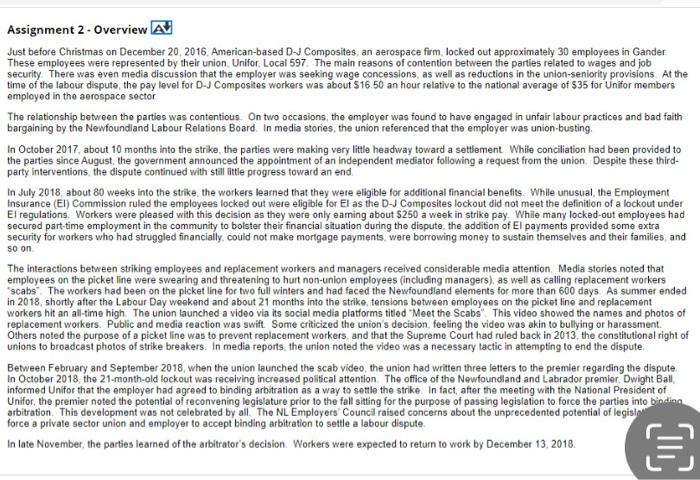
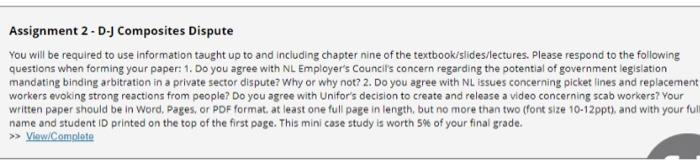
Assignment 2 - Overview Just before Christmas on December 20, 2016. American-based D-J Composites, an aerospace firm, locked out approximately 30 employees in Gander These employees were represented by their union. Unifor. Local 597 . The main reasons of contention between the parties related to wages and job security. There was even media discussion that the employer was seeking wage concessions, as well as reductions in the union-seniority provisions. At the time of the labour dispute, the pay level for D.J Composites workers was about $16.50 an hour relative to the national average of $35 for Unifor members employed in the aerospace sector The relationship between the partios was contentious. On two occasions, the employer was found to have engaged in unfair labour practices and bad faith bargaining by the Newfoundland Labour Relations Board. In media stories, the union referenced that the employer was union-busting. In October 2017, about 10 months into the strike, the parties were making very little headway toward a settlement. While conciliation had been provided to the parties since August, the government announced the appointment of an independent mediator following a request from the union. Despite these thirdparty interventions, the dispute continued with still little progress toward an end. In July 2018, about 80 weeks into the strike, the workers learned that they were eligible for additional financial benefits. While unusual, the Employment insurance (EI) Commission ruled the employees locked out were eligible for EI as the D-J Composites lockout did not meet the definition of a lockout under El regulations. Workers were pleased with this decision as they were only eaming about $250 a week in strike pay. While many locked-out employees had secured part-time employment in the community to bolster their financial situation during the dispute, the addition of El payments provided some extra security for workers who had struggled financially, could not make mortgage payments, ware borrowing money to sustain themselves and their families, and so on. The interactions between striking employees and replacement workers and managers received considerable media attention. Media stories noted that employees on the picket line were swearing and threatening to hurt non-union employees (including managers), as well as calling replacement workers 'scabs". The workers had been on the picket line for two full winters and had faced the Newfoundland elements for more than 600 days. As summer ended in 2018, shortly after the Labour Day weekend and about 21 months into the strike, tensions between employees on the picket line and replacement workers hit an all-time high. The union launched a video via its social media platforms titled "Meot the Scabs". This video showed the names and photos of replacement workers. Public and media reaction was swift. Some criticized the union's decision, feeling the video was akin to bullying or harassment. Others noted the purpose of a picket line was to prevent replacement workers, and that the Supreme Court had ruled back in 2013 , the constitutional right of unions to broadcast photos of strike breakers. In media reports, the union noted the video was a necessary tactic in attempting to end the dispute. Between February and September 2018, when the union launched the scab video, the union had written three letters to the premier regarding the dispute in October 2018, the 21-month-old lockout was receiving increased political attention. The office of the Newfoundiand and Labrador premier. Dwight Ball. informed Unifor that the employer had agreed to binding arbitration as a way to settle the strike. In fact, after the meeting with the National President of Unifor, the premier noted the potential of reconvening legislature prior to the fall sitting for the purpose of passing legislation to force the parties into bindien arbitration. This development was not celebrated by all. The NL. Employers' Council raised concerns about the unprecedented potential of legisle! force a private sector union and employer to accept binding arbitration to settle a labour dispute In late November, the parties learned of the arbitrator's decision. Workers were expected to return to work by December 13, 2018. Assignment 2-D-J Composites Dispute You will be required to use information taught up to and including chapter nine of the textbook/slides/lectures. Please respond to the following questions when forming your paper: 1. Do you agree with NL Employer's Council's concern regarding the potential of government legislation mandating binding arbitration in a private sector dispute? Why or why not? 2. Do you agree with NL issues concerning picket lines and replacement workers evoking strong reactions from people? Do you agree with Unifor's decision to create and release a video concerning scab workers? Your written paper should be in Word, Pages, or PDF format. at least one full page in length, but no more than two (font size 10-12ppt). and with your ful name and student ID printed on the top of the first page. This mini case study is worth 5% of your final grade. > ViewiComplote
Step by Step Solution
There are 3 Steps involved in it

Get step-by-step solutions from verified subject matter experts
 Study Help