







Question: please read case D-J composites dispute case provided above and answer the following two questions in between 400-500 words 1. Discuss the most relevant theory
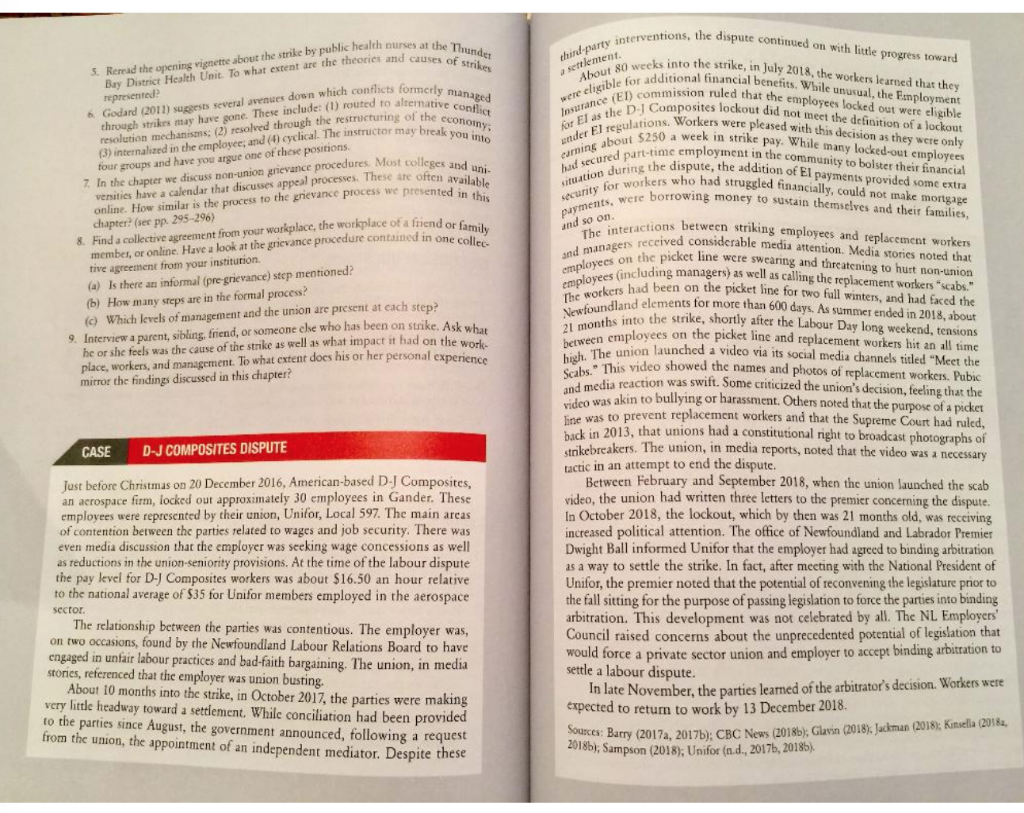 please read case D-J composites dispute case provided above and answer the following two questions in between 400-500 words
1. Discuss the most relevant theory from three theories of strikes to analyze this work stoppage.
2. Do you agree with NL Employers Councils concern regarding the potential of government legislation mandating binding arbitration in a private sector dispute? Why or why not?
settlement represented this 5. Read the opening vignette about the strike by public health nurses at the Thunder Bay District Health Unit. To what extent are the theories and causes of strikes 6. Godard (2011) suggests several avenues down which conflicts formerly managed through strikes may have gone. These include: (1) routed to alternative conflict resolution mechanisms; (2) resolved through the restructuring of the economy (3) internalized in the employee; and (4) cyclical. The instructor may break you into 7. In the chapter we discuss non-union grievance procedures. Most colleges and ani. four groups and have you argue one of these positions. versities have a calendar that discusses appeal processes. These are often available online. How similar is the process to the grievance process we presented chapter? (see pp. 295-296) 8. Find a collective agreement from your workplace, the workplace of a friend or family membes, or online. Have a look at the grievance procedure contained in one collec- tive agreement from your institution (a) Is there an informal (pre grievance) step mentioned? (b) How many steps are in the formal process? (c) Which levels of management and the union are present at each step? 9. Interview a parent, sibling, friend, or someone else who has been on strike. Ask what he or she feels was the cause of the strike as well as what impact it had on the work place, workers, and management. To what extent does his or her personal experience mirror the findings discussed in this chapter? and so on. 21 months into third-party interventions, the dispute continued on with little progress toward About 80 weeks into the strike, in July 2018, the workers learned that they were cligible for additional financial benefits. Wbile unusual, the Employment Insurance (EI) commission ruled that the employees locked out were eligible under El regulations. Workers were pleased with this decision as they were only for El as the DJ Composites lockout did not meet the definition of a lockout had secured part-time employment in the community to bolster their financial curning about $250 a week in strike pay. While many locked-out employees situation during the dispute, the addition of El payments provided some extra security for workers who had struggled financially, could not make mortgage payments, were borrowing money to sustain themselves and their families, The interactions between striking employees and replacement workers and managers received considerable media attention. Media stories noted that employees on the picket line were swearing and threatening to hurt non-union employees (including managers) as well as calling the replacement workers "scabs." The workers had been on the picket line for two fall winters, and had faced the Newfoundland elements for more than 600 days. As summer ended in 2018, about the strike, shortly after the Labour Day long weekend, tensions between employees on the picket line and replacement workers hit an all time high. The union launched a video via its via its social media channels titled "Meet the cabs. This video showed the names and photos of replacement workers. Pubie and media reaction was swift. Some Some criticized the union's decision, feeling that the ondeo was akin to bullying or harassment. Others noted that the purpose of a picker line was to prevent replacement workers and that the Supreme Court had ruled, back in 2013, that unions had a constitutional right to broadcast photographs of strikebreakers. The union, in media reports, noted that the video was a necessary tactic in an attempt to end the dispute. Between February and September 2018, when the union launched the scab video, the union had written three letters to the premier concerning the dispute. In October 2018, the lockout, which by then was 21 months old, was receiving increased political attention. The office of Newfoundland and Labrador Premier Dwight Ball informed Unifor that the employer had agreed to binding arbitration as a way to settle the strike. In fact, after meeting with the National President of Unifor, the premier noted that the potential of reconvening the legislature prior to the fall sitting for the purpose of passing legislation to force the parties into binding arbitration. This development was not celebrated by all. The NL Employers' Council raised concerns about the unprecedented potential of legislation that would force a private sector union and employer to accept binding arbitration to settle a labour dispute. In late November, the parties learned of the arbitrator's decision. Workers were expected to return to work by 13 December 2018. Sources: Barry (2017a, 2017b); CBC News (2018b); Glavin (2018) Jackman (2018); Kinsella (2018, 2018b); Sampson (2018); Unifor (n.d., 2017b, 2018b). CASE D-J COMPOSITES DISPUTE the Just before Christmas on 20 December 2016, American-based DJ Composites, an aerospace firm, locked out approximately 30 employees in Gander. These employees were represented by their union, Unifor, Local 597. The main areas of contention between the parties related to wages and job security There was even media discussion that the employer was seeking wage concessions as well as reductions in the union-seniority provisions. At the time of the labour dispute pay level for D-J Composites workers was about $16.50 an hour relative to the national average of $35 for Unifor members employed in the aerospace The relationship between the parties was contentious. The employer was, on two occasions, found by the Newfoundland Labour Relations Board to have engaged in unfair labour practices and bad-faith bargaining. The union, in media stories, referenced that the employer was union busting. About 10 months into the strike, in October 2017, the parties were making very little headway toward a settlement. Whilc conciliation had been provided to the parties since August, the government announced, following a request from the union, the appointment of an independent mediator. Despite these sectorStep by Step Solution
There are 3 Steps involved in it
1 Expert Approved Answer
Step: 1 Unlock

Question Has Been Solved by an Expert!
Get step-by-step solutions from verified subject matter experts
Step: 2 Unlock
Step: 3 Unlock
 Study Help