







Question: Assignment 2 : SRAW Test Data Analysis Based on positive results in DT&E and following a successful Operational Test Readiness Review, the SRAW entered IOT&E
Assignment : SRAW Test Data Analysis
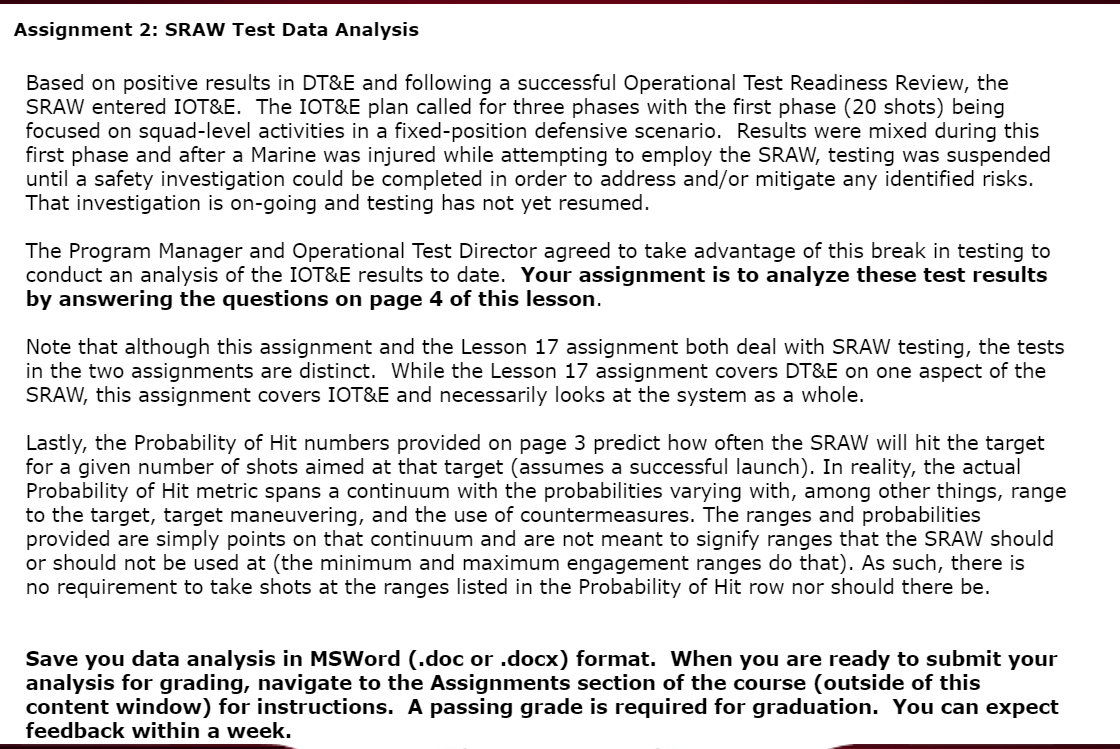
Based on positive results in DT&E and following a successful Operational Test Readiness Review, the
SRAW entered IOT&E The IOT&E plan called for three phases with the first phase shots being
focused on squadlevel activities in a fixedposition defensive scenario. Results were mixed during this
first phase and after a Marine was injured while attempting to employ the SRAW, testing was suspended
until a safety investigation could be completed in order to address andor mitigate any identified risks.
That investigation is ongoing and testing has not yet resumed.
The Program Manager and Operational Test Director agreed to take advantage of this break in testing to
conduct an analysis of the IOT&E results to date. Your assignment is to analyze these test results
by answering the questions on page of this lesson.
Note that although this assignment and the Lesson assignment both deal with SRAW testing, the tests
in the two assignments are distinct. While the Lesson assignment covers DT&E on one aspect of the
SRAW, this assignment covers IOT&E and necessarily looks at the system as a whole.
Lastly, the Probability of Hit numbers provided on page predict how often the SRAW will hit the target
for a given number of shots aimed at that target assumes a successful launch In reality, the actual
Probability of Hit metric spans a continuum with the probabilities varying with, among other things, range
to the target, target maneuvering, and the use of countermeasures. The ranges and probabilities
provided are simply points on that continuum and are not meant to signify ranges that the SRAW should
or should not be used at the minimum and maximum engagement ranges do that As such, there is
no requirement to take shots at the ranges listed in the Probability of Hit row nor should there be
Save you data analysis in MSWord doc or docx format. When you are ready to submit your
analysis for grading, navigate to the Assignments section of the course outside of this
content window for instructions. A passing grade is required for graduation. You can expect
feedback within a week. SRAW IOT&E Summary of Results
tabletableShot#tableTargetRange tableTargetCoursetableTGTSpeedkmhrtableMotorFunctiontableSRAWArmedtableTgtHitRemarksYes,Yes,Yes,Yes,Yes,Yes,High Winds Yes,NoYes,Yes,Yes,NoNoNoNoHang Fire Yes,Yes,No The Assignment Common Mistakes document that is available here and with the other background information may help with questions that you may have. If you have other questions specific to this assignment, email TST@dau.edu with your questions; an instructor will respond as soon as possible.
Question
o A Given the Threshold and Objective KPP values for the Engagement Envelope see the table on the previous page and noting that the results for shots and were essentially the same in both cases the motor functioned and the SRAW armed itself but both missed the target describe why not hitting the target on shot is different from not hitting the target on shot
o B Considering only shots and which result if any is more problematic from a SRAW performance perspective and why?
Question
o A When considering shot in isolation independent of the other shots does the result reflect an individual failure of the SRAW targeting system? Why or why not?
o B When considering shot in isolation independent of the other shots does the result reflect an individual failure of the SRAW targeting system? Why or why not?
Question
o A Given that IOT&E examines mission effectiveness in this case, mission effectiveness equates to target destruction and assuming that target destruction occurs when a SRAW launches and arms successfully and then hits the target, note that neither shot nor shot destroyed the target. Are these two failures equivalent? Why or why not?
o B Considering only shots and which result if any is more problematic from a SRAW performance perspective and why?
Question What one preliminary positive conclusion might an advocate of the system highlight? Make sure this conclusion is not simply an observation. Also, cite the data used to support the conclusion. As an example, an observation might be that the SRAW hit the target X of Y times. A conclusion might be that based on the results of shots a b c f g and j the system is on track to meet the Threshold Probability of Hit requirement for moving targets.
Question What one preliminary negative conclusion might a critic of the system highlight? Again, make sure this conclusion is not simply an observation and cite the data used to support the conclusion.
Step by Step Solution
There are 3 Steps involved in it
1 Expert Approved Answer
Step: 1 Unlock

Question Has Been Solved by an Expert!
Get step-by-step solutions from verified subject matter experts
Step: 2 Unlock
Step: 3 Unlock
 Study Help