







Question: Assignment #4 The purpose of this assignment is to solidify your understanding on the capital budgeting techniques (mainly Net Present Value and Internal Rate of
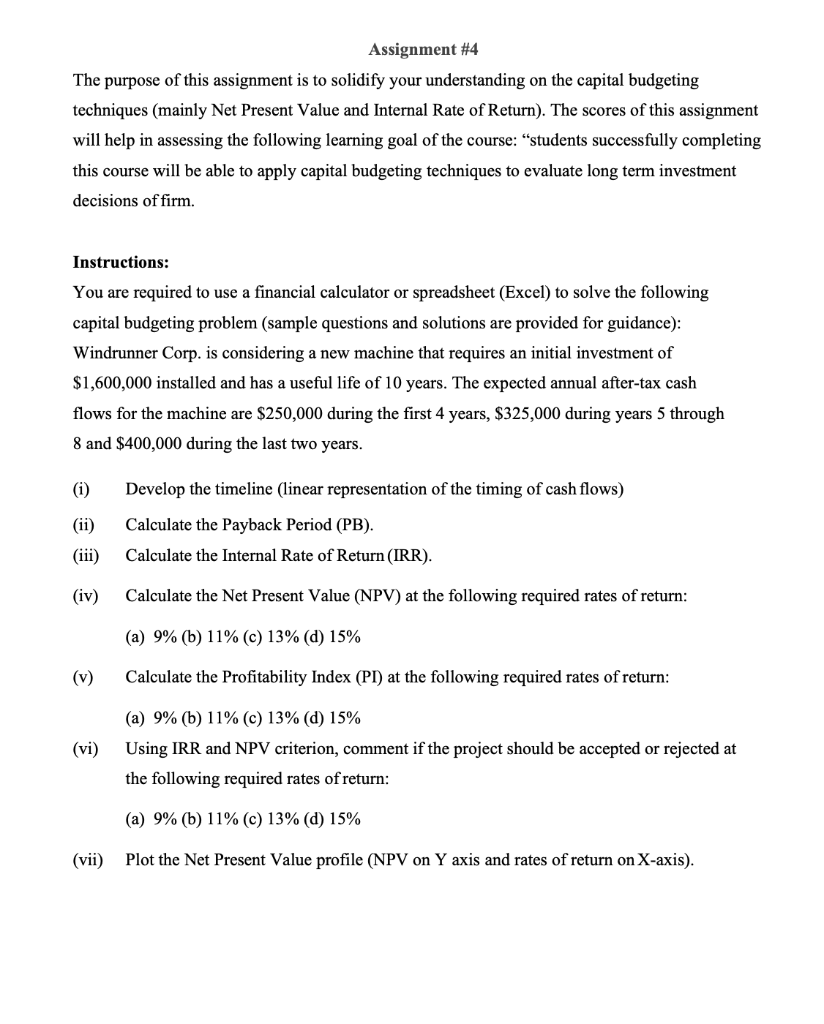
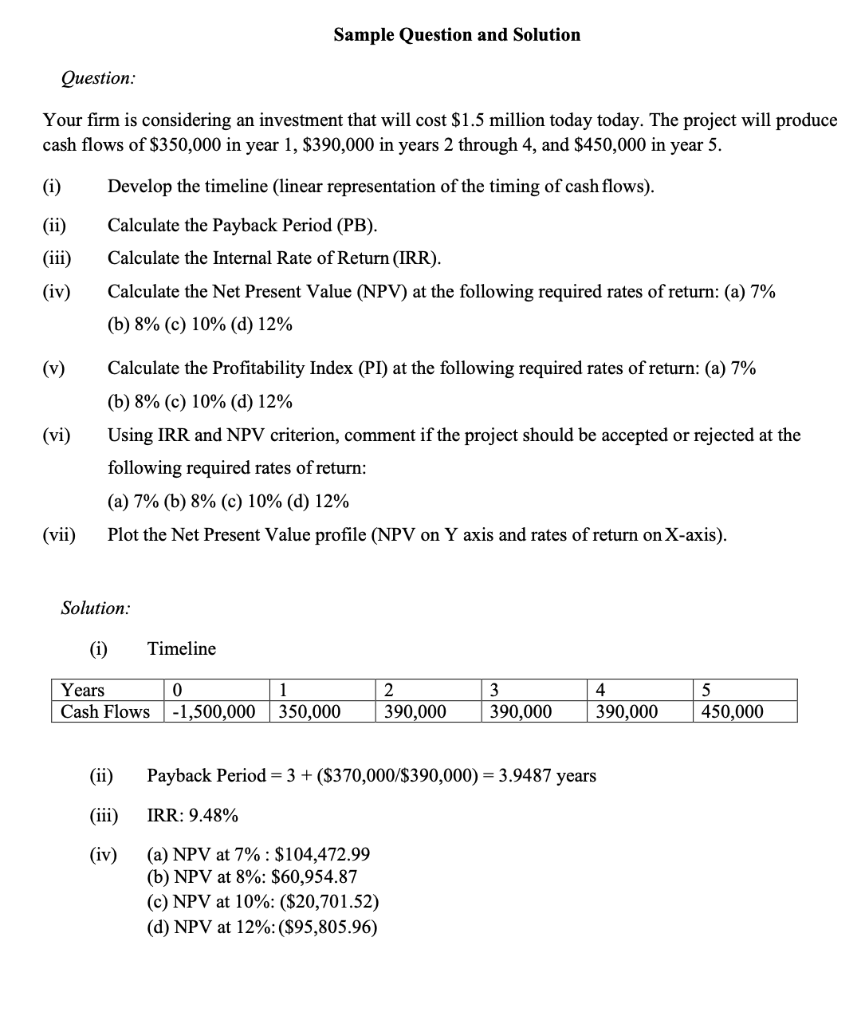
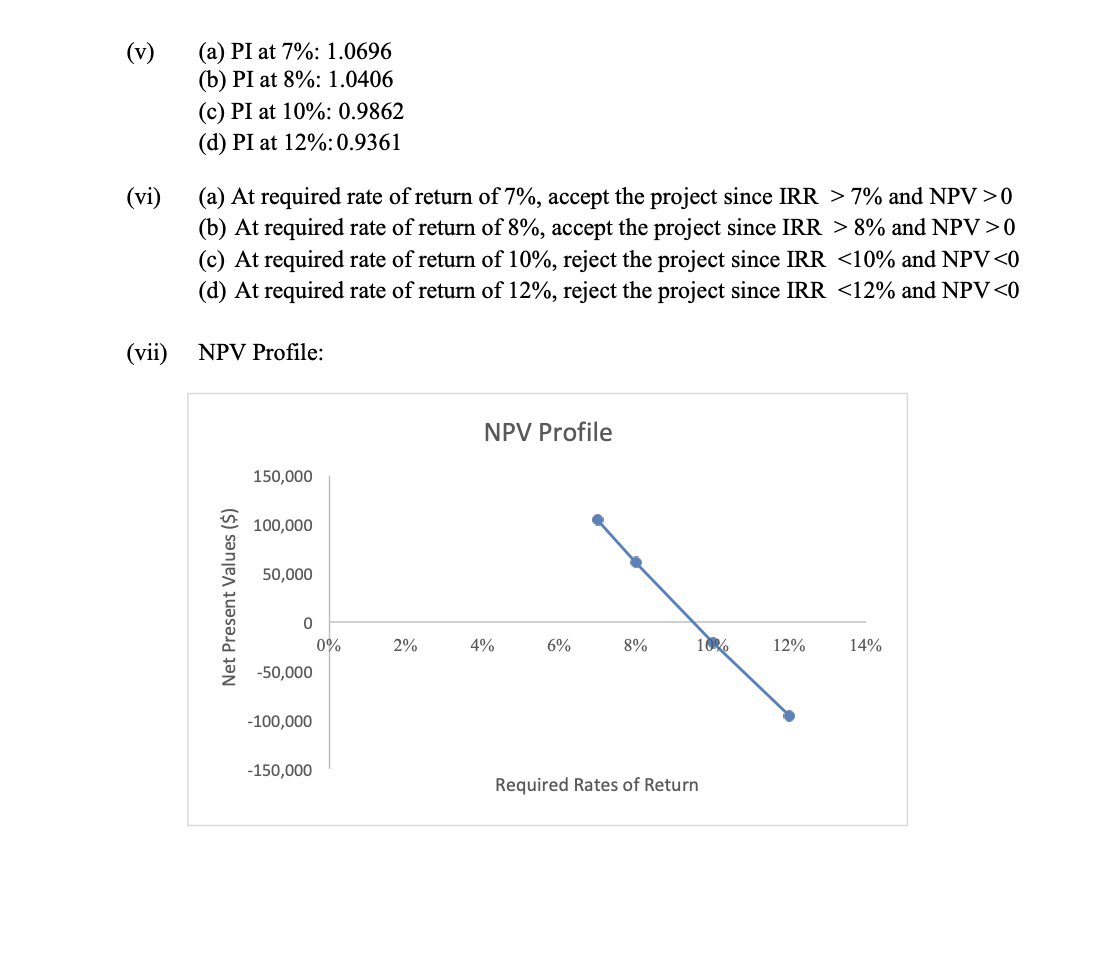
Assignment #4 The purpose of this assignment is to solidify your understanding on the capital budgeting techniques (mainly Net Present Value and Internal Rate of Return). The scores of this assignment will help in assessing the following learning goal of the course: "students successfully completing this course will be able to apply capital budgeting techniques to evaluate long term investment decisions of firm. Instructions: You are required to use a financial calculator or spreadsheet (Excel) to solve the following capital budgeting problem (sample questions and solutions are provided for guidance): Windrunner Corp. is considering a new machine that requires an initial investment of $1,600,000 installed and has a useful life of 10 years. The expected annual after-tax cash flows for the machine are $250,000 during the first 4 years, $325,000 during years 5 through 8 and $400,000 during the last two years. (i) (ii) Develop the timeline (linear representation of the timing of cash flows) Calculate the Payback Period (PB). Calculate the Internal Rate of Return (IRR). (iii) (iv) Calculate the Net Present Value (NPV) at the following required rates of return: (a) 9% (b) 11% (c) 13% (d) 15% (v) Calculate the Profitability Index (PI) at the following required rates of return: (vi) (a) 9% (b) 11% (c) 13% (d) 15% Using IRR and NPV criterion, comment if the project should be accepted or rejected at the following required rates of return: (a) 9% (b) 11%) 13% (d) 15% (vii) Plot the Net Present Value profile (NPV on Y axis and rates of return on X-axis). Sample Question and Solution Question: Your firm is considering an investment that will cost $1.5 million today today. The project will produce cash flows of $350,000 in year 1, $390,000 in years 2 through 4, and $450,000 in year 5. (i) Develop the timeline (linear representation of the timing of cash flows). (ii) (iii) (iv) Calculate the Payback Period (PB). Calculate the Internal Rate of Return (IRR). Calculate the Net Present Value (NPV) at the following required rates of return: (a) 7% (b) 8% (c) 10% (d) 12% (v) (vi) Calculate the Profitability Index (PI) at the following required rates of return: (a) 7% (b) 8% (c) 10% (d) 12% Using IRR and NPV criterion, comment if the project should be accepted or rejected at the following required rates of return: (a) 7% (b) 8% (c) 10% (d) 12% Plot the Net Present Value profile (NPV on Y axis and rates of return on X-axis). (vii) Solution: (i) Timeline Years Cash Flows 0 1 -1,500,000 350,000 2 390,000 3 390,000 4 390,000 5 450,000 (ii) Payback Period = 3 + ($370,000/$390,000) = 3.9487 years IRR: 9.48% (iv) (a) NPV at 7%: $104,472.99 (b) NPV at 8%: $60,954.87 (C) NPV at 10%: ($20,701.52) (d) NPV at 12%:($95,805.96) (v) (a) PI at 7%: 1.0696 (b) PI at 8%: 1.0406 (C) PI at 10%: 0.9862 (d) PI at 12%:0.9361 (vi) (a) At required rate of return of 7%, accept the project since IRR > 7% and NPV >0 (b) At required rate of return of 8%, accept the project since IRR > 8% and NPV>0 (c) At required rate of return of 10%, reject the project since IRR
Step by Step Solution
There are 3 Steps involved in it

Get step-by-step solutions from verified subject matter experts
 Study Help