







Question: ASSIGNMENT 8 Chapter 9: Transportation and Congestion Submit your answers to multiple choice assignments online using the Submit Multiple Choice Assignments link on your Course
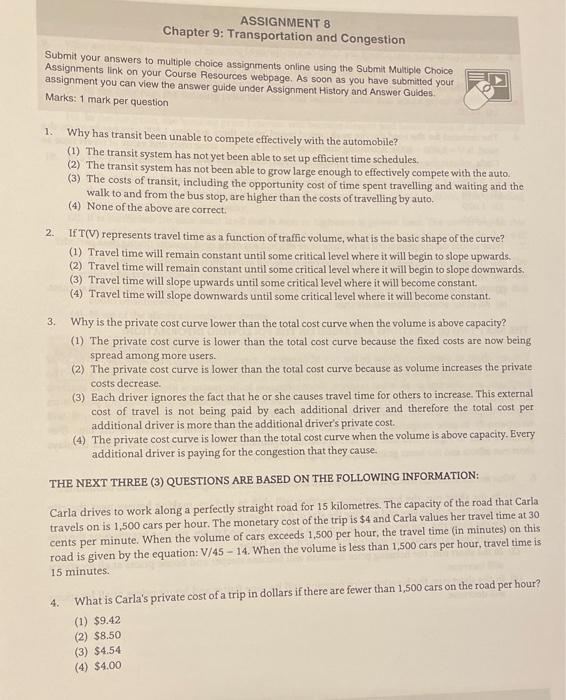
ASSIGNMENT 8 Chapter 9: Transportation and Congestion Submit your answers to multiple choice assignments online using the Submit Multiple Choice Assignments link on your Course Resources webpage, As soon as you have submitted your assignment you can view the answer guide under Assignment History and Answer Guides. Marks: 1 mark per question Why has transit been unable to compete effectively with the automobile? (1) The transit system has not yet been able to set up efficient time schedules. (2) The transit system has not been able to grow large enough to effectively compete with the auto. (3) The costs of transit, including the opportunity cost of time spent travelling and waiting and the walk to and from the bus stop, are higher than the costs of travelling by auto. (4) None of the above are correct. 2. If T(V) represents travel time as a function of traffic volume, what is the basic shape of the curve? (1) Travel time will remain constant until some critical level where it will begin to slope upwards. (2) Travel time will remain constant until some critical level where it will begin to slope downwards, (3) Travel time will slope upwards until some critical level where it will become constant. (4) Travel time will slope downwards until some critical level where it will become constant. 3. Why is the private cost curve lower than the total cost curve when the volume is above capacity? (1) The private cost curve is lower than the total cost curve because the fixed costs are now being spread among more users. (2) The private cost curve is lower than the total cost curve because as volume increases the private costs decrease. (3) Each driver ignores the fact that he or she causes travel time for others to increase. This external cost of travel is not being paid by each additional driver and therefore the total cost per additional driver is more than the additional driver's private cost. (4) The private cost curve is lower than the total cost curve when the volume is above capacity. Every additional driver is paying for the congestion that they cause. THE NEXT THREE (3) QUESTIONS ARE BASED ON THE FOLLOWING INFORMATION: Carla drives to work along a perfectly straight road for 15 kilometres. The capacity of the road that Carla travels on is 1.500 cars per hour. The monetary cost of the trip is $4 and Carla values her travel time at 30 cents per minute. When the volume of cars exceeds 1,500 per hour, the travel time (in minutes) on this road is given by the equation: V/45 - 14. When the volume is less than 1,500 cars per hour, travel time is 15 minutes. 4. What is Carla's private cost of a trip in dollars if there are fewer than 1,500 cars on the road per hour? (1) $9.42 (2) $8.50 (3) $4.54 (4) $4.00
Step by Step Solution
There are 3 Steps involved in it

Get step-by-step solutions from verified subject matter experts
 Study Help