







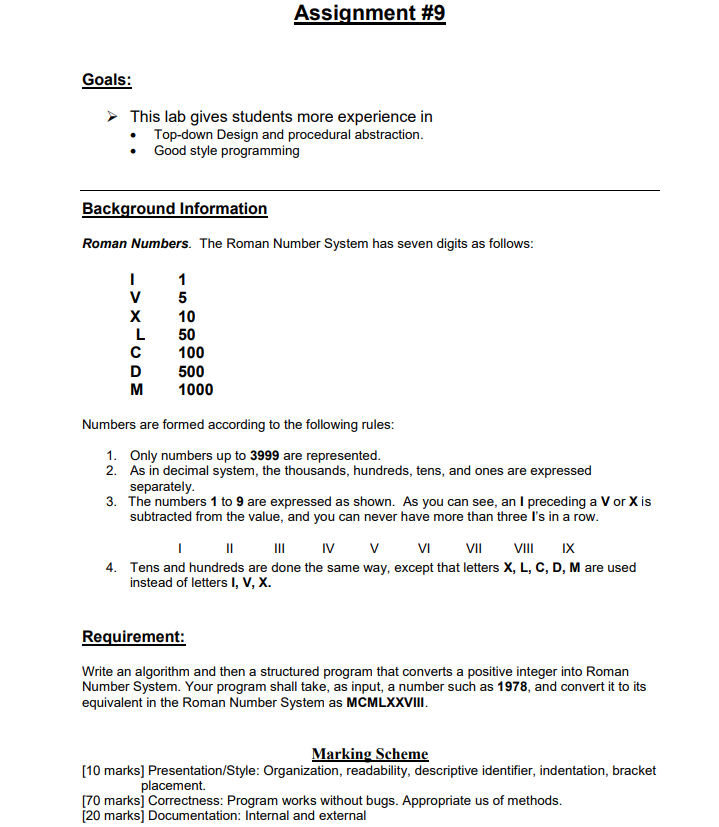
Question: Assignment # 9 Goals: > This lab gives students more experience in - Top - down Design and procedural abstraction . - Good style
Assignment #
Goals:
This lab gives students more experience in
Topdown Design and procedural abstraction
Good style programming
Background Information
Roman Numbers. The Roman Number System has seven digits as follows:
Numbers are formed according to the following rules:
Only numbers up to mathbf are represented.
As in decimal system, the thousands, hundreds, tens, and ones are expressed separately.
The numbers mathbf to mathbf are expressed as shown. As you can see, an I preceding a mathbfV or mathbfX is subtracted from the value, and you can never have more than three Is in a row.
Tens and hundreds are done the same way, except that letters mathbfXmathrmLmathbfCmathbfDmathbfM are used instead of letters mathbfImathbfVmathbfX
Requirement:
Write an algorithm and then a structured program that converts a positive integer into Roman Number System. Your program shall take, as input, a number such as and convert it to its equivalent in the Roman Number System as MCMLXXVIII.
marks PresentationStyle: Organization, readability, descriptive identifier, indentation, bracket placement.
marks Correctness: Program works without bugs. Appropriate us of methods.
marks Documentation: Internal and external
Step by Step Solution
There are 3 Steps involved in it
1 Expert Approved Answer
Step: 1 Unlock

Question Has Been Solved by an Expert!
Get step-by-step solutions from verified subject matter experts
Step: 2 Unlock
Step: 3 Unlock
 Study Help