







Question: Assignment Briefing The case you are studying is flow past an equilateral triangle at low Reynolds number of 10-20, the typical geometry is shown in
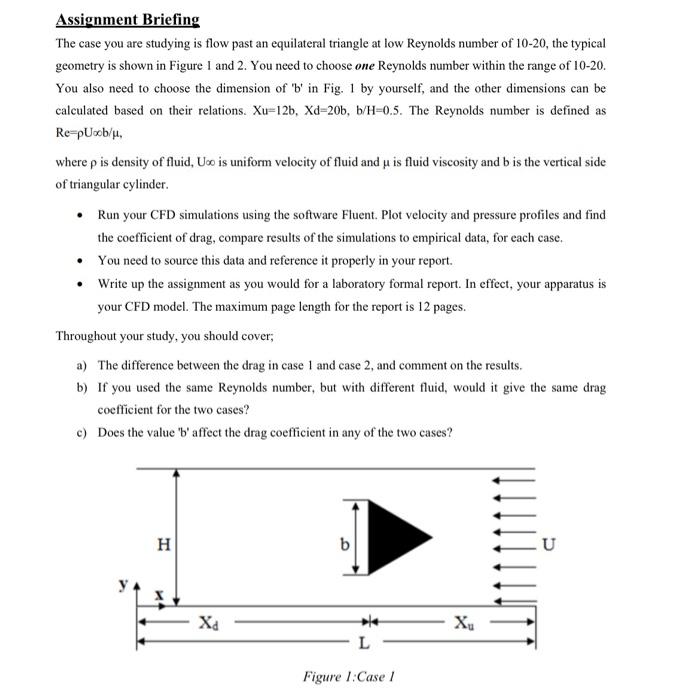
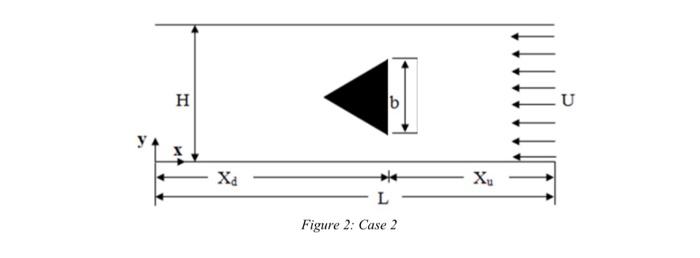
Assignment Briefing The case you are studying is flow past an equilateral triangle at low Reynolds number of 10-20, the typical geometry is shown in Figure I and 2. You need to choose one Reynolds number within the range of 10-20. You also need to choose the dimension of ' b ' in Fig. 1 by yourself, and the other dimensions can be calculated based on their relations. Xu=12b,Xd=20b,b/H=0.5. The Reynolds number is defined as Re=Ub/, where is density of fluid, U is uniform velocity of fluid and is fluid viscosity and b is the vertical side of triangular cylinder. - Run your CFD simulations using the software Fluent. Plot velocity and pressure profiles and find the coefficient of drag, compare results of the simulations to empirical data, for each case. - You need to source this data and reference it properly in your report. - Write up the assignment as you would for a laboratory formal report. In effect, your apparatus is your CFD model. The maximum page length for the report is 12 pages. Throughout your study, you should cover; a) The difference between the drag in case 1 and case 2 , and comment on the results. b) If you used the same Reynolds number, but with different fluid, would it give the same drag coefficient for the two cases? c) Does the value 'b' affect the drag coefficient in any of the two cases? I'tgure I:case I rigure 4 , Wase 4
Step by Step Solution
There are 3 Steps involved in it

Get step-by-step solutions from verified subject matter experts
 Study Help