Question: Assignment Description 6. For each of the five PMLC models illustrated in Chapter 2, identify a project from your experience that would seem to have

Assignment Description
6. For each of the five PMLC models illustrated in Chapter 2, identify a project from your experience that would seem to have a good fit. Would using that PMLC for that project have improved the outcome? Why?
7. Referring to the PDQ Case Study presented in Appendix C, what PMLC model would you use for each of the six subsystems (Order Entry, Order Submit, Routing, Inventory Management, and Pizza Factory Locator)? Defend your choices.
8. Strategic planning horizons have changed from 5 years, to 3 years, and even to 1 year. Chapter 3 advocates a continuous process that includes quarterly reviews of projects, programs, and portfolios where changes to the strategic plan can be made at any quarterly review. As your enterprise implements transitioning to a continuous process, what obstacles can they expect? What would you recommend they do to mitigate these obstacles?
9. A big challenge in implementing the Co-Manager model, presented in Chapter 4, is giving the client equal authority and responsibility in managing the project. The process co-manager has to relinquish authority and the product co-manager has to acquire that authority and responsibility. What specific actions should each co-manager take in order to establish that equality?
10. As far as your companys needs for a project management methodology are concerned, are any of the Process Groups, presented in Chapter 5, incomplete? Do any of the Process Groups have superfluous processes that would not be applicable to your company? Which are they and why would they not work for you?
Assignment Description 6. For each of the five
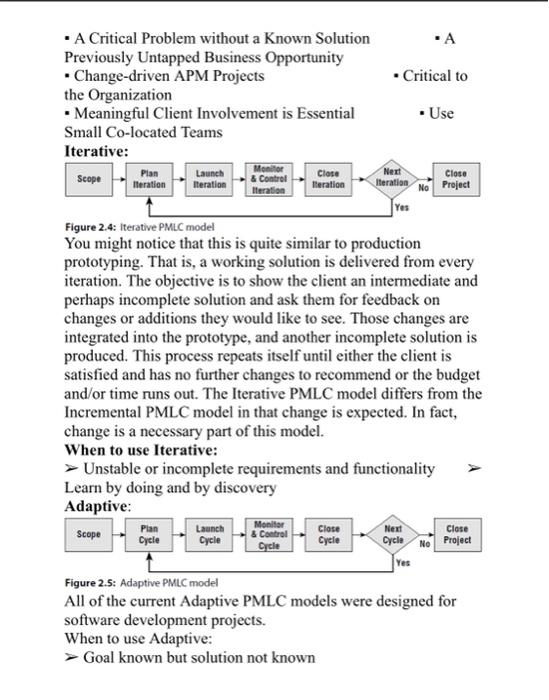
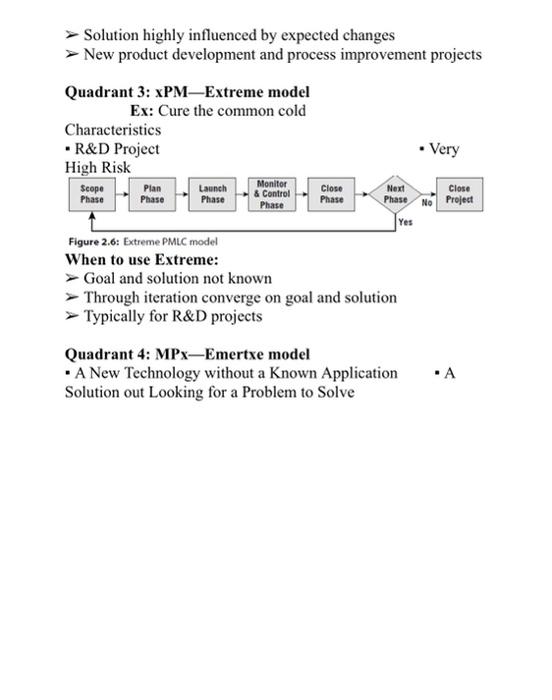
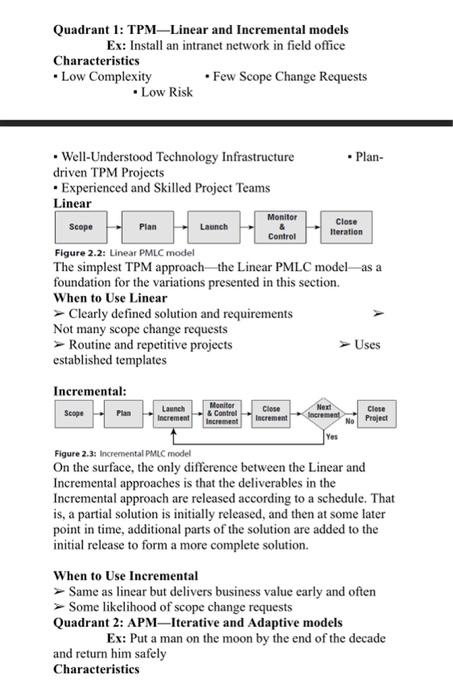
Quadrant 1: TPM-Linear and Incremental models Ex: Install an intranet network in field office Characteristics - Low Complexity . Few Scope Change Requests Low Risk Monitor Launch Close Iteration Control Well-Understood Technology Infrastructure Plan- driven TPM Projects Experienced and Skilled Project Teams Linear Scope Plan Figure 2.2: Linear PMLC model The simplest TPM approach the Linear PMLC model as a foundation for the variations presented in this section. When to Use Linear > Clearly defined solution and requirements Not many scope change requests > Routine and repetitive projects > Uses established templates Incremental: Scope Launch Increment Monitor & Control Increment Close Increment Next Increment Close Project Yes Figure 2.3: Incremental PMLC model On the surface, the only difference between the Linear and Incremental approaches is that the deliverables in the Incremental approach are released according to a schedule. That is, a partial solution is initially released, and then at some later point in time, additional parts of the solution are added to the initial release to form a more complete solution. When to Use Incremental Same as linear but delivers business value early and often Some likelihood of scope change requests Quadrant 2: APMIterative and Adaptive models Ex: Put a man on the moon by the end of the decade and return him safely Characteristics Plan Launch Close Monitor & Control Iteration Teration . A Critical Problem without a Known Solution .A Previously Untapped Business Opportunity Change-driven APM Projects Critical to the Organization Meaningful Client Involvement is Essential Use Small Co-located Teams Iterative: Next Scope Close Iteration Iteration Iteration No Project Yes Figure 2.4: Iterative PMLC model You might notice that this is quite similar to production prototyping. That is, a working solution is delivered from every iteration. The objective is to show the client an intermediate and perhaps incomplete solution and ask them for feedback on changes or additions they would like to see. Those changes are integrated into the prototype, and another incomplete solution is produced. This process repeats itself until either the client is satisfied and has no further changes to recommend or the budget and/or time runs out. The Iterative PMLC model differs from the Incremental PMLC model in that change is expected. In fact, change is a necessary part of this model. When to use Iterative: Unstable or incomplete requirements and functionality Learn by doing and by discovery Adaptive: Plan Scope Close Close Cycle Cycle Cycle Cycle Launch Next Monitor & Control Cycle No Project Yes Figure 2.5: Adaptive PMLC model All of the current Adaptive PMLC models were designed for software development projects. When to use Adaptive: > Goal known but solution not known > Solution highly influenced by expected changes > New product development and process improvement projects Quadrant 3: XPM-Extreme model Ex: Cure the common cold Characteristics R&D Project Very High Risk Scope Launch Monitor Next Close Phase Phase Phase No Project Plan Close Phase & Control Phase Phase Yes Figure 2.6: Extreme PMLC model When to use Extreme: Goal and solution not known > Through iteration converge on goal and solution > Typically for R&D projects Quadrant 4: MPx-Emertxe model - A New Technology without a Known Application Solution out Looking for a Problem to Solve .A

Step by Step Solution

There are 3 Steps involved in it

1 Expert Approved Answer
Step: 1 Unlock blur-text-image

Question Has Been Solved by an Expert!

Get step-by-step solutions from verified subject matter experts

Step: 2 Unlock
Step: 3 Unlock

Students Have Also Explored These Related General Management Questions!