







Question: ASSIGNMENT GUIDELINES PURPOSE This assignment aims to assess Graduate Attribute 7: Sustainability and Impact of Management Activity. LEARNING OUTCOME Demonstrate knowledge and understanding of the
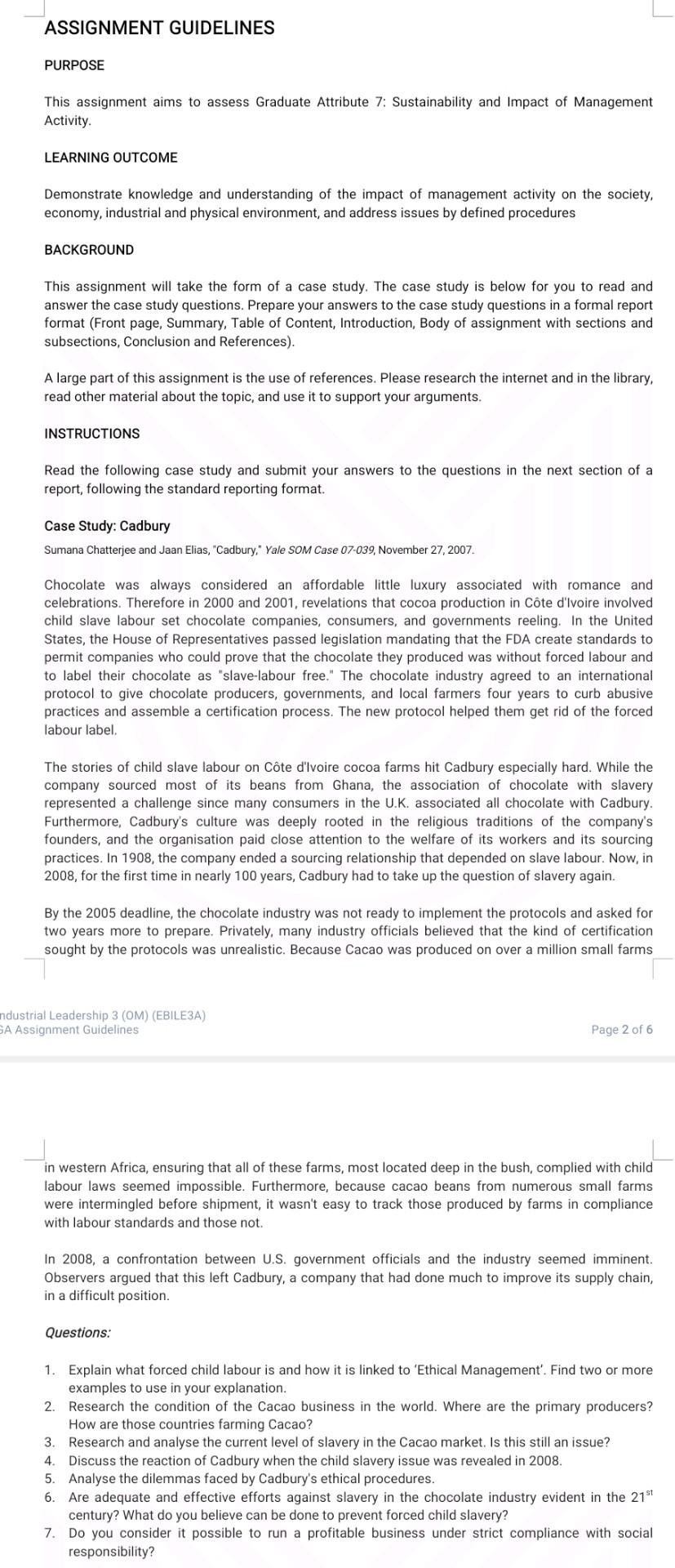
ASSIGNMENT GUIDELINES PURPOSE This assignment aims to assess Graduate Attribute 7: Sustainability and Impact of Management Activity. LEARNING OUTCOME Demonstrate knowledge and understanding of the impact of management activity on the society, economy, industrial and physical environment, and address issues by defined procedures BACKGROUND This assignment will take the form of a case study. The case study is below for you to read and answer the case study questions. Prepare your answers to the case study questions in a formal report format (Front page, Summary, Table of Content, Introduction, Body of assignment with sections and subsections, Conclusion and References). A large part of this assignment is the use of references. Please research the internet and in the library, read other material about the topic, and use it to support your arguments INSTRUCTIONS Read the following case study and submit your answers to the questions in the next section of a report, following the standard reporting format. Case Study: Cadbury Sumana Chatterjee and Jaan Elias, "Cadbury," Yale SOM Case 07-039, November 27, 2007. Chocolate was always considered an affordable little luxury associated with romance and celebrations. Therefore in 2000 and 2001, revelations that cocoa production in Cte d'Ivoire involved child slave labour set chocolate companies, consumers, and governments reeling. In the United States, the House of Representatives passed legislation mandating that the FDA create standards to permit companies who could prove that the chocolate they produced was without forced labour and to label their chocolate as "slave-labour free." The chocolate industry agreed to an international protocol to give chocolate producers, governments, and local farmers four years to curb abusive practices and assemble a certification process. The new protocol helped them get rid of the forced labour label. The stories of child slave labour on Cte d'Ivoire cocoa farms hit Cadbury especially hard. While the company sourced most of its beans from Ghana, the association of chocolate with slavery represented a challenge since many consumers in the U.K. associated all chocolate with Cadbury. Furthermore, Cadbury's culture was deeply rooted in the religious traditions of the company's founders, and the organisation paid close attention to the welfare of its workers and its sourcing practices. In 1908, the company ended a sourcing relationship that depended on slave labour. Now, in 2008, for the first time in nearly 100 years, Cadbury had to take up the question of slavery again. By the 2005 deadline, the chocolate industry was not ready to implement the protocols and asked for two years more to prepare. Privately, many industry officials believed that the kind of certification sought by the protocols was unrealistic. Because Cacao was produced on over a million small farms in western Africa, ensuring that all of these farms, most located deep in the bush, complied with child labour laws seemed impossible. Furthermore, because cacao beans from numerous small farms were intermingled before shipment, it wasn't easy to track those produced by farms in compliance with labour standards and those not. In 2008, a confrontation between U.S. government officials and the industry seemed imminent. Observers argued that this left Cadbury, a company that had done much to improve its supply chain, in a difficult position. Questions. 1. Explain what forced child labour is and how it is linked to 'Ethical Management'. Find two or more examples to use in your explanation. 2. Research the condition of the Cacao business in the world. Where are the primary producers? How are those countries farming Cacao? 3. Research and analyse the current level of slavery in the Cacao market. Is this still an issue? 4. Discuss the reaction of Cadbury when the child slavery issue was revealed in 2008. 5. Analyse the dilemmas faced by Cadbury's ethical procedures. 6. Are adequate and effective efforts against slavery in the chocolate industry evident in the 21si century? What do you believe can be done to prevent forced child slavery? 7. Do you consider it possible to run a profitable business under strict compliance with social responsibility
Step by Step Solution
There are 3 Steps involved in it

Get step-by-step solutions from verified subject matter experts
 Study Help