







Question: Assignment Guidelines The following Assignment Guidelines are relevant for all the assignments in Parts 2 and 3 of the course. When you do a
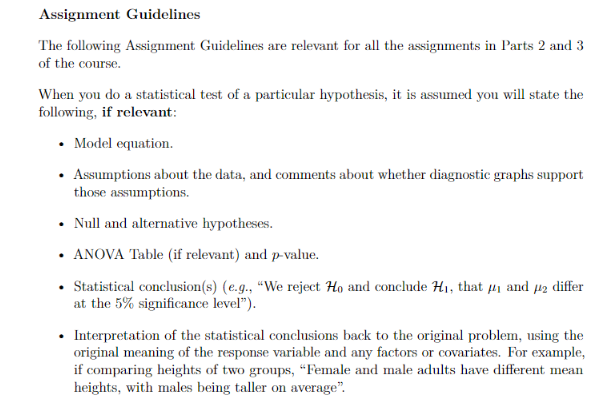
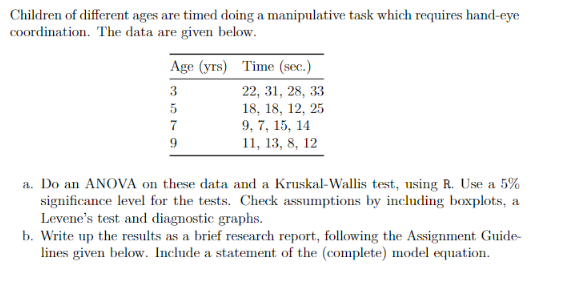
Assignment Guidelines The following Assignment Guidelines are relevant for all the assignments in Parts 2 and 3 of the course. When you do a statistical test of a particular hypothesis, it is assumed you will state the following, if relevant: Model equation. Assumptions about the data, and comments about whether diagnostic graphs support those assumptions. Null and alternative hypotheses. ANOVA Table (if relevant) and p-value. Statistical conclusion(s) (e.g., "We reject Ho and conclude H, that and differ at the 5% significance level"). Interpretation of the statistical conclusions back to the original problem, using the original meaning of the response variable and any factors or covariates. For example, if comparing heights of two groups, "Female and male adults have different mean heights, with males being taller on average". Children of different ages are timed doing a manipulative task which requires hand-eye coordination. The data are given below. Age (yrs) Time (sec.) 3 22, 31, 28, 33 5 18, 18, 12, 25 7 9, 7, 15, 14 9 11, 13, 8, 12 a. Do an ANOVA on these data and a Kruskal-Wallis test, using R. Use a 5% significance level for the tests. Check assumptions by including boxplots, a Levene's test and diagnostic graphs. b. Write up the results as a brief research report, following the Assignment Guide- lines given below. Include a statement of the (complete) model equation.
Step by Step Solution
There are 3 Steps involved in it

Get step-by-step solutions from verified subject matter experts
 Study Help