







Question: Assignment Instructions Step 1 : Read Scenario Imagine you are the CEO of a medium - sized company with 1 , 6 0 0 employees
Assignment Instructions
Step : Read Scenario
Imagine you are the CEO of a mediumsized company with employees in locations in the United States, Mexico, and Canada. Recently, the T&D Department implemented a new leadership program for its managers, and you are interested in finding out whether the program produced a positive return on investment ROI
On average, each manager works hours each week and earns $ per hour. They spend an average of hours in the new leadership program. The trainer's salary, benefits, and travel expenses total $ and the total cost of operating the various training sites is $ per year. Other costs associated with development, administration, facilitation, and evaluation, including technology and training materials, are $
Before the training department implemented the leadership program, the annual turnover rate of managers was After the training program, managers noticed a reduction of in the turnover rate. The average cost of recruiting, hiring, and training a replacement is $ Is this training program showing a positive ROI? Why or why not? Show your work.
Step : Determine ROI
Calculate and interpret the ROI of the training program described in the scenario above at the new turnover rate. Use this Microsoft PowerPoint template downarrow to help you. Recall that the formula for calculating ROI is as follows:
R O Ifractext Benefits text Costs text Costs times
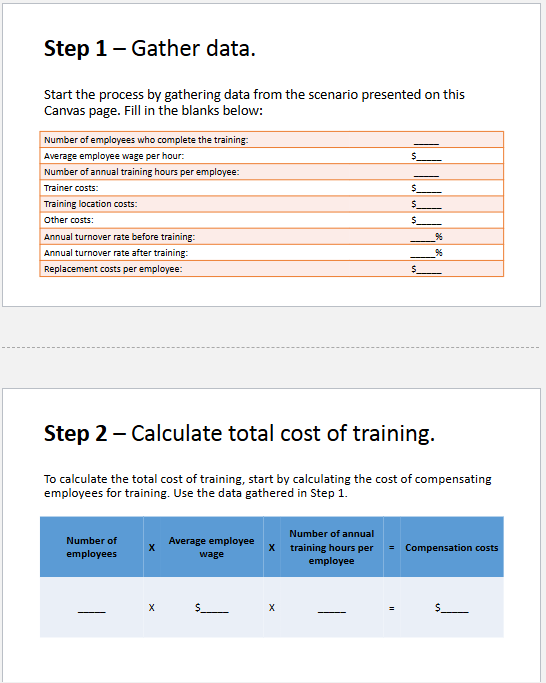
ROI Benefits Cost Cost Step Gather data.
Start the process by gathering data from the scenario presented on this Canvas page. Fill in the blanks below:
begintabularll
hline Number of employees who complete the training:
hline Average employee wage per hour:
hline Number of annual training hours per employee:
hline Trainer costs:
hline Training location costs:
hline Anner costs: &
hline Annual turnover rate before training:
hline Replacement costs per employee: &
hline
endtabular
Step Calculate total cost of training.
To calculate the total cost of training, start by calculating the cost of compensating employees for training. Use the data gathered in Step
Number of employees
Average employee wage
$ qquad X
Number of annual training hours per employee
Compensation costs Step Calculate total cost of training.
Then, use these compensation costs to calculate the total cost of training per year. Use the data you gathered in Step too.
Step Calculate total cost of turnover.
To calculate the total cost of turnover, start by determining the number of employees who leave the company each year. Use the data gathered in Step
Number of employees
X
Annual turnover rate before training
Number of employees who
leave each year before training
X
Step Calculate total cost of turnover.
Then, use the number of employees who leave each year to calculate the total cost of turnover per year. Use the data you gathered in Step too.
Number of employees who
leave each year before training
Replacement costs per employee
Total cost of turnover before training per year
X
$
$
Step Calculate net financial benefit of reduced turnover.
To complete Step start by calculating the number of employees who leave each year at the new turnover rate. Use the data gathered in Step
Number of employees
X
Annual turnover rate after
Number of employees who training
leave each year after training
X
Step Calculate net financial benefit of reduced turnover.
Then, use the number of employees who leave each year to calculate the total cost of turnover per year. Use the data you gathered in Step too.
Number of employees who
leave each year after training
Replacement costs per
Total cost of turnover after employee training per year
X
$
$
Step Calculate net financial benefit of reduced turnover.
Now, use the annual cost of turnover before and after training to calculate the savings of the reduced turnover.
Total cost of turnover before training per year
Total cost of turnover after training per year
$
Savings of reduced turnover
$ Step Calculate net financial benefit of reduced turnover.
Finally, to calculate the net financial benefit of the program's impact on turnover, subtract the total cost of training from the savings of the reduced turnover.
Savings of reduced turnover
Total cost of training per year
Net financial benefit
Step Calculate BCR
To calculate the benefitcost ratio BCR of the program, use your calculations from Steps and
Step by Step Solution
There are 3 Steps involved in it
1 Expert Approved Answer
Step: 1 Unlock

Question Has Been Solved by an Expert!
Get step-by-step solutions from verified subject matter experts
Step: 2 Unlock
Step: 3 Unlock
 Study Help