Question: Assignment + od/assign/view.php?id=1829804 ps Library Help & Support nd swer ming 1. Using only NAND gates, create circuits to calculate the following Boolean functions: 1.
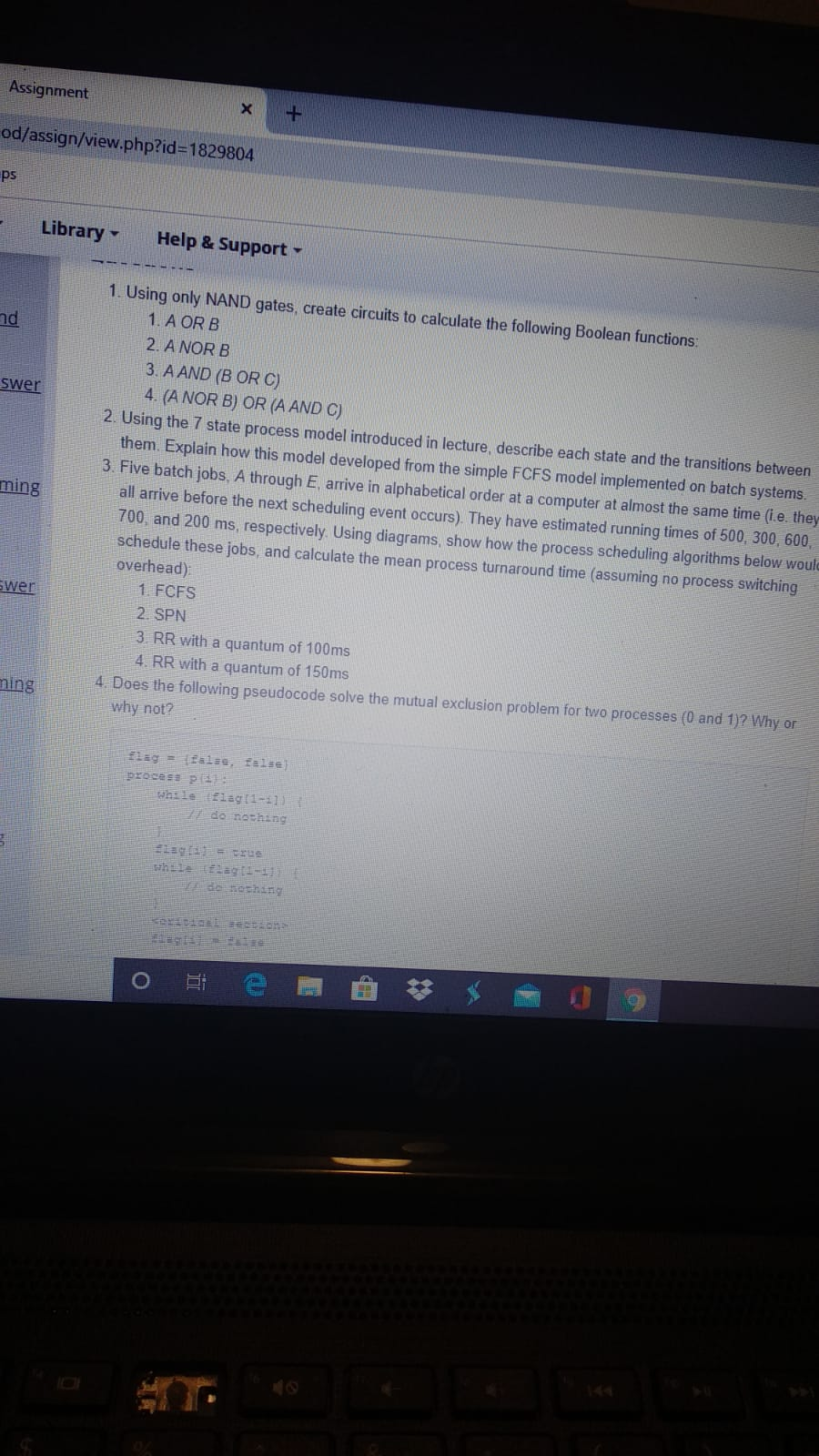
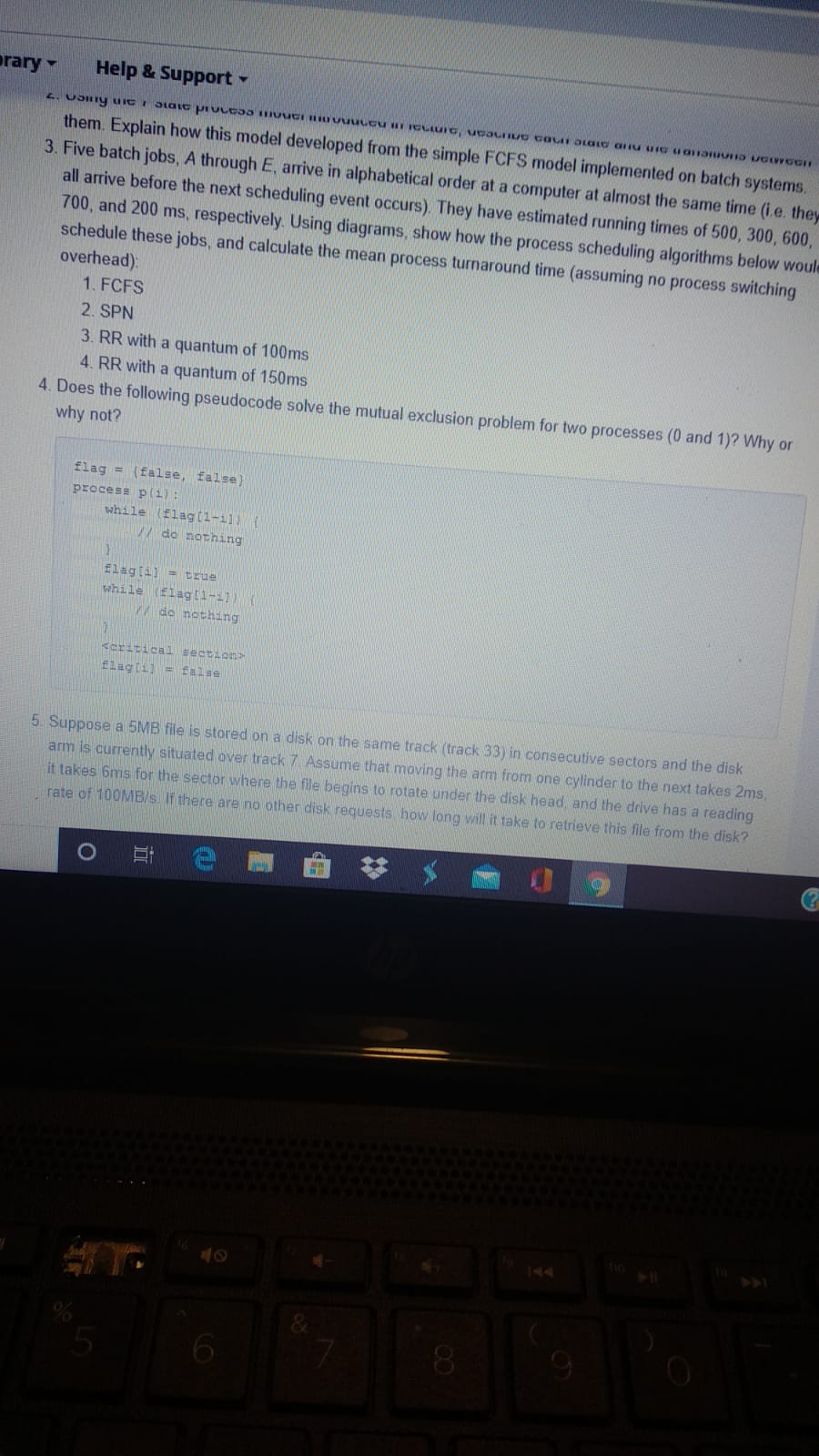
Assignment + od/assign/view.php?id=1829804 ps Library Help & Support nd swer ming 1. Using only NAND gates, create circuits to calculate the following Boolean functions: 1. A OR B 2. A NOR B 3. A AND (B OR C) 4. (A NOR B) OR (A AND C) 2. Using the 7 state process model introduced in lecture, describe each state and the transitions between them. Explain how this model developed from the simple FCFS model implemented on batch systems. 3. Five batch jobs, A through E, arrive in alphabetical order at a computer at almost the same time (i.e. they all arrive before the next scheduling event occurs). They have estimated running times of 500, 300, 600, 700 and 200 ms, respectively. Using diagrams, show how the process scheduling algorithms below would schedule these jobs, and calculate the mean process turnaround time (assuming no process switching overhead) 1. FCFS 2. SPN 3. RR with a quantum of 100ms 4. RR with a quantum of 150ms 4. Does the following pseudocode solve the mutual exclusion problem for two processes (0 and 1)? Why or why not? swer ming 129 = falas, False Flag11-21) do nothing orary Help & Support - 4. Uony UICI SLIC PULES HUCHWUCH CLUIC, COL COLI OLLC CHUIC HTS GECCE them. Explain how this model developed from the simple FCFS model implemented on batch systems. 3. Five batch jobs, A through E, arrive in alphabetical order at a computer at almost the same time (i e. they all arrive before the next scheduling event occurs). They have estimated running times of 500, 300, 600, 700, and 200 ms, respectively. Using diagrams, show how the process scheduling algorithms below woule schedule these jobs, and calculate the mean process turnaround time (assuming no process switching overhead) 1. FCFS 2. SPN 3. RR with a quantum of 100ms 4. RR with a quantum of 150ms 4. Does the following pseudocode solve the mutual exclusion problem for two processes (0 and 1)? Why or why not? flag = false, false) process pli while (flag (1-11) do nothing Elegal = true While (flag [1-11 do nothing Servical section Flag 1) = false 5. Suppose a 6MB file is stored on a disk on the same track (track 33) in consecutive sectors and the disk arm is currently situated over track 7 Assume that moving the arm from one cylinder to the next takes 2ms, takes 6ms for the sector where the file begins to rotate under the disk head and the drive has a reading rate of 100MB/s If there are no other disk requests how long will it take to retrieve this file from the disk? Assignment + od/assign/view.php?id=1829804 ps Library Help & Support nd swer ming 1. Using only NAND gates, create circuits to calculate the following Boolean functions: 1. A OR B 2. A NOR B 3. A AND (B OR C) 4. (A NOR B) OR (A AND C) 2. Using the 7 state process model introduced in lecture, describe each state and the transitions between them. Explain how this model developed from the simple FCFS model implemented on batch systems. 3. Five batch jobs, A through E, arrive in alphabetical order at a computer at almost the same time (i.e. they all arrive before the next scheduling event occurs). They have estimated running times of 500, 300, 600, 700 and 200 ms, respectively. Using diagrams, show how the process scheduling algorithms below would schedule these jobs, and calculate the mean process turnaround time (assuming no process switching overhead) 1. FCFS 2. SPN 3. RR with a quantum of 100ms 4. RR with a quantum of 150ms 4. Does the following pseudocode solve the mutual exclusion problem for two processes (0 and 1)? Why or why not? swer ming 129 = falas, False Flag11-21) do nothing orary Help & Support - 4. Uony UICI SLIC PULES HUCHWUCH CLUIC, COL COLI OLLC CHUIC HTS GECCE them. Explain how this model developed from the simple FCFS model implemented on batch systems. 3. Five batch jobs, A through E, arrive in alphabetical order at a computer at almost the same time (i e. they all arrive before the next scheduling event occurs). They have estimated running times of 500, 300, 600, 700, and 200 ms, respectively. Using diagrams, show how the process scheduling algorithms below woule schedule these jobs, and calculate the mean process turnaround time (assuming no process switching overhead) 1. FCFS 2. SPN 3. RR with a quantum of 100ms 4. RR with a quantum of 150ms 4. Does the following pseudocode solve the mutual exclusion problem for two processes (0 and 1)? Why or why not? flag = false, false) process pli while (flag (1-11) do nothing Elegal = true While (flag [1-11 do nothing Servical section Flag 1) = false 5. Suppose a 6MB file is stored on a disk on the same track (track 33) in consecutive sectors and the disk arm is currently situated over track 7 Assume that moving the arm from one cylinder to the next takes 2ms, takes 6ms for the sector where the file begins to rotate under the disk head and the drive has a reading rate of 100MB/s If there are no other disk requests how long will it take to retrieve this file from the disk









 Study Help