





Question: Assignment Question: What is the minimum expected time in which the project can be completed? Please draw all available critical paths. Exhibit 1 PROJECT DESCRIPTION
Assignment Question: What is the minimum expectedAssignment Question: What is the minimum expectedAssignment Question: What is the minimum expected

Assignment Question: What is the minimum expected time in which the project can be completed? Please draw all available critical paths.

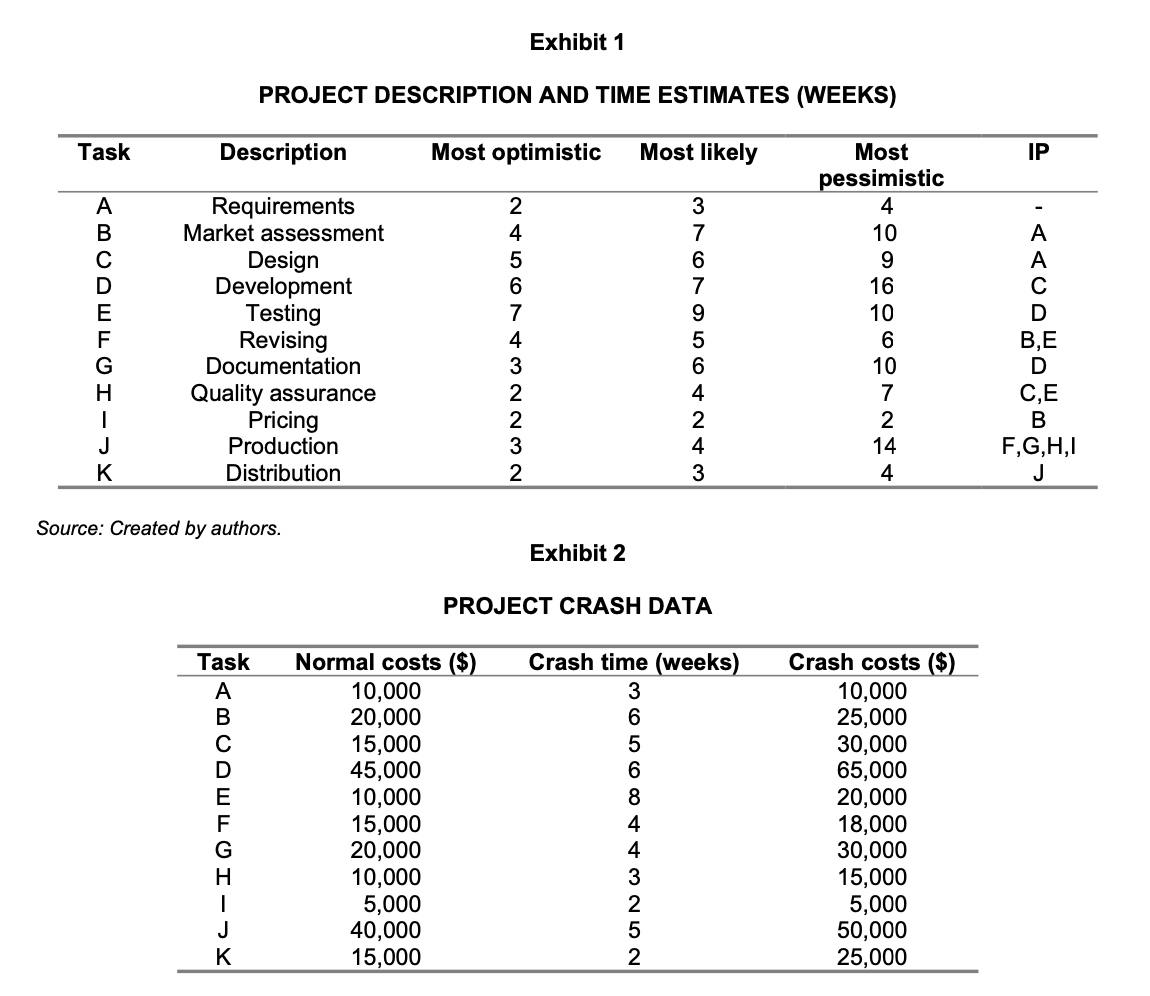
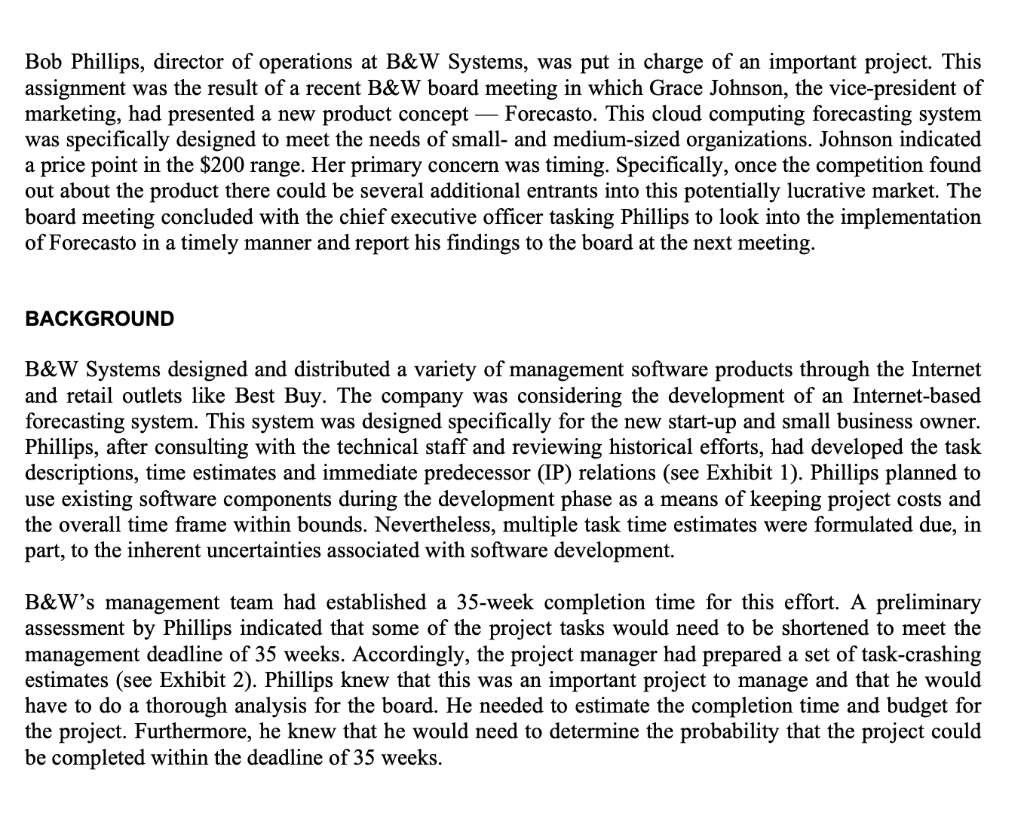
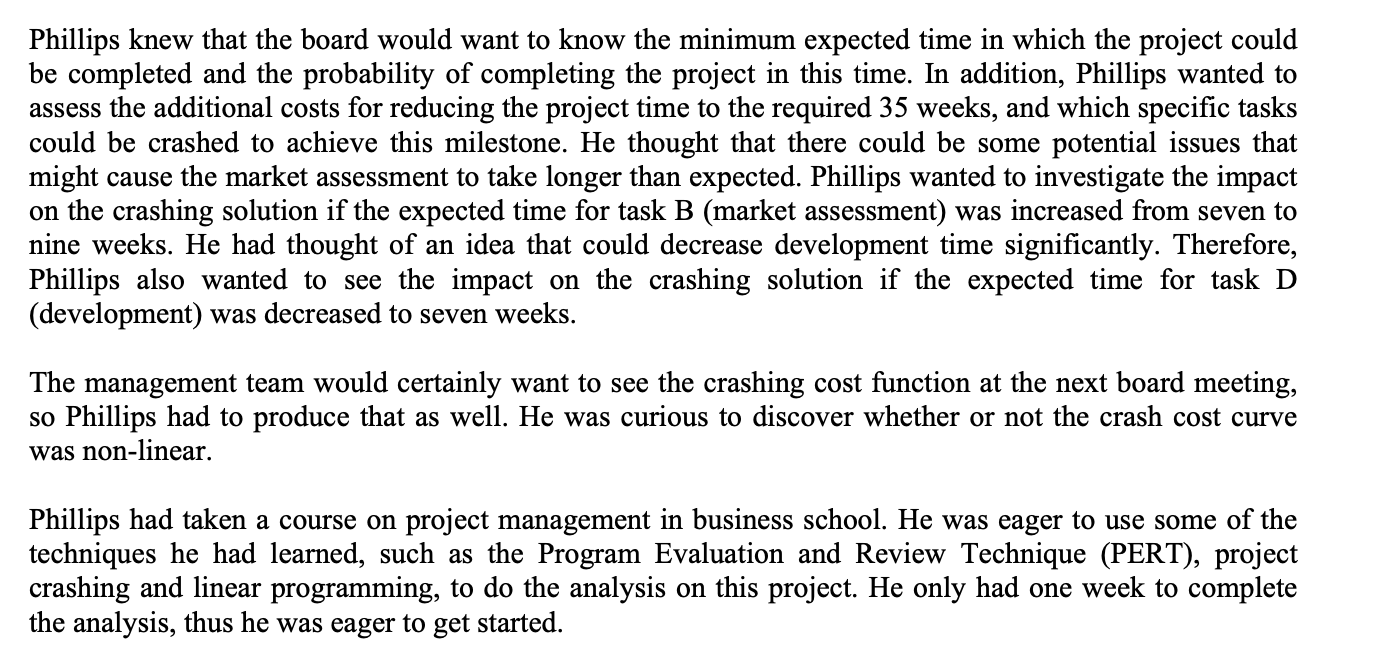
Exhibit 1 PROJECT DESCRIPTION AND TIME ESTIMATES (WEEKS) Task Description Most optimistic Most likely IP Most pessimistic 4 10 Normal costs ($) 10,000 20,000 15,000 45,000 10,000 15,000 20,000 10,000 5,000 40,000 15,000 Crash time (weeks) 3 6 5 6 8 4 4 3 2 5 2 MOLOOM Crash costs ($) 10,000 25,000 30,000 65,000 20,000 18,000 30,000 15,000 5,000 50,000 25,000 Bob Phillips, director of operations at B&W Systems, was put in charge of an important project. This assignment was the result of a recent B&W board meeting in which Grace Johnson, the vice-president of marketing, had presented a new product concept Forecasto. This cloud computing forecasting system was specifically designed to meet the needs of small- and medium-sized organizations. Johnson indicated a price point in the $200 range. Her primary concern was timing. Specifically, once the competition found out about the product there could be several additional entrants into this potentially lucrative market. The board meeting concluded with the chief executive officer tasking Phillips to look into the implementation of Forecasto in a timely manner and report his findings to the board at the next meeting. BACKGROUND B&W Systems designed and distributed a variety of management software products through the Internet and retail outlets like Best Buy. The company was considering the development of an Internet-based forecasting system. This system was designed specifically for the new start-up and small business owner. Phillips, after consulting with the technical staff and reviewing historical efforts, had developed the task descriptions, time estimates and immediate predecessor (IP) relations (see Exhibit 1). Phillips planned to use existing software components during the development phase as a means of keeping project costs and the overall time frame within bounds. Nevertheless, multiple task time estimates were formulated due, in part, to the inherent uncertainties associated with software development. B&W's management team had established a 35-week completion time for this effort. A preliminary assessment by Phillips indicated that some of the project tasks would need to be shortened to meet the management deadline of 35 weeks. Accordingly, the project manager had prepared a set of task-crashing estimates (see Exhibit 2). Phillips knew that this was an important project to manage and that he would have to do a thorough analysis for the board. He needed to estimate the completion time and budget for the project. Furthermore, he knew that he would need to determine the probability that the project could be completed within the deadline of 35 weeks. Phillips knew that the board would want to know the minimum expected time in which the project could be completed and the probability of completing the project in this time. In addition, Phillips wanted to assess the additional costs for reducing the project time to the required 35 weeks, and which specific tasks could be crashed to achieve this milestone. He thought that there could be some potential issues that might cause the market assessment to take longer than expected. Phillips wanted to investigate the impact on the crashing solution if the expected time for task B (market assessment) was increased from seven to nine weeks. He had thought of an idea that could decrease development time significantly. Therefore, Phillips also wanted to see the impact on the crashing solution if the expected time for task (development) was decreased to seven weeks. The management team would certainly want to see the crashing cost function at the next board meeting, so Phillips had to produce that as well. He was curious to discover whether or not the crash cost curve was non-linear. Phillips had taken a course on project management in business school. He was eager to use some of the techniques he had learned, such as the Program Evaluation and Review Technique (PERT), project crashing and linear programming, to do the analysis on this project. He only had one week to complete the analysis, thus he was eager to get started
Step by Step Solution

There are 3 Steps involved in it

1 Expert Approved Answer
Step: 1 Unlock blur-text-image

Question Has Been Solved by an Expert!

Get step-by-step solutions from verified subject matter experts

Step: 2 Unlock
Step: 3 Unlock

Students Have Also Explored These Related General Management Questions!