







Question: Assignment Question(s): Read carefully the mini case No 18 from your textbook (entitled Tesla Motors Inc.) and briefly answer the following questions: (1 mark for
Assignment Question(s):
Read carefully the mini case No 18 from your textbook (entitled Tesla Motors Inc.) and briefly answer the following questions: (1 mark for each question)
1. What is the competitive strategy used by Tesla Motors company?
2. Use the five forces of the M. Porter matrix to describe the industry that Tesla Motors belongs to.
3. Describe the different functional strategies of the Tesla Motors company.
4. Describe the relationship of Tesla Motors with its primary stakeholders.
5. Describe the market position of Tesla Motors.
6. Describe the core competency of Tesla Motors.
7. Describe any strategic alliance (acquisition, outsourcing, joint venture, .) used by Tesla Motors? Was it successful? justify.
8. What are the main challenges that Tesla Motors faced?
9. Assess the competitive advantage of Tesla Motors in its market.
10. Recommend solutions for Tesla Motors to improve its competitive advantage.
Please write it in a professional and more detailed manner
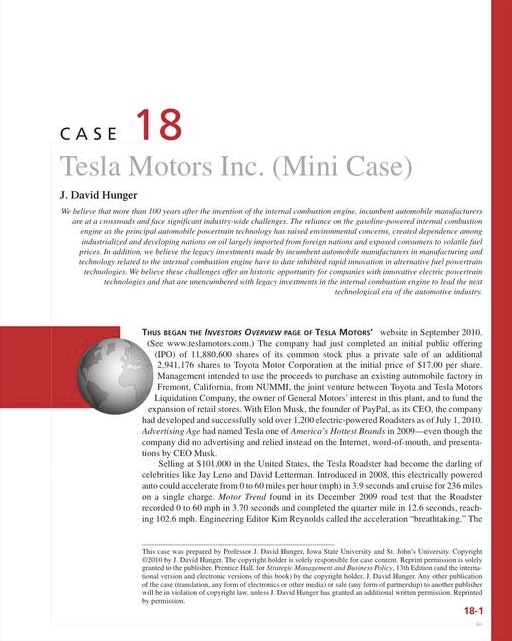
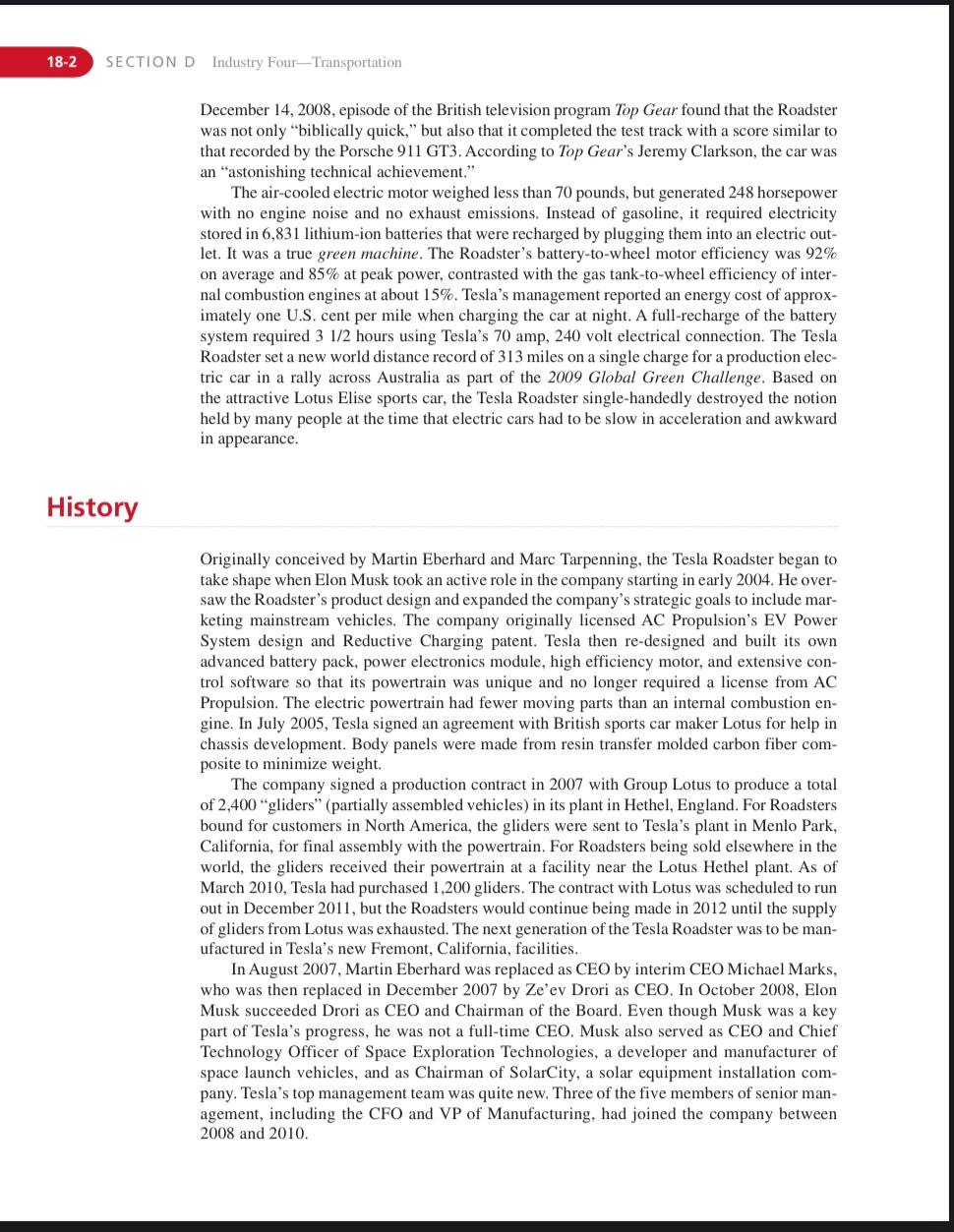
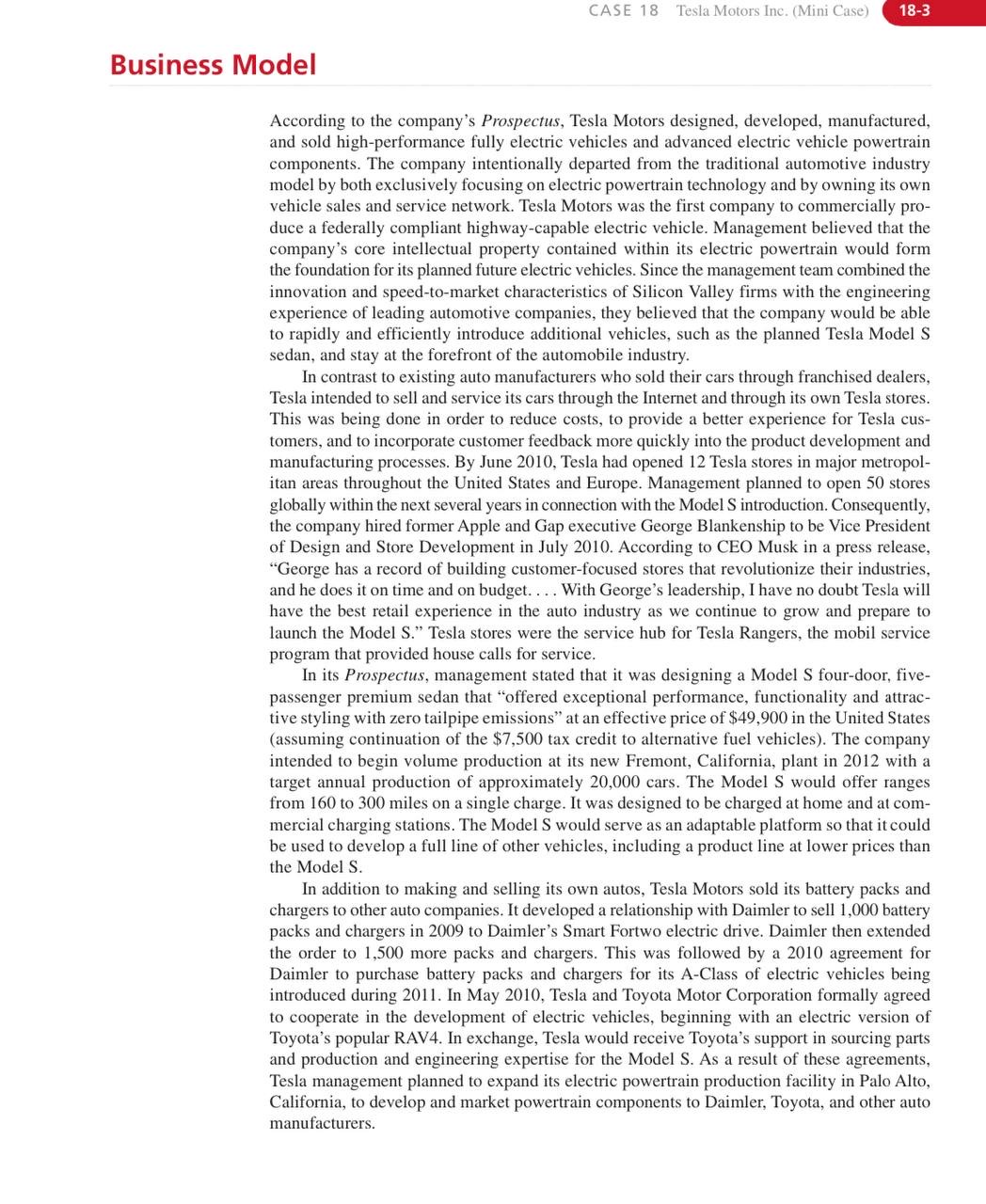
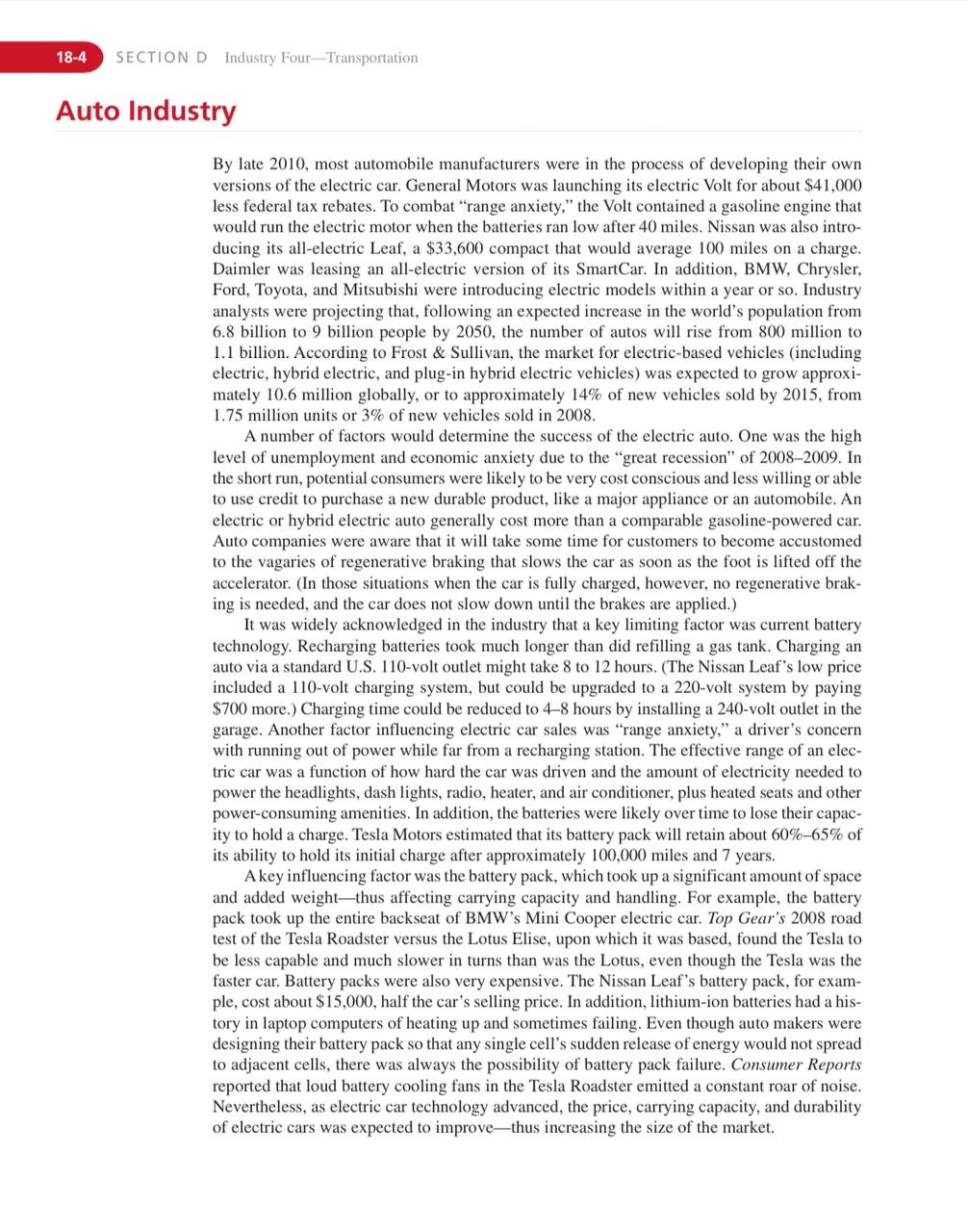
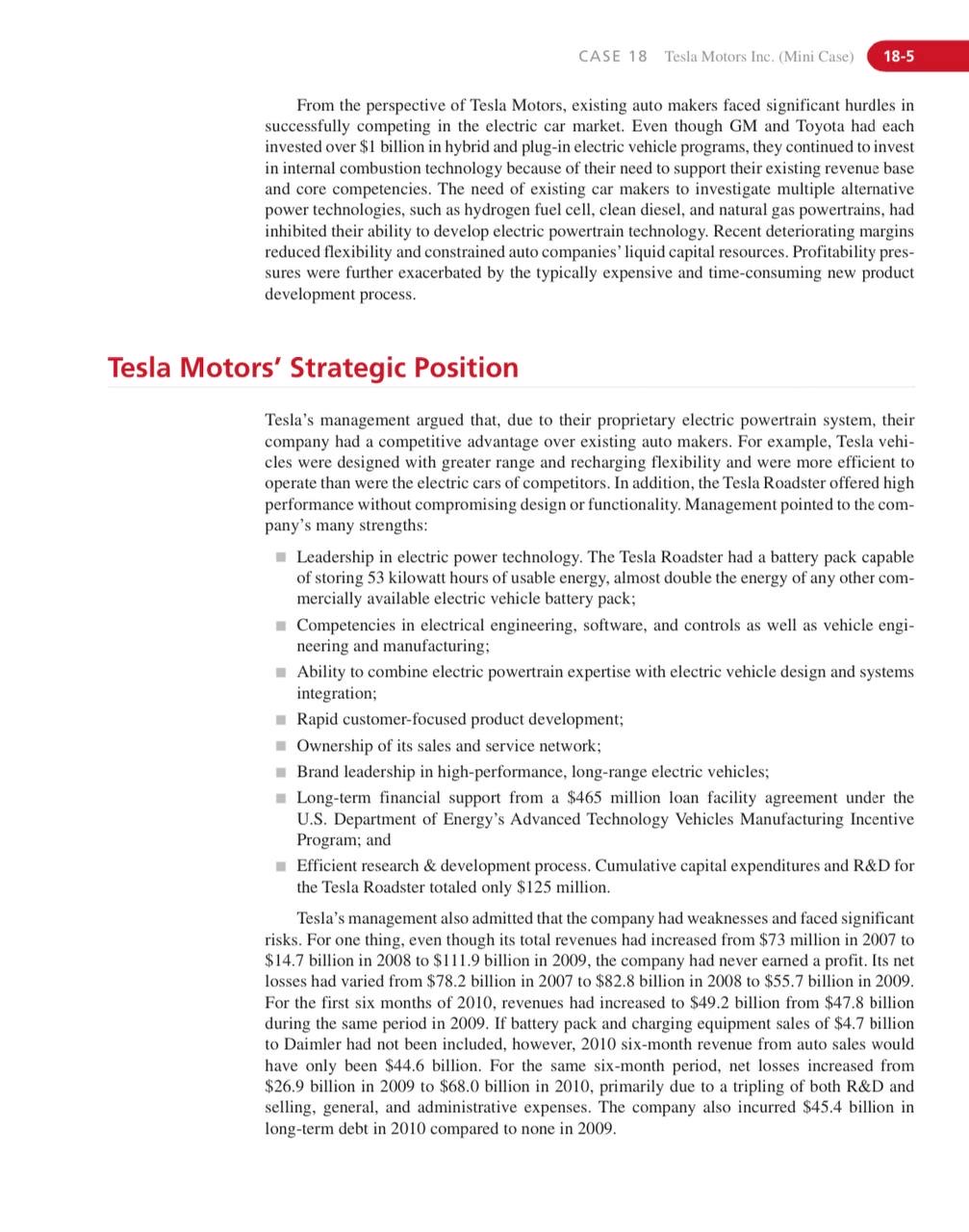
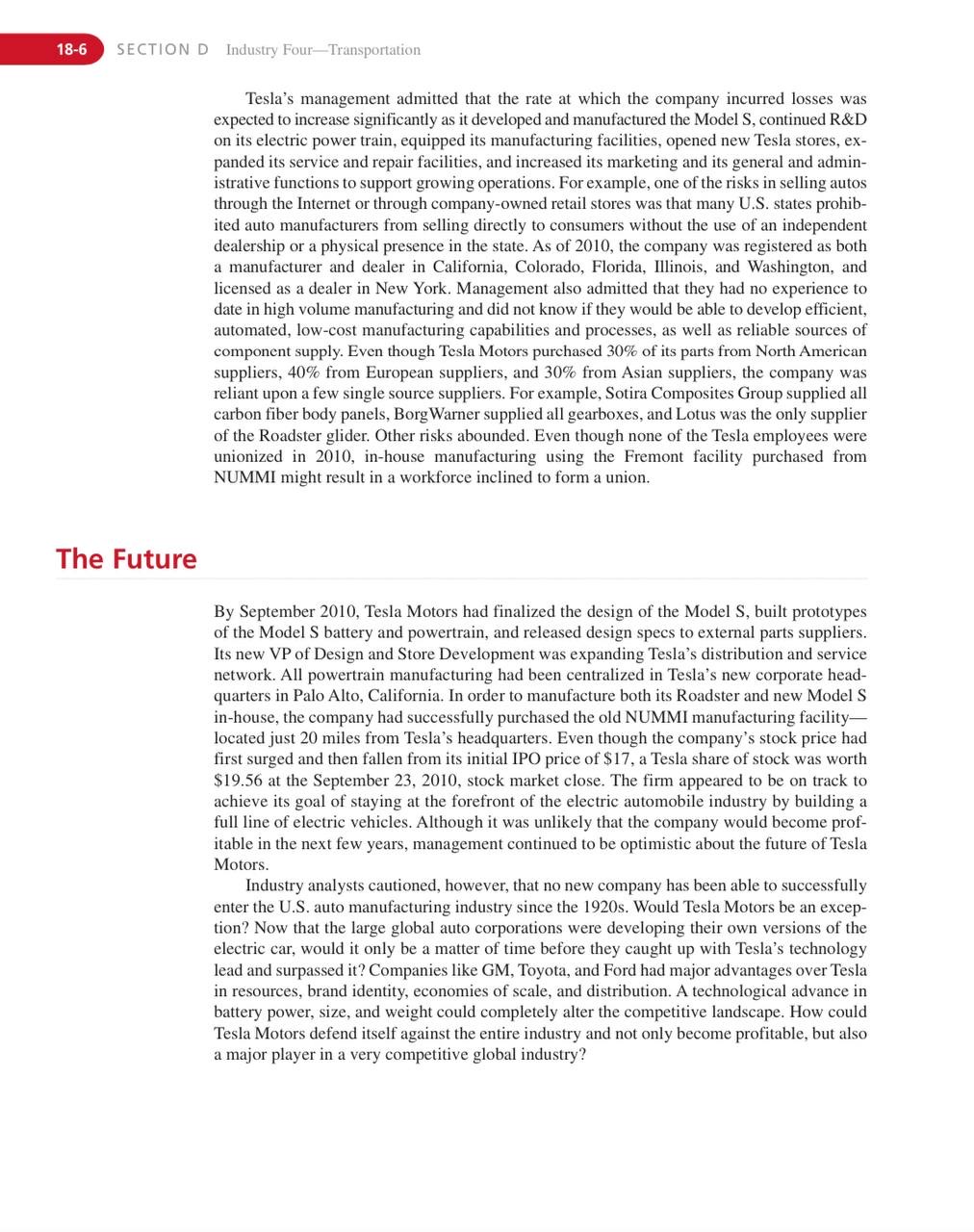
CASE Tesiam Motors Inc. (Mini Case) J. David Hunger techinological era uf the ausomodive industery Thes aEgan the Invesrons Overvew mage of Testa Morons' website in September 2010. (See www, feslamolors.com.) The company had just completed an initial public offering (IPO) of 11.880,600-shares of its common stock plus a private sale of an aiditaonal 2,941,176 shares to Toyota Motor Comoration at the initial ptice of \$17.000 per share. Management intended to use the procecds to purchase an existing antomobile factory in Fremont, California, from NUMMI, the joint venture between Toyota and Tesla Motors Liguadation Company, the owner of General Motors" interest in thas plant, and to fund the expansion of retail stores. Wath Eikn Musk, the founder of PayPal, as its CEO, the company had developed and saccessfully sold over 1,200 electric-powered Readsters as of July 1, 2010. Advertising Age had named Tesla one of America's Hottesf Brands in 2009 -oven though the company did no advertising and relied instexd on the Intemet, word-of-mouth, and presentations by CEO Musk- Selling at $101,0(K) in the United States, the Testa Roadster had become the darling of celebrities like Jay Leso and David Letterman. Introdtaced in 20018 , this electrically powered aute coukl actelerate from 0 to 60 miles per hour (mpha) in 3.9 seconds and crute for 23.6 miles on a single change. Mohor Tremi found in its December 2009 road text that the Roadster recorded 0 to 60 mph in 3.70 seconis and corspleted the quarter mile in 12.6 seconds, reach. ing 102.6 mph. Enginecring Editor Kim Reynolds called the acceleration thecathtaking. "The tionul verion and cloctronic veriens of thas book) by the copright holdor, 1. Davis Itungrr. Any other peblication by permicioin. December 14, 2008, episode of the British television program Top Gear found that the Roadster was not only "biblically quick," but also that it completed the test track with a score similar to that recorded by the Porsche 911 GT3. According to Top Gear's Jeremy Clarkson, the car was an "astonishing technical achievement." The air-cooled electric motor weighed less than 70 pounds, but generated 248 horsepower with no engine noise and no exhaust emissions. Instead of gasoline, it required electricity stored in 6,831 lithium-ion batteries that were recharged by plugging them into an electric outlet. It was a true green machine. The Roadster's battery-to-wheel motor efficiency was 92% on average and 85% at peak power, contrasted with the gas tank-to-wheel efficiency of internal combustion engines at about 15\%. Tesla's management reported an energy cost of approximately one U.S. cent per mile when charging the car at night. A full-recharge of the battery system required 31/2 hours using Tesla's 70amp,240 volt electrical connection. The Tesla Roadster set a new world distance record of 313 miles on a single charge for a production electric car in a rally across Australia as part of the 2009 Global Green Challenge. Based on the attractive Lotus Elise sports car, the Tesla Roadster single-handedly destroyed the notion held by many people at the time that electric cars had to be slow in acceleration and awkward in appearance. Originally conceived by Martin Eberhard and Marc Tarpenning, the Tesla Roadster began to take shape when Elon Musk took an active role in the company starting in early 2004 . He oversaw the Roadster's product design and expanded the company's strategic goals to include marketing mainstream vehicles. The company originally licensed AC Propulsion's EV Power System design and Reductive Charging patent. Tesla then re-designed and built its own advanced battery pack, power electronics module, high efficiency motor, and extensive control software so that its powertrain was unique and no longer required a license from AC Propulsion. The electric powertrain had fewer moving parts than an internal combustion engine. In July 2005, Tesla signed an agreement with British sports car maker Lotus for help in chassis development. Body panels were made from resin transfer molded carbon fiber composite to minimize weight. The company signed a production contract in 2007 with Group Lotus to produce a total of 2,400 "gliders" (partially assembled vehicles) in its plant in Hethel, England. For Roadsters bound for customers in North America, the gliders were sent to Tesla's plant in Menlo Park, California, for final assembly with the powertrain. For Roadsters being sold elsewhere in the world, the gliders received their powertrain at a facility near the Lotus Hethel plant. As of March 2010, Tesla had purchased 1,200 gliders. The contract with Lotus was scheduled to run out in December 2011, but the Roadsters would continue being made in 2012 until the supply of gliders from Lotus was exhausted. The next generation of the Tesla Roadster was to be manufactured in Tesla's new Fremont, California, facilities. In August 2007, Martin Eberhard was replaced as CEO by interim CEO Michael Marks, who was then replaced in December 2007 by Ze'ev Drori as CEO. In October 2008, Elon Musk succeeded Drori as CEO and Chairman of the Board. Even though Musk was a key part of Tesla's progress, he was not a full-time CEO. Musk also served as CEO and Chief Technology Officer of Space Exploration Technologies, a developer and manufacturer of space launch vehicles, and as Chairman of SolarCity, a solar equipment installation company. Tesla's top management team was quite new. Three of the five members of senior management, including the CFO and VP of Manufacturing, had joined the company between 2008 and 2010. According to the company's Prospectus, Tesla Motors designed, developed, manufactured, and sold high-performance fully electric vehicles and advanced electric vehicle powertrain components. The company intentionally departed from the traditional automotive industry model by both exclusively focusing on electric powertrain technology and by owning its own vehicle sales and service network. Tesla Motors was the first company to commercially produce a federally compliant highway-capable electric vehicle. Management believed that the company's core intellectual property contained within its electric powertrain would form the foundation for its planned future electric vehicles. Since the management team combined the innovation and speed-to-market characteristics of Silicon Valley firms with the engineering experience of leading automotive companies, they believed that the company would be able to rapidly and efficiently introduce additional vehicles, such as the planned Tesla Model S sedan, and stay at the forefront of the automobile industry. In contrast to existing auto manufacturers who sold their cars through franchised dealers, Tesla intended to sell and service its cars through the Internet and through its own Tesla stores. This was being done in order to reduce costs, to provide a better experience for Tesla customers, and to incorporate customer feedback more quickly into the product development and manufacturing processes. By June 2010 , Tesla had opened 12 Tesla stores in major metropolitan areas throughout the United States and Europe. Management planned to open 50 stores globally within the next several years in connection with the Model S introduction. Consequently, the company hired former Apple and Gap executive George Blankenship to be Vice President of Design and Store Development in July 2010 . According to CEO Musk in a press release, "George has a record of building customer-focused stores that revolutionize their industries, and he does it on time and on budget... With George's leadership, I have no doubt Tesla will have the best retail experience in the auto industry as we continue to grow and prepare to launch the Model S." Tesla stores were the service hub for Tesla Rangers, the mobil service program that provided house calls for service. In its Prospectus, management stated that it was designing a Model S four-door, fivepassenger premium sedan that "offered exceptional performance, functionality and attractive styling with zero tailpipe emissions" at an effective price of $49,900 in the United States (assuming continuation of the $7,500 tax credit to alternative fuel vehicles). The company intended to begin volume production at its new Fremont, California, plant in 2012 with a target annual production of approximately 20,000 cars. The Model S would offer ranges from 160 to 300 miles on a single charge. It was designed to be charged at home and at commercial charging stations. The Model S would serve as an adaptable platform so that it could be used to develop a full line of other vehicles, including a product line at lower prices than the Model S. In addition to making and selling its own autos, Tesla Motors sold its battery packs and chargers to other auto companies. It developed a relationship with Daimler to sell 1,000 battery packs and chargers in 2009 to Daimler's Smart Fortwo electric drive. Daimler then extended the order to 1,500 more packs and chargers. This was followed by a 2010 agreement for Daimler to purchase battery packs and chargers for its A-Class of electric vehicles being introduced during 2011. In May 2010, Tesla and Toyota Motor Corporation formally agreed to cooperate in the development of electric vehicles, beginning with an electric version of Toyota's popular RAV4. In exchange, Tesla would receive Toyota's support in sourcing parts and production and engineering expertise for the Model S. As a result of these agreements, Tesla management planned to expand its electric powertrain production facility in Palo Alto, California, to develop and market powertrain components to Daimler, Toyota, and other auto manufacturers. By late 2010, most automobile manufacturers were in the process of developing their own versions of the electric car. General Motors was launching its electric Volt for about $41,000 less federal tax rebates. To combat "range anxiety," the Volt contained a gasoline engine that would run the electric motor when the batteries ran low after 40 miles. Nissan was also introducing its all-electric Leaf, a $33,600 compact that would average 100 miles on a charge. Daimler was leasing an all-electric version of its SmartCar. In addition, BMW, Chrysler, Ford, Toyota, and Mitsubishi were introducing electric models within a year or so. Industry analysts were projecting that, following an expected increase in the world's population from 6.8 billion to 9 billion people by 2050 , the number of autos will rise from 800 million to 1.1 billion. According to Frost \& Sullivan, the market for electric-based vehicles (including electric, hybrid electric, and plug-in hybrid electric vehicles) was expected to grow approximately 10.6 million globally, or to approximately 14% of new vehicles sold by 2015 , from 1.75 million units or 3% of new vehicles sold in 2008 . A number of factors would determine the success of the electric auto. One was the high level of unemployment and economic anxiety due to the "great recession" of 2008-2009. In the short run, potential consumers were likely to be very cost conscious and less willing or able to use credit to purchase a new durable product, like a major appliance or an automobile. An electric or hybrid electric auto generally cost more than a comparable gasoline-powered car. Auto companies were aware that it will take some time for customers to become accustomed to the vagaries of regenerative braking that slows the car as soon as the foot is lifted off the accelerator. (In those situations when the car is fully charged, however, no regenerative braking is needed, and the car does not slow down until the brakes are applied.) It was widely acknowledged in the industry that a key limiting factor was current battery technology. Recharging batteries took much longer than did refilling a gas tank. Charging an auto via a standard U.S. 110-volt outlet might take 8 to 12 hours. (The Nissan Leaf's low price included a 110 -volt charging system, but could be upgraded to a 220-volt system by paying $700 more.) Charging time could be reduced to 4-8 hours by installing a 240-volt outlet in the garage. Another factor influencing electric car sales was "range anxiety," a driver's concern with running out of power while far from a recharging station. The effective range of an electric car was a function of how hard the car was driven and the amount of electricity needed to power the headlights, dash lights, radio, heater, and air conditioner, plus heated seats and other power-consuming amenities. In addition, the batteries were likely over time to lose their capacity to hold a charge. Tesla Motors estimated that its battery pack will retain about 60\%-65\% of its ability to hold its initial charge after approximately 100,000 miles and 7 years. A key influencing factor was the battery pack, which took up a significant amount of space and added weight-thus affecting carrying capacity and handling. For example, the battery pack took up the entire backseat of BMW's Mini Cooper electric car. Top Gear's 2008 road test of the Tesla Roadster versus the Lotus Elise, upon which it was based, found the Tesla to be less capable and much slower in turns than was the Lotus, even though the Tesla was the faster car. Battery packs were also very expensive. The Nissan Leaf's battery pack, for example, cost about $15,000, half the car 's selling price. In addition, lithium-ion batteries had a history in laptop computers of heating up and sometimes failing. Even though auto makers were designing their battery pack so that any single cell's sudden release of energy would not spread to adjacent cells, there was always the possibility of battery pack failure. Consumer Reports Nevertheless, as electric car technology advanced, the price, carrying capacity, and durability of electric cars was expected to improve-thus increasing the size of the market. From the perspective of Tesla Motors, existing auto makers faced significant hurdles in successfully competing in the electric car market. Even though GM and Toyota had each invested over $1 billion in hybrid and plug-in electric vehicle programs, they continued to invest in internal combustion technology because of their need to support their existing revenue base and core competencies. The need of existing car makers to investigate multiple alternative power technologies, such as hydrogen fuel cell, clean diesel, and natural gas powertrains, had inhibited their ability to develop electric powertrain technology. Recent deteriorating margins reduced flexibility and constrained auto companies' liquid capital resources. Profitability pressures were further exacerbated by the typically expensive and time-consuming new product development process. tors' Strategic Position Tesla's management argued that, due to their proprietary electric powertrain system, their company had a competitive advantage over existing auto makers. For example, Tesla vehicles were designed with greater range and recharging flexibility and were more efficient to operate than were the electric cars of competitors. In addition, the Tesla Roadster offered high performance without compromising design or functionality. Management pointed to the company's many strengths: - Leadership in electric power technology. The Tesla Roadster had a battery pack capable of storing 53 kilowatt hours of usable energy, almost double the energy of any other commercially available electric vehicle battery pack; [ Competencies in electrical engineering, software, and controls as well as vehicle engineering and manufacturing; - Ability to combine electric powertrain expertise with electric vehicle design and systems integration; [ Rapid customer-focused product development; - Ownership of its sales and service network; - Brand leadership in high-performance, long-range electric vehicles; - Long-term financial support from a $465 million loan facility agreement under the U.S. Department of Energy's Advanced Technology Vehicles Manufacturing Incentive Program; and Efficient research \& development process. Cumulative capital expenditures and R\&D for the Tesla Roadster totaled only $125 million. Tesla's management also admitted that the company had weaknesses and faced significant risks. For one thing, even though its total revenues had increased from $73 million in 2007 to $14.7 billion in 2008 to $111.9 billion in 2009 , the company had never earned a profit. Its net losses had varied from $78.2 billion in 2007 to $82.8 billion in 2008 to $55.7 billion in 2009 . For the first six months of 2010 , revenues had increased to $49.2 billion from $47.8 billion during the same period in 2009 . If battery pack and charging equipment sales of $4.7 billion to Daimler had not been included, however, 2010 six-month revenue from auto sales would have only been $44.6 billion. For the same six-month period, net losses increased from $26.9 billion in 2009 to $68.0 billion in 2010 , primarily due to a tripling of both R\&D and selling, general, and administrative expenses. The company also incurred $45.4 billion in long-term debt in 2010 compared to none in 2009. Tesla's management admitted that the rate at which the company incurred losses was expected to increase significantly as it developed and manufactured the Model S, continued R\&D on its electric power train, equipped its manufacturing facilities, opened new Tesla stores, expanded its service and repair facilities, and increased its marketing and its general and administrative functions to support growing operations. For example, one of the risks in selling autos through the Internet or through company-owned retail stores was that many U.S. states prohibited auto manufacturers from selling directly to consumers without the use of an independent dealership or a physical presence in the state. As of 2010 , the company was registered as both a manufacturer and dealer in California, Colorado, Florida, Illinois, and Washington, and licensed as a dealer in New York. Management also admitted that they had no experience to date in high volume manufacturing and did not know if they would be able to develop efficient, automated, low-cost manufacturing capabilities and processes, as well as reliable sources of component supply. Even though Tesla Motors purchased 30\% of its parts from North American suppliers, 40% from European suppliers, and 30% from Asian suppliers, the company was reliant upon a few single source suppliers. For example, Sotira Composites Group supplied all carbon fiber body panels, BorgWarner supplied all gearboxes, and Lotus was the only supplier of the Roadster glider. Other risks abounded. Even though none of the Tesla employees were unionized in 2010, in-house manufacturing using the Fremont facility purchased from NUMMI might result in a workforce inclined to form a union. By September 2010, Tesla Motors had finalized the design of the Model S, built prototypes of the Model S battery and powertrain, and released design specs to external parts suppliers. Its new VP of Design and Store Development was expanding Tesla's distribution and service network. All powertrain manufacturing had been centralized in Tesla's new corporate headquarters in Palo Alto, California. In order to manufacture both its Roadster and new Model S in-house, the company had successfully purchased the old NUMMI manufacturing facilitylocated just 20 miles from Tesla's headquarters. Even though the company's stock price had first surged and then fallen from its initial IPO price of $17, a Tesla share of stock was worth $19.56 at the September 23,2010 , stock market close. The firm appeared to be on track to achieve its goal of staying at the forefront of the electric automobile industry by building a full line of electric vehicles. Although it was unlikely that the company would become profitable in the next few years, management continued to be optimistic about the future of Tesla Motors. Industry analysts cautioned, however, that no new company has been able to successfully enter the U.S. auto manufacturing industry since the 1920s. Would Tesla Motors be an exception? Now that the large global auto corporations were developing their own versions of the electric car, would it only be a matter of time before they caught up with Tesla's technology lead and surpassed it? Companies like GM, Toyota, and Ford had major advantages over Tesla in resources, brand identity, economies of scale, and distribution. A technological advance in battery power, size, and weight could completely alter the competitive landscape. How could Tesla Motors defend itself against the entire industry and not only become profitable, but also a major player in a very competitive global industry Step by Step Solution
There are 3 Steps involved in it
1 Expert Approved Answer
Step: 1 Unlock

Question Has Been Solved by an Expert!
Get step-by-step solutions from verified subject matter experts
Step: 2 Unlock
Step: 3 Unlock
 Study Help