Question: Assignment-3 Please read the Management in Action case Norwegian Air Shuttle Aspires to Become the Cheapest Global Airline at the end of Chapter 4 Global
Assignment-3
Please read the Management in Action case Norwegian Air Shuttle Aspires to Become the Cheapest Global Airline at the end of Chapter 4 Global Management available in your textbook Management: A Practical Approach 7th edition by Kinicki, A., & Williams, B., and answer the following questions:
Assignment Question(s): (Marks 10)
1. What are the biggest challenges Norwegian experienced in trying to expand its airline across the globe? (2.5 marks)
2. To what extent did you observe examples of ethnocentric, polycentric, or geocentric attitudes in this case? Provide examples to support your conclusions. (2.5 marks)
3. Use Table 4.4 (Given below) to identify cultural differences that are likely to arise between Norwegian employees working in Denmark and Sweden and Thailand. How might these differences affect interpersonal interactions, and what can the company do to reduce any unintended conflict from these differences? (3 marks)
4. What are the most important lessons to be learned about global management from this case? Discuss.(2 marks)
TABLE 4.4 Countries Ranking Highest and Lowest on the Globe Cultural Dimensions
DIMENSION | HIGHEST | LOWEST |
Power distance | Morocco, Argentina, Thailand, Spain, Russia | Denmark, Netherlands, South Africa (black sample), Israel, Costa Rica |
Uncertainty avoidance | Switzerland, Sweden, Germany (former West), Denmark, Austria | Russia, Hungary, Bolivia, Greece, Venezuela |
Institutional collectivism | Sweden, South Korea, Japan, Singapore, Denmark | Greece, Hungary, Germany (former East), Argentina, Italy |
In-group collectivism | Iran, India, Morocco, China, Egypt | Denmark, Sweden, New Zealand, Netherlands, Finland |
Gender egalitarianism | Hungary, Poland, Slovenia, Denmark, Sweden | South Korea, Egypt, Morocco, India, China |
Assertiveness | Germany (former East), Austria, Greece, United States, Spain | Sweden, New Zealand, Switzerland, Japan, Kuwait |
Future orientation | Singapore, Switzerland, Netherlands, Canada (English speaking), Denmark | Russia, Argentina, Poland, Italy, Kuwait |
Performance orientation | Singapore, Hong Kong, New Zealand, Taiwan, United States | Russia, Argentina, Greece, Venezuela, Italy |
Human orientation | Philippines, Ireland, Malaysia, Egypt, Indonesia | Germany (former West), Spain, France, Singapore, Brazil |
5. Source: Adapted from M. Javidan and R. J. House, Cultural Acumen for the Global Manager: Lessons from Project GLOBE, Organizational Dynamics, Spring 2001, pp. 289305.
Answers:
1.
2.
3.
4.
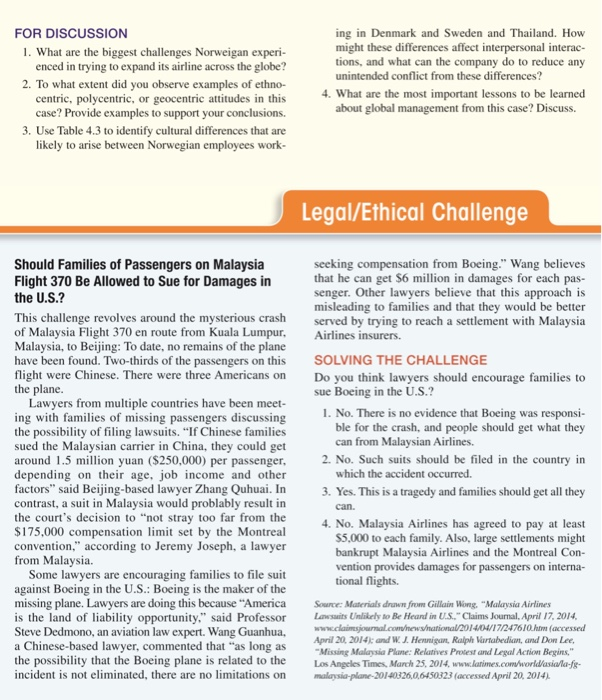
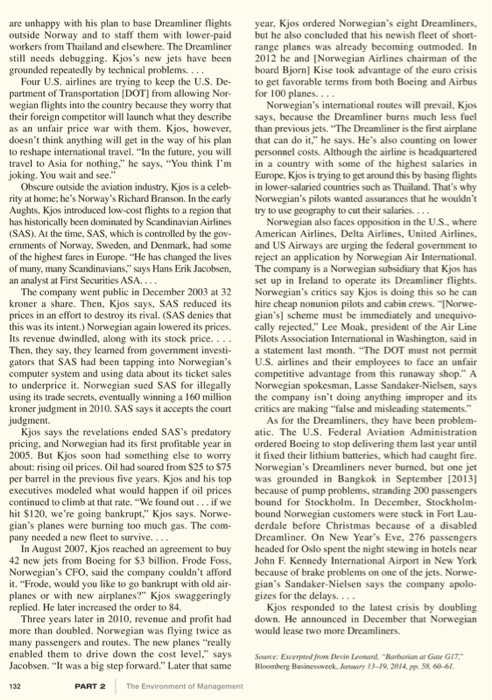
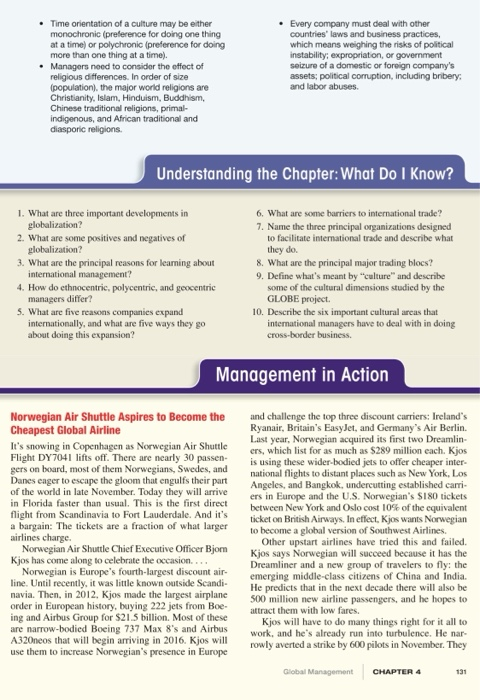
FOR DISCUSSION 1. What are the biggest challenges Norweigan experi- enced in trying to expand its airline across the globe? 2. To what extent did you observe examples of ethno- centric, polycentric, or geocentric attitudes in this case? Provide examples to support your conclusions. 3. Use Table 4.3 to identify cultural differences that are likely to arise between Norwegian employees work- ing in Denmark and Sweden and Thailand. How might these differences affect interpersonal interac- tions, and what can the company do to reduce any unintended conflict from these differences? 4. What are the most important lessons to be learned about global management from this case? Discuss. Legal/Ethical Challenge seeking compensation from Boeing." Wang believes that he can get $6 million in damages for each pas- senger. Other lawyers believe that this approach is misleading to families and that they would be better served by trying to reach a settlement with Malaysia Airlines insurers. Should Families of Passengers on Malaysia Flight 370 Be Allowed to Sue for Damages in the U.S.? This challenge revolves around the mysterious crash of Malaysia Flight 370 en route from Kuala Lumpur, Malaysia, to Beijing: To date, no remains of the plane have been found. Two-thirds of the passengers on this flight were Chinese. There were three Americans on the plane. Lawyers from multiple countries have been meet- ing with families of missing passengers discussing the possibility of filing lawsuits. "If Chinese families sued the Malaysian carrier in China, they could get around 1.5 million yuan ($250,000) per passenger, depending on their age, job income and other factors" said Beijing-based lawyer Zhang Quhuai. In contrast, a suit in Malaysia would problably result in the court's decision to "not stray too far from the $175,000 compensation limit set by the Montreal convention," according to Jeremy Joseph, a lawyer from Malaysia. Some lawyers are encouraging families to file suit against Boeing in the U.S.: Boeing is the maker of the missing plane. Lawyers are doing this because "America is the land of liability opportunity," said Professor Steve Dedmono, an aviation law expert. Wang Guanhua, a Chinese-based lawyer, commented that was long as the possibility that the Boeing plane is related to the incident is not eliminated, there are no limitations on SOLVING THE CHALLENGE Do you think lawyers should encourage families to sue Boeing in the U.S.? 1. No. There is no evidence that Boeing was responsi- ble for the crash, and people should get what they can from Malaysian Airlines. 2. No. Such suits should be filed in the country in which the accident occurred. 3. Yes. This is a tragedy and families should get all they can. 4. No. Malaysia Airlines has agreed to pay at least $5,000 to each family. Also, large settlements might bankrupt Malaysia Airlines and the Montreal Con- vention provides damages for passengers on interna- tional flights. Source: Materials drawn from Gillain Wong. "Malaysia Airlines Lawsuits Unlikely to Be Heard in U.S. Claims Journal, April 17, 2014 www.claimsjournal.comewsational/2014/04/17/247610 mm (accessed April 20, 2014) and W. J. Hennigan, Ralph Vartabedian, and Don Lee, "Missing Malaysia Plane: Relatives Protest and Legal Action Begins," Los Angeles Times, March 25, 2014, www.latimes.com/World/asia/la-la- malaysia-plane-20140326,0,6450323 (accessed April 20, 2014) are unhappy with his plan to base Dreamliner flights outside Norway and to staff them with lower-paid workers from Thailand and elsewhere. The Dreamliner still needs debugging. Kjos's new jets have been grounded repeatedly by technical problems.... Four U.S. airlines are trying to keep the U.S. De- partment of Transportation (DOT) from allowing Nor wegian flights into the country because they worry that their foreign competitor will launch what they describe as an unfair price war with them. Kjos, however, doesn't think anything will get in the way of his plan to reshape international travel. "In the future, you will travel to Asia for nothing," he says, "You think I'm joking. You wait and see. Obscure outside the aviation industry. Kjos is a celeb- rity at home; he's Norway's Richard Branson. In the early Aughts, Kjos introduced low-cost flights to a region that has historically been dominated by Scandinavian Airlines (SAS). At the time, SAS, which is controlled by the gov- crnments of Norway, Sweden, and Denmark, had some of the highest fares in Europe. "He has changed the lives of many, many Scandinavians," says Hans Erik Jacobsen an analyst at First Securities ASA.... The company went public in December 2003 at 32 kroner a share. Then, Kjos says, SAS reduced its prices in an effort to destroy its rival. (SAS denies that this was its intent.) Norwegian again lowered its prices. Its revenue dwindled, along with its stock price.... Then, they say, they learned from government investi- gators that SAS had been tapping into Norwegian's computer system and using data about its ticket sales to underprice it. Norwegian sued SAS for illegally using its trade secrets, eventually winning a 160 million kroner judgment in 2010. SAS says it accepts the court judgment Kjos says the revelations ended SAS's predatory pricing, and Norwegian had its first profitable year in 2005. But Kjos soon had something else to worry about: rising oil prices. Oil had soared from $25 to $75 per barrel in the previous five years. Kjos and his top executives modeled what would happen if oil prices continued to climb at that rate. "We found out ... if we hit $120, we're going bankrupt. Kjos says. Norwe- gian's planes were burning too much gas. The com- pany needed a new fleet to survive.... In August 2007. Kjos reached an agreement to buy 42 new jets from Boeing for $3 billion. Frode Foss. Norwegian's CFO, said the company couldn't afford it. "Frode, would you like to go bankrupt with old air- planes or with new airplanes? Kjos swaggeringly replied. He later increased the order to 84. Three years later in 2010, revenue and profit had more than doubled. Norwegian was flying twice as many passengers and routes. The new planes "really enabled them to drive down the cost level," says Jacobsen. "It was a big step forward. Later that same year, Kjos ordered Norwegian's eight Dreamliners, but he also concluded that his newish fleet of short range planes was already becoming outmoded. In 2012 he and Norwegian Airlines chairman of the board Bjorn) Kise took advantage of the curo crisis to get favorable terms from both Boeing and Airbus for 100 planes.... Norwegian's international routes will prevail. Kjos says, because the Dreamliner burns much less fuel than previous jets. "The Dreamliner is the first airplane that can do it," he says. He's also counting on lower personnel costs. Although the airline is headquartered in a country with some of the highest salaries in Europe. Kjos is trying to get around this by using flights in lower-salaried countries such as Thailand. That's why Norwegian's pilots wanted assurances that he wouldn't try to use geography to cut their salaries.... Norwegian also faces opposition in the US, where American Airlines, Delta Airlines, United Airlines, and US Airways are urging the federal government to reject an application by Norwegian Air International The company is a Norwegian subsidiary that Kjos has set up in Ireland to operate its Dreamliner flights. Norwegian's critics say Kjos is doing this so he can hire cheap nonunion pilots and cabin crews. "Norwe- gian's] scheme must be immediately and unequivo cally rejected." Lee Moak, president of the Air Line Pilots Association International in Washington, said in a statement last month. "The DOT must not permit U.S. airlines and their employees to face an unfair competitive advantage from this runaway shop." A Norwegian spokesman, Lasse Sandaker-Nielsen, says the company isn't doing anything improper and its critics are making "false and misleading statements." As for the Dreamliners, they have been problem- atic. The U.S. Federal Aviation Administration ordered Boeing to stop delivering them last year until it fixed their lithium batteries, which had caught fire Norwegian's Dreamliners never burned, but one jet was grounded in Bangkok in September 2013 because of pump problems, stranding 200 passengers bound for Stockholm. In December, Stockholm bound Norwegian customers were stuck in Fort Lau derdale before Christmas because of a disabled Dreamliner. On New Year's Eve, 276 passengers headed for Oslo spent the night stewing in hotels near John F. Kennedy International Airport in New York because of brake problems on one of the jets. Norwe gian's Sandaker Nielsen says the company apolo gizes for the delays.... Kjos responded to the latest crisis by doubling down. He announced in December that Norwegian would lease two more Dreamliners. Sourer Exced from Devil Bloomberg Businesweek. 1219.2014 G GIT S60 61 PART 2 The Environment of Management Time orientation of a culture may be either monochronic (preference for doing one thing at a time or polychronic (preference for doing more than one thing at a time. Managers need to consider the effect of religious differences. In order of size population, the major world religions are Christianity, Islam, Hinduism, Buddhism, Chinese traditional religions, primal indigenous, and African traditional and diasporic religions Every company must deal with other countries' laws and business practices, which means weighing the risks of political instability, expropriation, or government seizure of a domestic or foreign company's assets, political comption, including bribery. and labor abuses Understanding the Chapter: What Do I Know? 1. What are three important developments in globalization? 2. What are some positives and negatives of globalization? 3. What are the principal reasons for learning about international management? 4. How do ethnocentric, polycentric, and geocentric managers differ? 5. What are five reasons companies expand internationally, and what are five ways they go about doing this expansion? 6. What are some barriers to international trade? 7. Name the three principal organizations designed to facilitate international trade and describe what they do. 8. What are the principal major trading blocs? 9. Define what's meant by "culture and describe some of the cultural dimensions studied by the GLOBE project 10. Describe the six important cultural areas that international managers have to deal with in doing Cross-border business Management in Action Norwegian Air Shuttle Aspires to Become the Cheapest Global Airline It's snowing in Copenhagen as Norwegian Air Shuttle Flight DY7041 lifts off. There are nearly 30 passen- gers on board, most of them Norwegians, Swedes, and Danes eager to escape the gloom that engulfs their part of the world in late November. Today they will arrive in Florida faster than usual. This is the first direct flight from Scandinavia to Fort Lauderdale. And it's a bargain: The tickets are a fraction of what larger airlines charge. Norwegian Air Shuttle Chief Executive Officer Bjom Kjos has come along to celebrate the occasion.... Norwegian is Europe's fourth-largest discount air- line. Until recently, it was little known outside Scandi- navia. Then, in 2012. Kjos made the largest airplane order in European history, buying 222 jets from Boe- ing and Airbus Group for $21.5 billion. Most of these are narrow-bodied Boeing 737 Max 8's and Airbus A320neos that will begin arriving in 2016. Kjos will use them to increase Norwegian's presence in Europe and challenge the top three discount carriers: Ireland's Ryanair, Britain's EasyJet, and Germany's Air Berlin Last year, Norwegian acquired its first two Dreamlin- ers, which list for as much as $289 million each. Kjos is using these wider-bodied jets to offer cheaper inter national flights to distant places such as New York, Los Angeles, and Bangkok, undercutting established carri ers in Europe and the U.S. Norwegian's S180 tickets between New York and Oslo cost 10% of the equivalent ticket on British Airways. In effect. Kjos wants Norwegian to become a global version of Southwest Airlines Other upstart airlines have tried this and failed. Kjos says Norwegian will succeed because it has the Dreamliner and a new group of travelers to fly: the emerging middle-class citizens of China and India. He predicts that in the next decade there will also be 500 million new airline passengers, and he hopes to attract them with low fares. Kjos will have to do many things right for it all to work, and he's already run into turbulence. He mar rowly averted a strike by 600 pilots in November. They Global Management CHAPTER 191