



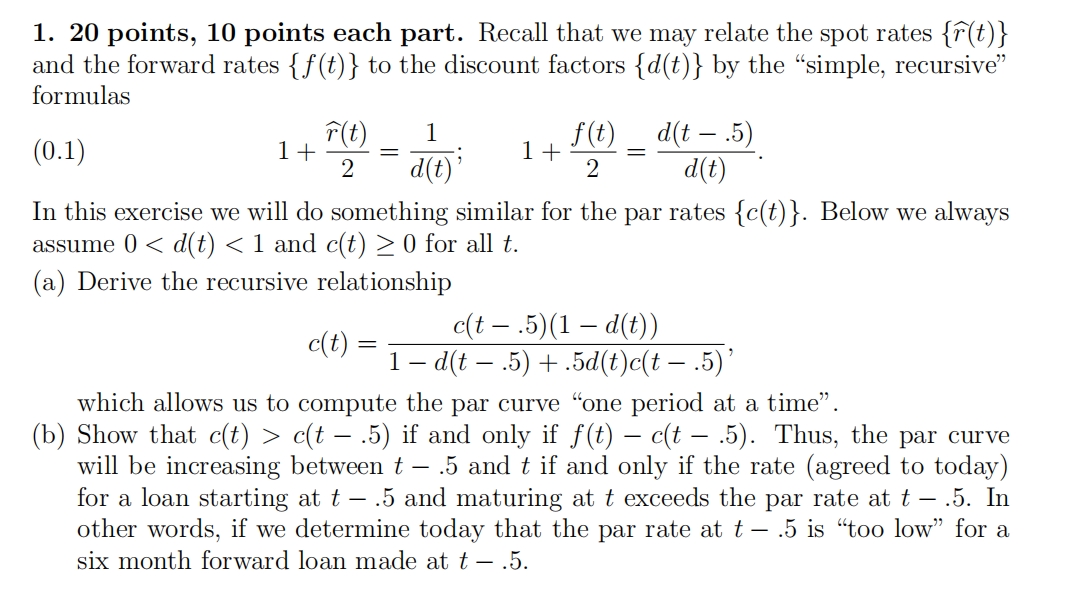
Question: assume c ( t ) 0 t c ( t ) = c ( t - . 5 ) ( 1 - d ( t
assume and for all
Derive the recursive relationship
which allows compute the par curve "one period a time".
Show that and only Thus, the par curve
will increasing between and and only the rate today
for a loan starting and maturing exceeds the par rate
other words, determine today that the par rate "too low" for
six month forward loan made
Step by Step Solution
There are 3 Steps involved in it
1 Expert Approved Answer
Step: 1 Unlock

Question Has Been Solved by an Expert!
Get step-by-step solutions from verified subject matter experts
Step: 2 Unlock
Step: 3 Unlock