







Question: A 33/11 kV substation has an earth mat that has a resistance to ground of 0.1 ohm and the maximum phase-to-ground fault current is
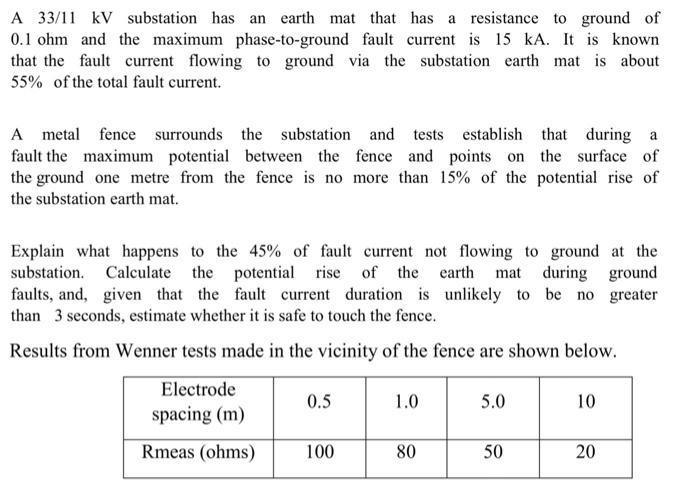
A 33/11 kV substation has an earth mat that has a resistance to ground of 0.1 ohm and the maximum phase-to-ground fault current is 15 kA. It is known that the fault current flowing to ground via the substation earth mat is about 55% of the total fault current. A metal fence surrounds the substation and tests establish that during a fault the maximum potential between the fence and points on the surface of the ground one metre from the fence is no more than 15% of the potential rise of the substation earth mat. Explain what happens to the 45% of fault current not flowing to ground at the substation. Calculate the potential rise of the earth mat during ground faults, and, given that the fault current duration is unlikely to be no greater than 3 seconds, estimate whether it is safe to touch the fence. Results from Wenner tests made in the vicinity of the fence are shown below. Electrode spacing (m) Rmeas (ohms) 0.5 100 1.0 80 5.0 50 10 20
Step by Step Solution
3.31 Rating (157 Votes )
There are 3 Steps involved in it
The problem youve described involves calculating the potential rise of the earth mat during ground faults in a substation as well as assessing the saf... View full answer

Get step-by-step solutions from verified subject matter experts
 Study Help