







Question: Assume that X is a nonnegative, integer-valued random variable. Let G(z) = E[z]. To simplify notation, let Pk = px (k)= P{X = k}
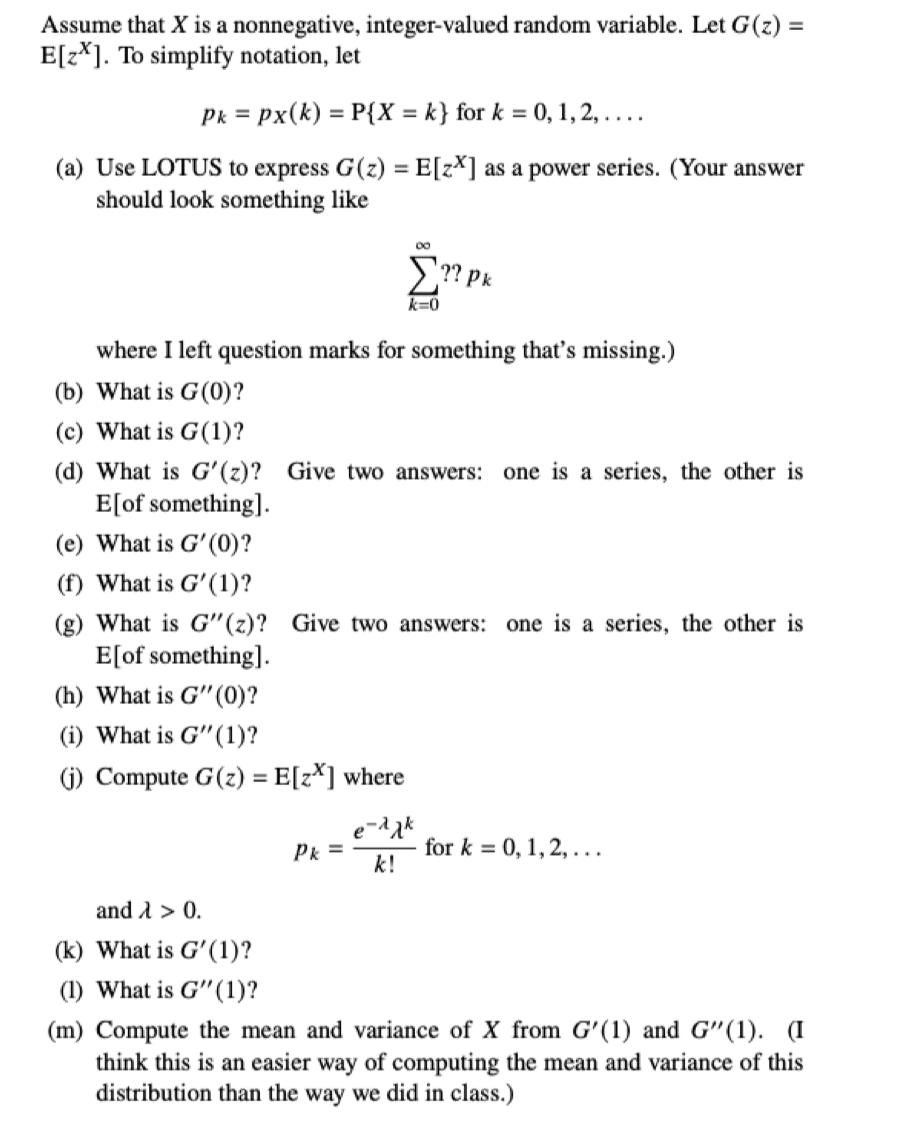
Assume that X is a nonnegative, integer-valued random variable. Let G(z) = E[z]. To simplify notation, let Pk = px (k)= P{X = k} for k = 0, 1, 2,.... (a) Use LOTUS to express G(z) = E[zX] as a power series. (Your answer should look something like 80 Pk = k=0 where I left question marks for something that's missing.) (b) What is G(0)? (c) What is G(1)? (d) What is G'(z)? Give two answers: one is a series, the other is E[of something]. (e) What is G'(0)? What is G'(1)? (g) What is G"(z)? Give two answers: one is a series, the other is E[of something]. (h) What is G" (0)? (i) What is G"(1)? (j) Compute G(z) = E[z*] where ?? Pk e-rk k! for k= 0, 1, 2,... and > 0. (k) What is G'(1)? (1) What is G" (1)? (m) Compute the mean and variance of X from G'(1) and G"(1). (I think this is an easier way of computing the mean and variance of this distribution than the way we did in class.)
Step by Step Solution
3.50 Rating (153 Votes )
There are 3 Steps involved in it

Get step-by-step solutions from verified subject matter experts
 Study Help