







Question: Assume the binomial model. So = 4, u = 4, d = , r = 3. Use fractions; if using dec- imals instead, leave at

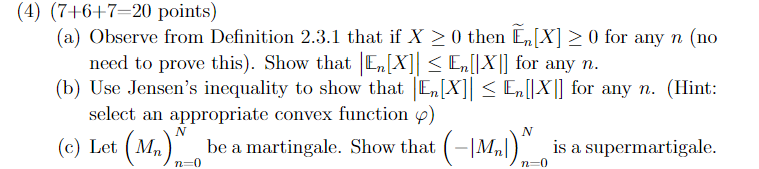
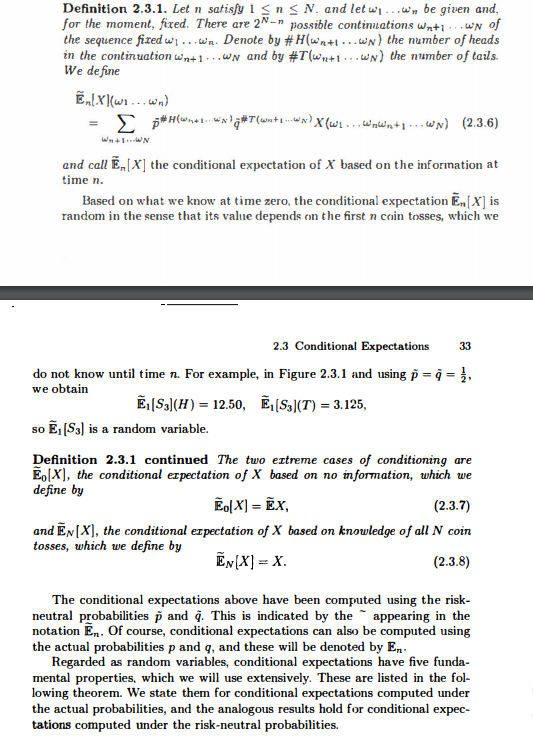
Assume the binomial model. So = 4, u = 4, d = , r = 3. Use fractions; if using dec- imals instead, leave at least four digits after the dot. Recall that if a random variable X depends on only the first n tosses, then we write X(wi...wn) as an abbreviation for Xw1 ...wn); for example, if N = 3 and X depends on the first toss only, then we can write X (H) = 1 or X(HHH) = X(HHT) = X(HTH) = X(HTT) = 1. (4) (7+6+7=20 points) (a) Observe from Definition 2.3.1 that if x > 0 then n[X] > 0 for any n (no need to prove this). Show that |E,[X]| 0 then n[X] > 0 for any n (no need to prove this). Show that |E,[X]|
Step by Step Solution
There are 3 Steps involved in it
1 Expert Approved Answer
Step: 1 Unlock

Question Has Been Solved by an Expert!
Get step-by-step solutions from verified subject matter experts
Step: 2 Unlock
Step: 3 Unlock
 Study Help