







Question: Assume there are H agents with constant absolute risk aversion a. There is a risk-free asset, and two risky assets with distribution Si ~ N(u,
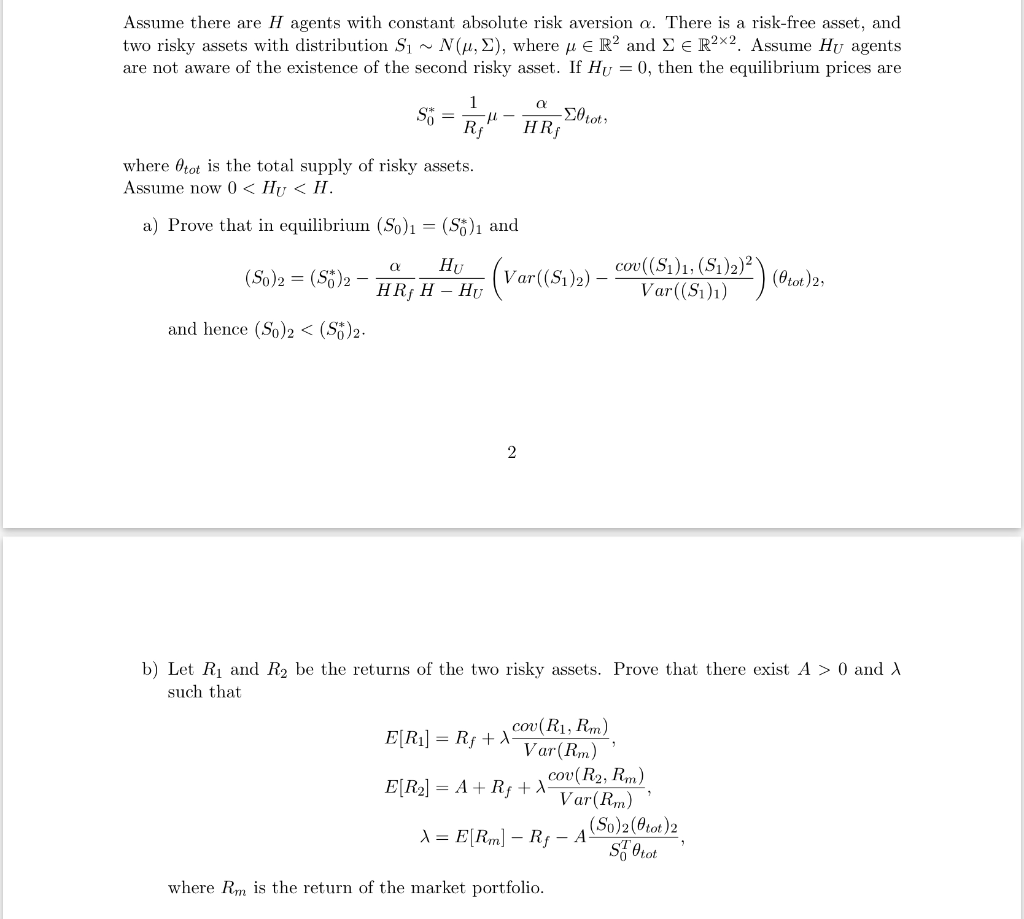
Assume there are H agents with constant absolute risk aversion a. There is a risk-free asset, and two risky assets with distribution Si ~ N(u, 2), where u ERP and SER2X2. Assume Hu agents are not aware of the existence of the second risky asset. If Hy = 0, then the equilibrium prices are 1 So = R" - HR 030 tots where Otot is the total supply of risky assets. Assume now 0 0 and such that E[R1] = Rj+ cou(R1, Rm) Var(Rm) E[R2] = A + Rp + COU(R2, Rm) Var(Rm) X = E[Rm - R, -A (S0)2(tot)2 Stot where Rm is the return of the market portfolio. Assume there are H agents with constant absolute risk aversion a. There is a risk-free asset, and two risky assets with distribution Si ~ N(u, 2), where u ERP and SER2X2. Assume Hu agents are not aware of the existence of the second risky asset. If Hy = 0, then the equilibrium prices are 1 So = R" - HR 030 tots where Otot is the total supply of risky assets. Assume now 0 0 and such that E[R1] = Rj+ cou(R1, Rm) Var(Rm) E[R2] = A + Rp + COU(R2, Rm) Var(Rm) X = E[Rm - R, -A (S0)2(tot)2 Stot where Rm is the return of the market portfolio
Step by Step Solution
There are 3 Steps involved in it

Get step-by-step solutions from verified subject matter experts
 Study Help