







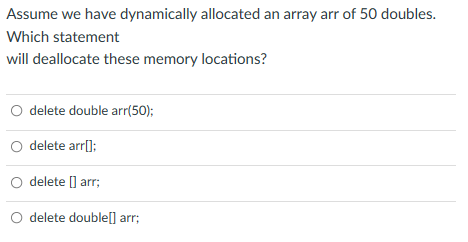
Question: Assume we have dynamically allocated an array arr of 50 doubles. Which statement will deallocate these memory locations? delete double arr(50); delete arr[]; delete []
![Which statement will deallocate these memory locations? delete double arr(50); delete arr[];](https://s3.amazonaws.com/si.experts.images/answers/2024/09/66dabc07cf334_01566dabc076d519.jpg)
![delete [] arr; delete double[] arr; What will be the output of](https://s3.amazonaws.com/si.experts.images/answers/2024/09/66dabc085948e_01666dabc08046a9.jpg)
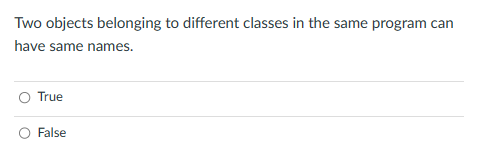
Assume we have dynamically allocated an array arr of 50 doubles. Which statement will deallocate these memory locations? delete double arr(50); delete arr[]; delete [] arr; delete double[] arr; What will be the output of the following C++ code? int main () \{ unsigned int i; vector first; vector second (4,100); vector third (second.begin(), second.end()); vector fourth (third); int myints[] ={16,2,77,29} vector fifth (myints, myints + sizeof(myints) / sizeof(int) ); for (vector : iterator it = fifth.begin(); it != fifth.end(); ++it) cout " ' it; return 0 \} 16 162 1627729 16277 1. Given the following code class A\{ protected: int a, b; public: float f1, f2; \} class B: class A{} Which variables in class A that class B could access? \begin{tabular}{l} \hlinea,b,f1,f2 \\ \hlinef1,f2 \\ \hlinea,b \end{tabular} none of the above Two objects belonging to different classes in the same program can have same names. True False
Step by Step Solution
There are 3 Steps involved in it

Get step-by-step solutions from verified subject matter experts
 Study Help