







Question: SAMPLE OF PROBLEMS: Program 9-16: Duplicates Arrays // This program uses a function to duplicate // an int array of any size. #include using namespace
SAMPLE OF PROBLEMS:
Program 9-16: Duplicates Arrays
// This program uses a function to duplicate
// an int array of any size.
#include
using namespace std;
// Function prototype
int *duplicateArray(const int *, int);
void displayArray(const int[], int);
int main()
{
// Define constants for the array sizes.
const int SIZE1 = 5, SIZE2 = 7, SIZE3 = 10;
// Define three arrays of different sizes.
int array1[SIZE1] = { 100, 200, 300, 400, 500 };
int array2[SIZE2] = { 10, 20, 30, 40, 50, 60, 70 };
int array3[SIZE3] = { 1, 2, 3, 4, 5, 6, 7, 8, 9, 10 };
// Define three pointers for the duplicate arrays.
int *dup1 = nullptr, *dup2 = nullptr, *dup3 = nullptr;
Program 9-16 Cont.
// Duplicate the arrays.
dup1 = duplicateArray(array1, SIZE1);
dup2 = duplicateArray(array2, SIZE2);
dup3 = duplicateArray(array3, SIZE3);
// Display the original arrays.
cout
displayArray(array1, SIZE1);
displayArray(array2, SIZE2);
displayArray(array3, SIZE3);
// Display the new arrays.
cout
displayArray(dup1, SIZE1);
displayArray(dup2, SIZE2);
displayArray(dup3, SIZE3);
// Free the dynamically allocated memory and
// set the pointers to 0.
delete [] dup1;
delete [] dup2;
delete [] dup3;
dup1 = nullptr;
dup2 = nullptr;
dup3 = nullptr;
return 0;
}
ANOTHER EXAMPLE:
Program 9-16: Duplicates Arrays
// This program uses a function to duplicate
// an int array of any size.
#include
using namespace std;
// Function prototype
int *duplicateArray(const int *, int);
void displayArray(const int[], int);
int main()
{
// Define constants for the array sizes.
const int SIZE1 = 5, SIZE2 = 7, SIZE3 = 10;
// Define three arrays of different sizes.
int array1[SIZE1] = { 100, 200, 300, 400, 500 };
int array2[SIZE2] = { 10, 20, 30, 40, 50, 60, 70 };
int array3[SIZE3] = { 1, 2, 3, 4, 5, 6, 7, 8, 9, 10 };
// Define three pointers for the duplicate arrays.
int *dup1 = nullptr, *dup2 = nullptr, *dup3 = nullptr;
Program 9-16 Cont.
// Duplicate the arrays.
dup1 = duplicateArray(array1, SIZE1);
dup2 = duplicateArray(array2, SIZE2);
dup3 = duplicateArray(array3, SIZE3);
// Display the original arrays.
cout
displayArray(array1, SIZE1);
displayArray(array2, SIZE2);
displayArray(array3, SIZE3);
// Display the new arrays.
cout
displayArray(dup1, SIZE1);
displayArray(dup2, SIZE2);
displayArray(dup3, SIZE3);
// Free the dynamically allocated memory and
// set the pointers to 0.
delete [] dup1;
delete [] dup2;
delete [] dup3;
dup1 = nullptr;
dup2 = nullptr;
dup3 = nullptr;
return 0;
ANOTHER EXAMPLE:
Program 9-16: displayArray Function
//**************************************************
// The displayArray function accepts an int array *
// and its size as arguments and displays the
*
// contents of the array.
*
//**************************************************
void displayArray(const int arr[], int size)
{
for (int index = 0; index
cout
cout
}
Program 9-12
// This program demonstrates that a pointer may be used as a parameter to accept the address of an array.
#include
#include
using namespace std;
// Function prototypes
void getSales(double *, int);
double totalSales(double *, int);
int main()
{
const int QTRS = 4;
double sales[QTRS];
// Get the sales data for all quarters.
getSales(sales, QTRS);
// Set the numeric output formatting.
cout
// Display the total sales for the year.
cout
cout
return 0;
}
Program 9-12
Functions
// Definition of getSales. This function uses a pointer to accept the address of an array of doubles.
// The function asks the user to enter sales figures and stores them in the array.
//*****************************************************************
void getSales(double *arr, int size)
{
for (int count = 0; count
{
cout
cout
cin >> arr[count];
}
}
//*****************************************************************
// Definition of totalSales. This function uses a pointer to accept the address of an array.
// The function returns the total of the elements in the array.
double totalSales(double *arr, int size)
{
double sum = 0.0;
for (int count = 0; count
{
sum += *arr;
arr++;
}
return sum;
}
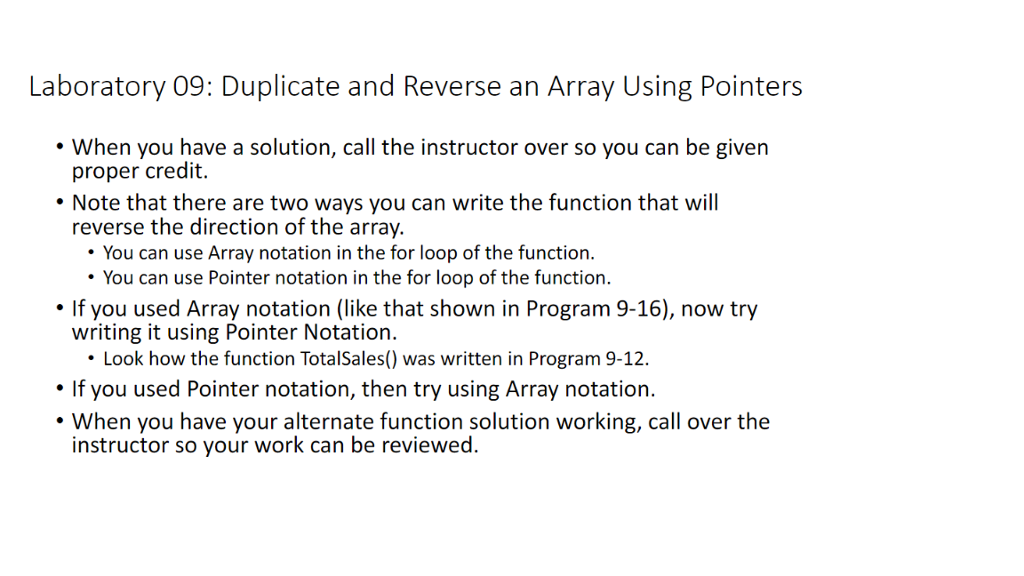
PLEASE DO BOTH LAB9A AND LAB 9B
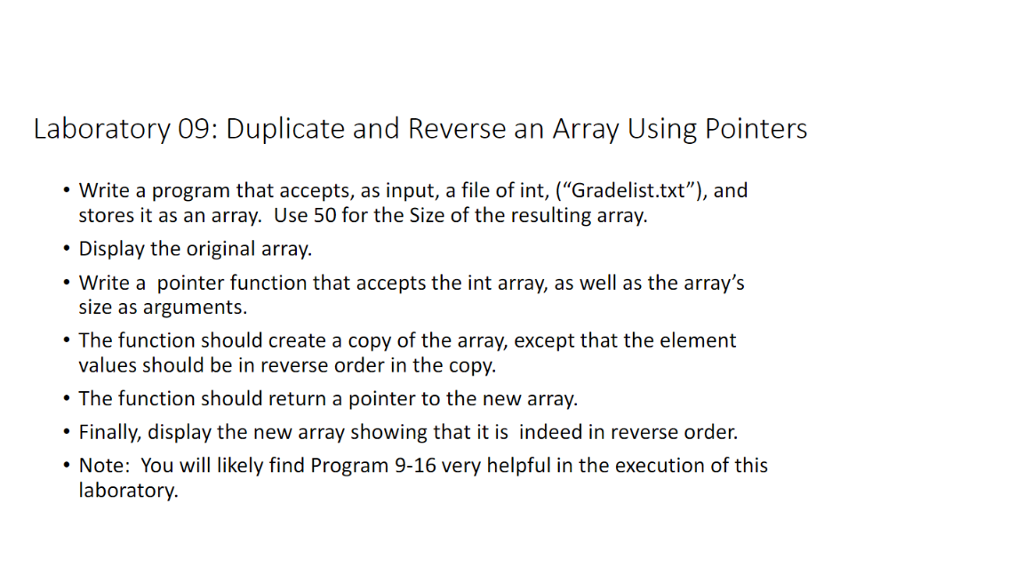
Laboratory 09: Duplicate and Reverse an Array Using Pointers Write a program that accepts, as input, a file of int, ("Gradelist.txt"), and stores it as an array. Use 50 for the Size of the resulting array Display the original array. Write a pointer function that accepts the int array, as well as the array's size as arguments. The function should create a copy of the array, except that the element values should be in reverse order in the copy. The function should return a pointer to the new array. Finally, display the new array showing that it is indeed in reverse order. Note: You will likely find Program 9-16 very helpful in the execution of this laboratory
Step by Step Solution
There are 3 Steps involved in it

Get step-by-step solutions from verified subject matter experts
 Study Help