







Question: Assume you have a complete binary tree structure with weight assigned to each edge of the tree. You implement the following greedy algorithm to find
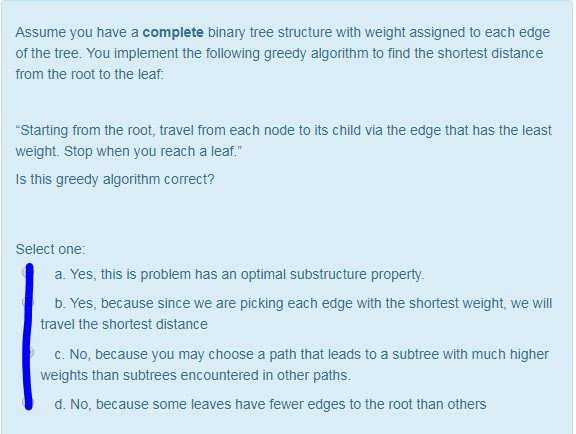
Assume you have a complete binary tree structure with weight assigned to each edge of the tree. You implement the following greedy algorithm to find the shortest distance from the root to the leaf. Starting from the root, travel from each node to its child via the edge that has the least weight. Stop when you reach a leaf. is this greedy algorithm Select one: a. Yes, this is problem has an optimal substructure property. b. Yes, because since we are picking each edge with the shortest weight, we will travel the shortest distance C. No, because you may choose a path that leads to a subtree with much higher weights than subtrees encountered in other paths. d. No, because some leaves have fewer edges to the root than others Assume you have a complete binary tree structure with weight assigned to each edge of the tree. You implement the following greedy algorithm to find the shortest distance from the root to the leaf. Starting from the root, travel from each node to its child via the edge that has the least weight. Stop when you reach a leaf. is this greedy algorithm Select one: a. Yes, this is problem has an optimal substructure property. b. Yes, because since we are picking each edge with the shortest weight, we will travel the shortest distance C. No, because you may choose a path that leads to a subtree with much higher weights than subtrees encountered in other paths. d. No, because some leaves have fewer edges to the root than others
Step by Step Solution
There are 3 Steps involved in it

Get step-by-step solutions from verified subject matter experts
 Study Help