







Question: We are given a COMPLETE BINARY TREE where nodes and edges have positive weights. Node weights are stored in a 1-dimensional array WN. Edge weights
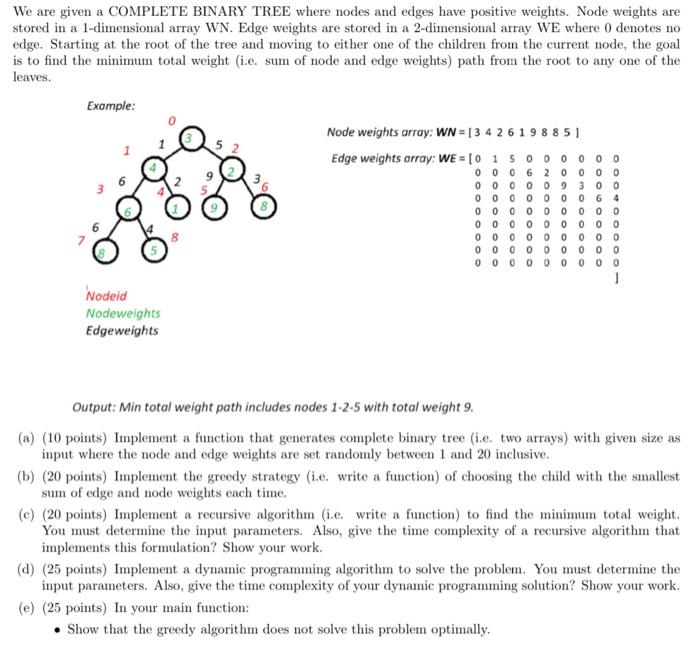
We are given a COMPLETE BINARY TREE where nodes and edges have positive weights. Node weights are stored in a 1-dimensional array WN. Edge weights are stored in a 2-dimensional array WE where 0 denotes no edge. Starting at the root of the tree and moving to either one of the children from the current node, the goal is to find the minimum total weight (i.e. sum of node and edge weights) path from the root to any one of the leaves. Edgeweightsarray:WE=0000000000100000000500000000060000000020000000009000000003000000000600000000400000] Output: Min total weight path includes nodes 1-2-5 with total weight 9. (a) (10 points) Implement a function that generates complete binary tree (i.e. two arrays) with given size as input where the node and edge weights are set randomly between 1 and 20 inclusive. (b) (20 points) Implement the greedy strategy (i.e. write a function) of choosing the child with the smallest sum of edge and node weights each time. (c) (20 points) Implement a recursive algorithm (i.e. write a function) to find the minimum total weight. You must determine the input parameters. Also, give the time complexity of a recursive algorithm that implements this formulation? Show your work. (d) (25 points) Implement a dynamic programming algorithm to solve the problem. You must determine the input parameters. Also, give the time complexity of your dynamic programming solution? Show your work. (e) (25 points) In your main function: - Show that the greedy algorithm does not solve this problem optimally
Step by Step Solution
There are 3 Steps involved in it

Get step-by-step solutions from verified subject matter experts
 Study Help