







Question: Assuming that the behavioural change programme had been successful, explain why PrintUp would fit Level 2 : Managing of the SCMM . Note: Your answer
Assuming that the behavioural change programme had been successful, explain why PrintUp would fit Level : Managing of the SCMM
Note: Your answer must be based on the scenario only.
The behavioural change programme
For the first three weeks of the programme, you spend some time outlining its aims; this includes a series of presentations to all workers. The CEO, the senior accounting manager, and two of the supervisors are too busy to attend any of the presentations.
Many workers welcome the introduction of the programme. Some of the workers tell you that they are looking forward to getting rewarded for their behaviour, while others say that accidents have always been seen as normal in this type of industry. The newest supervisor expresses concern about it taking time away from meeting deadlines.
Following one of your presentations, two workers separately ask to speak to you in confidence. One worker tells you that they were seriously injured six months ago, because of a nonworkrelated accident, which means that they now need to use a wheelchair. They go on to say that they returned to fulltime work two months ago without a phased return to work. Their supervisor refused to allow them to retum to their usual job on the shopfloor, citing 'safety concerns'. However, the worker was assessed as medically fit to return to their previous job, but some modifications would be needed. They tell you that they had been placed in the office and had been given administration tasks, with a promise that they could return to their normal role within a few months. This has not happened. They also find it difficult to open heavy doors around the site.
The second worker, who has worked for PrintUp for many years, tells you that many workers are not following safety protocols. They say that it 'never used to be like this' and they have often seen workers take shortcuts to save time. Workers are often on sick leave and the workload for others has consequently increased. They admit they have felt too scared to report near misses.
After the presentation series is finished, you decide to develop the programme with some of the workers from the shopfloor. Fifteen morningshift workers from this department are randomly chosen to be observers. These are a mix of new and longterm printing press workers, indoor vehicle operators, and a supervisor. You arrange a oneday training session for the observers that explains how to observe, give observation feedback, and measure worker behaviours and safety performance. They then practise these skills. Due to production demands, only twelve of the fifteen observers complete the scheduled training
You set a target for all trained observers to complete at least two observations a week, using a fivepage checklist that you have devised. This checklist contains a range of safe behaviours on topics such as wearing personal safety equipment, safe machinery operation and vehicle movement, following procedures and safe material handling.
You set up a steering group made up of yourself and the fifteen observers. The supervisor is selected to lead the group. The steering group will meet monthly to discuss the observation findings.
Two weeks later, three workers approach you and ask you how long this 'programme' is going to last. They say that they do not like being watched by new workers. They tell you that the new workers are not experienced enough to 'tell them how to do their job'. They also ask you why the shopfloor is the only department being 'watched'. You thank them for their concerns and tell them that you will discuss this at the first steering group meeting.
Steering group meetings
Six of the observers do not attend the first steering group meeting, including the supervisor, You learn that each observation is taking approximately minutes to complete and is done during the observer's morning shifts. Observers who attend say that lots of concerning behaviour has been identified. One example was where a group of workers were not using designated walkways. One of these workers narrowly avoided a collision with a moving FLT Observers tell you that they tried to correct the behaviour, but one of the workers just said, "the supervisors do it so why shouldn't I?" Another observer said that they had seen a shopfloor worker being lifted by an FLT to reach some racking. They did not challenge this by giving observation feedback, as they thought that this issue was already being dealt with.
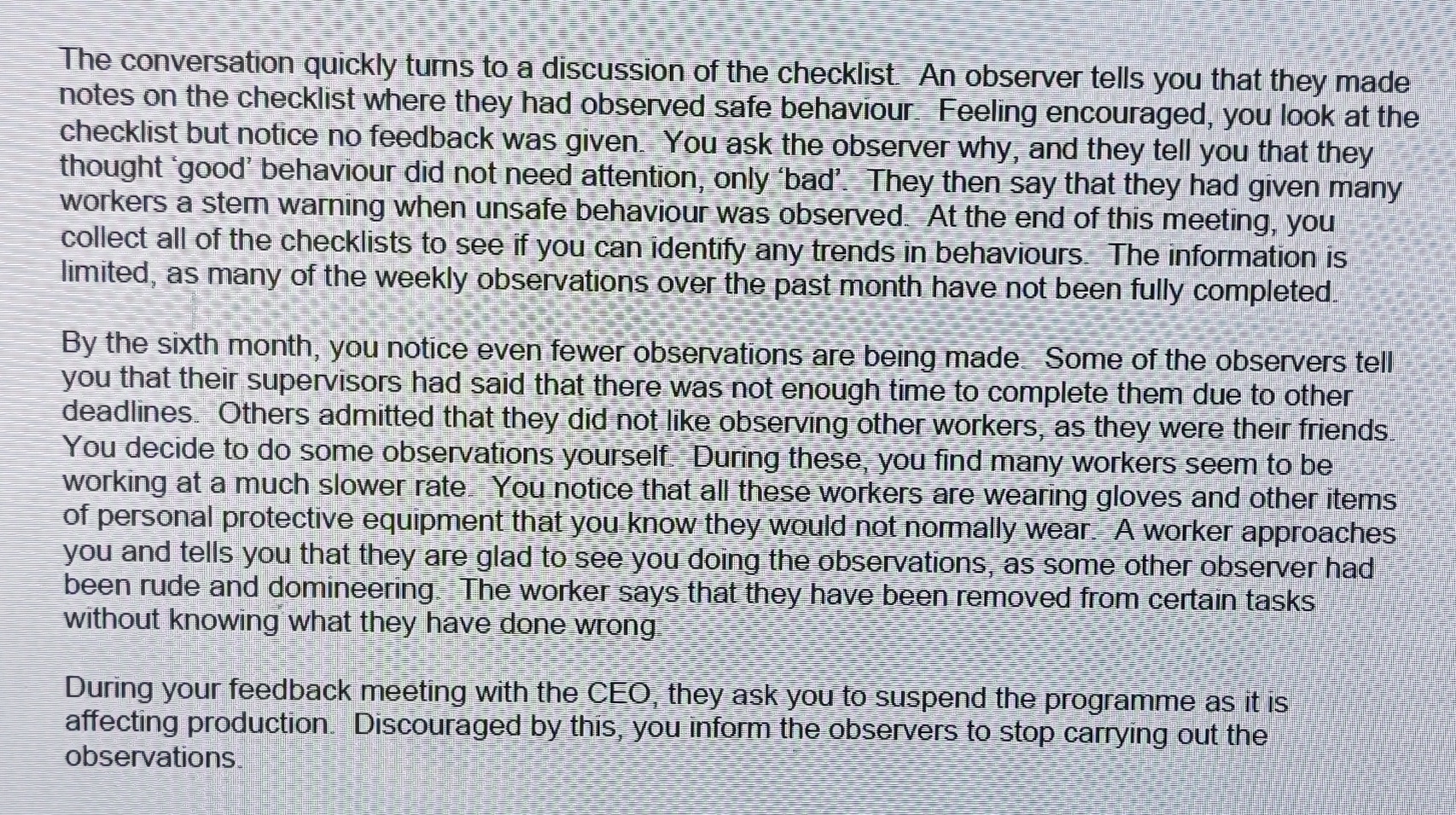
A month later, the second steering group meeting has better attendance. During this meeting you discuss a near miss that was observed. The observer saw an experienced worker attempting to identify and repair an intermittent fault with one of the printing presses. Their hand was almost trapped between the rollers of the printing press while trying to find the fault. The observer quickly pressed the emergency stop button and told the experienced worker that they should switch off the printing press and wait
Step by Step Solution
There are 3 Steps involved in it
1 Expert Approved Answer
Step: 1 Unlock

Question Has Been Solved by an Expert!
Get step-by-step solutions from verified subject matter experts
Step: 2 Unlock
Step: 3 Unlock
 Study Help